







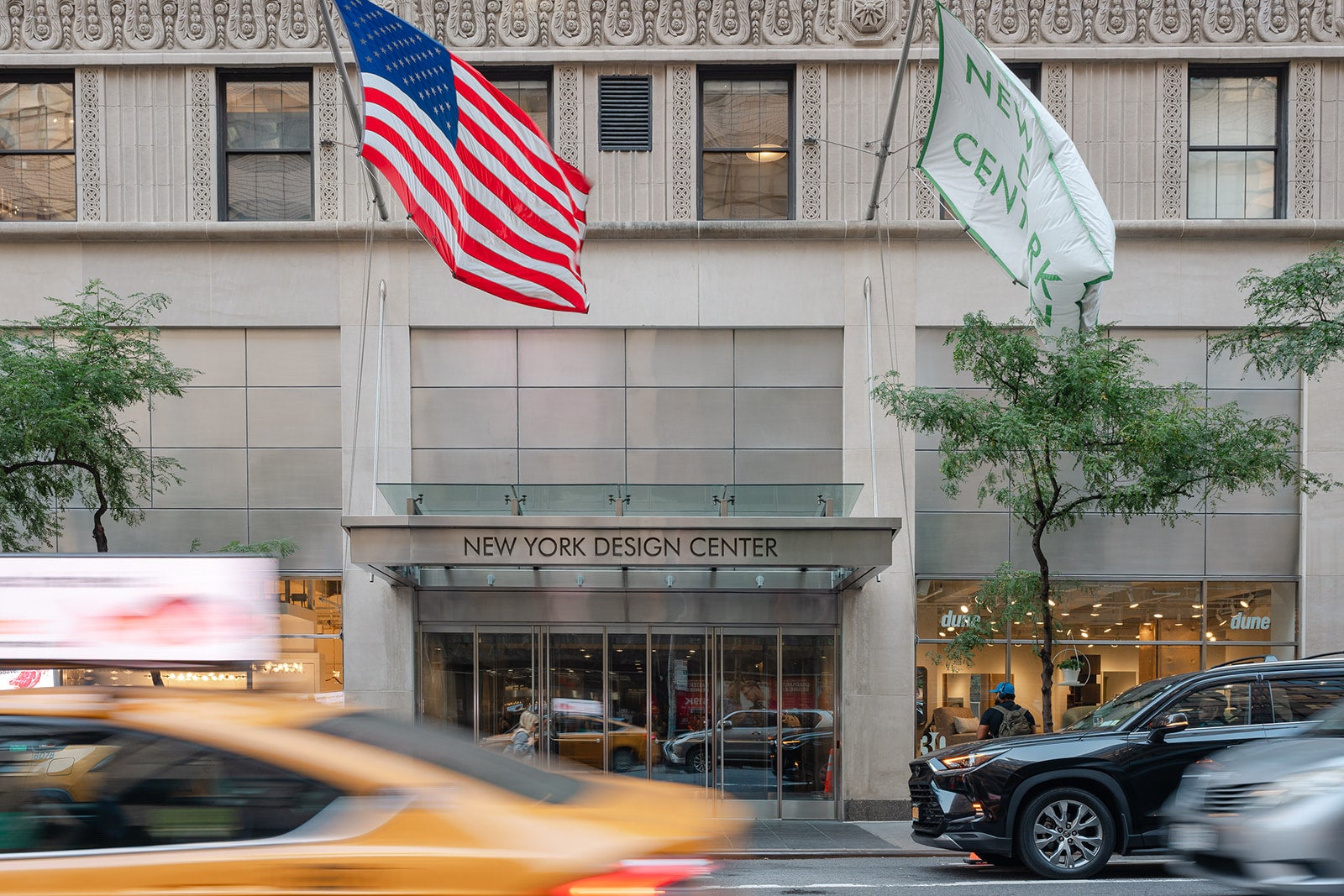
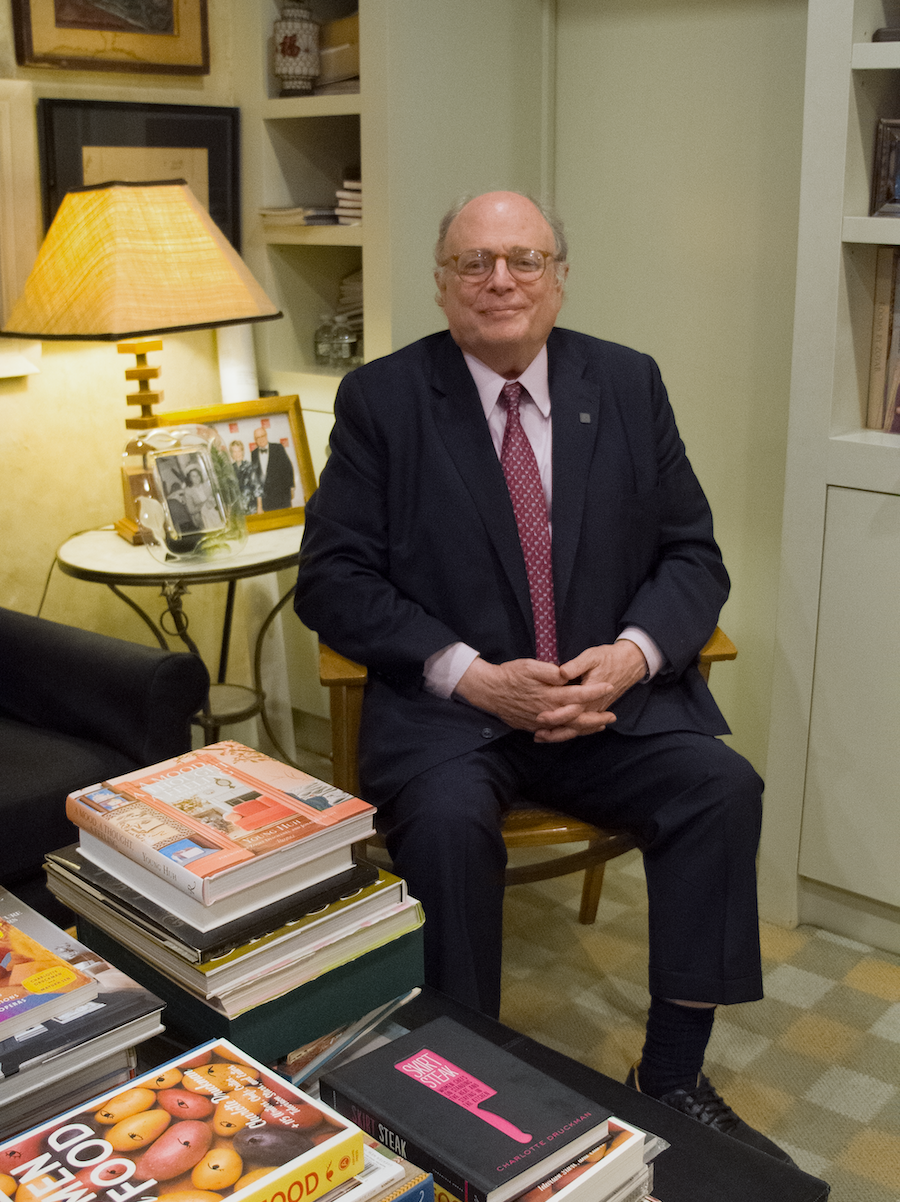
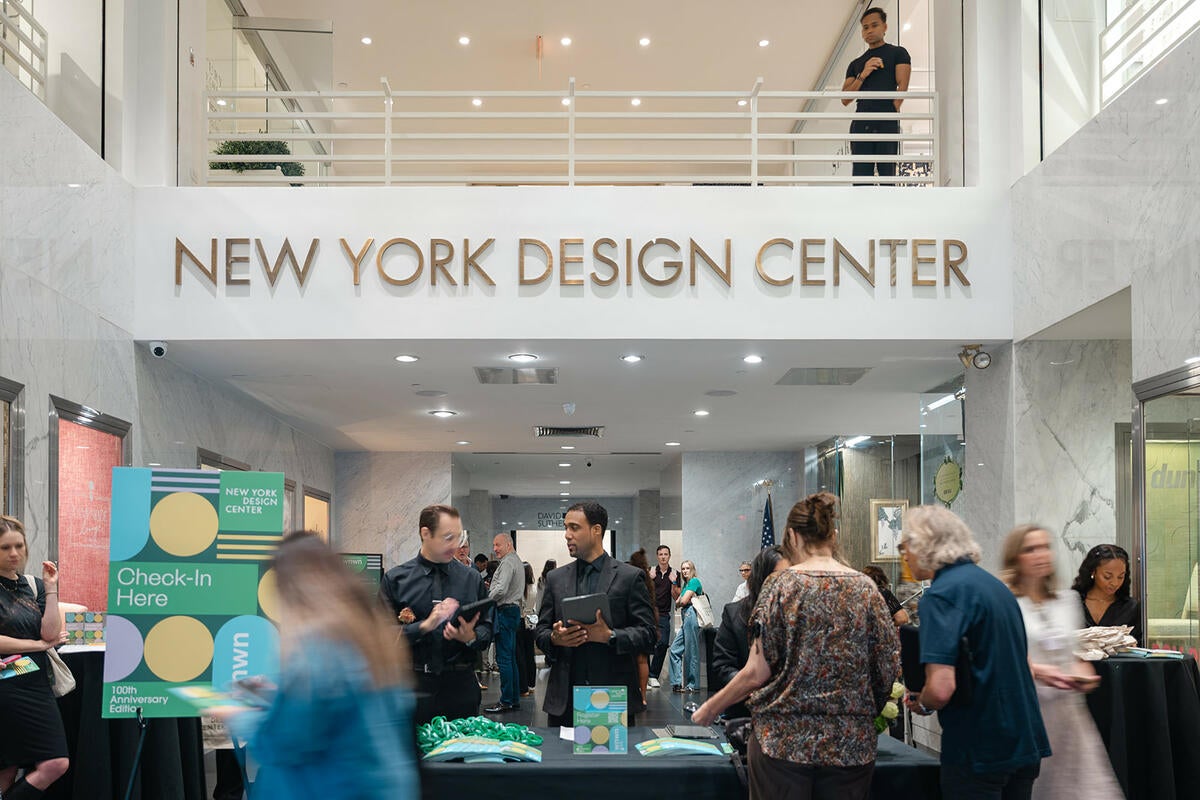
As the design world descended on Manhattan last week, one figure was omnipresent: New York Design Center president and CEO Jim Druckman. On Tuesday, it was a jam-packed opening for the Kips Bay Decorator Show House. (He serves as the president of the board for the showhouse’s charitable recipient, the Kips Bay Boys & Girls Club.) Then, on Wednesday night, he hosted Design Leadership Network members for a takeover of the iconic Katz’s Deli on the Lower East Side, where an influx of top designers and executives mingled over late-night pastrami sandwiches under the glow of neon signs. And on Thursday, Druckman held court as thousands of industry insiders flocked to 200 Lex for What’s New, What’s Next, a day of panel discussions, product debuts, and showroom parties.
The high-octane week coincided with a major milestone—the New York Design Center’s 100th anniversary. Originally built as the New York Furniture Exchange in 1926, the 500,000-square-foot building has transformed from a regional destination for furniture sales into an anchor of the design community that draws talents from across the country.
That landmark anniversary is especially notable in today’s industry climate, where debates about the relevance of the trade showroom have raged fiercely both publicly and behind closed doors. Design districts have sprung up across the country as an alternative to traditional design centers, earning praise for shaking up a staid model. Yet NYDC stands out as a rarity in many ways, surviving shifting economies, digital disruption and changing trade habits by doing something surprisingly simple: cultivating a community.
In a design world increasingly driven by digital shortcuts, Druckman remains a fierce advocate for the tangible—for the ways seeing and touching a product deepens understanding, for human connection, and for the “marginal differences” that make a meaningful impact. Here, he reflects on how 200 Lex made it to 100 and what it takes to get ahead in the design industry today.
On The Business of Home Podcast in 2021, you talked about how, when you took over the building from your father, you wanted to shift the building’s focus to the design trade.
When I took over [in 1995] I realized that unless we supported the community, we wouldn’t gain the relationships with or respect from designers that hopefully we have attained in this current environment. A difference between us and the rest of the design centers is that we consider ourselves part of the community, as well as a vibrant marketplace. I’ve always said we’re not just a real estate project—if we were, we might have started renting to dentists years ago, and we could have made more money with less effort. But we’re an industry with a soul. Unless you nurture that soul, you just become a place for [people] to shop when they have to, as opposed to shop and participate because they want to.
Who’s a good fit as a tenant at 200 Lex today?
My first goal is to be a one-stop shop that nobody has to leave. We think about: What don’t we have here? I don’t have kitchen appliances. If I were approached by a high-end appliance brand, I would immediately get to work trying to create space.
My second goal is that I always want somebody who’s elevating the experience, or who is interesting design-wise. We have some of the best people in the marketplace, so it’s hard to get anybody better, but you want more unusual [businesses].
I can also get a feeling [about prospective tenants]—if I don’t like them, I don’t want to take them. I care about their product and how it’s made. I try to visit their factories if I can, to really understand the product, because I don’t want inferior products. I’ve been with other landlords who put blinders on to some extent. Our industry exposure is such that sometimes I think we understand too much. Everyone knows that I know—that’s the problem!
How do you balance the mix of residential and commercial brands in the building?
We’re the only place in town where there’s a concentration of commercial companies. I think it’s important to attract architects—and because of that, they get exposed to the building. Many of the firms also have a residential department, so we’re here to help. I think it serves as an engine. You used to have other concentrations in New York—they tried to do one in Queens, but our clientele wouldn’t go over the bridge, even though it was 10 minutes away. I want to be full service, but we also try in the contract area to have unique and unusual tenants, like [workplace furniture brand] Halcon, for instance, which is the premier example of what they do. That’s the kind of thing I want here. I want people to know that if they want to see the best, they can come here and find it.
Speaking of cultivating a mix, how did adding antiques and vintage on the 10th floor change the tenor of the building?
It’s the greatest marketing thing we ever did, bar none. It came out of my love of antiques—Nancy, my wife, was in that business for 37 years, so I was always interested. At the time, I was thinking about what could create a traffic-builder where we could get the top designers in the building more often.
Our original setup [in 2011] was a joint venture with 1stDibs, which gave us greater credibility with top designers. And they still shop—it’s not through 1stDibs anymore, but most designers shop on our 10th floor, which means they are coming to the building. Even if we didn’t do as well as we could have those first couple of years while we were building up sales, it didn’t matter, because you name the designer, they were here.
What role has the city played for the building?
When the current owners of the D&D Building bought it in the late 1990s, I met with them because I wanted to have really strong twice-a-year market weeks in New York. In those days, all of the talk about high-end design was in California, or somewhere else. You had Therien & Co., Randolph & Hein, J. Robert Scott—they were what you heard quoted. Or it was Holly Hunt, who was in Chicago. I always felt that good, innovative design still came from New York—and to reclaim that, we should have two big market weeks and get everyone involved: the museums, the Cooper Hewitt, the Museum of the City of New York, MoMA—get Paola Antonelli to do something … and we should have buses going up and down the city, and banners on the lampposts!
I love this vision!
Unfortunately, [the owners] didn’t agree with me. But I said, “We should reclaim our status as the design capital of the nation.” And I think now we have reclaimed that. In New York, there’s always something new, you just have to find it.
That’s why I loved this week we just did, as much as I’m exhausted. Think about it: You had [the launch party for] a new magazine bringing a couple hundred designers together with Anthology. Then the next night, you had the opening of the Kips Bay Decorator Show House. The next night, we had the DLN dinner. The next day, we had everything here [for WNWN]. And that was my goal. I honestly believe now that there are only two high-end markets for Americans left: What’s New What’s Next and Déco Off in Paris.
Markets bring everyone together. But the day-to-day role of this building has changed a lot. How are smart brands using their showroom spaces today?
Well, the smarter the brand, the more they use the showroom to educate their client base and attract new clients. I would say smaller events work today better than the big cocktail parties of the past to bring people in and talk about product. Professional designers are much more interested in the product and the conversation than the cocktail.
My favorite story is one day I found Albert Hadley wandering through the halls. And I said, “Mr. Hadley, can I help you? Are you lost? Is there anything I can direct you to?” And he looked at me, all indignant, and said, “I’m shopping!” Because he was a consummate professional. Jamie Drake shops like that—most of the names that you know of and have heard of—they or their people shop like that: They want to see everything.
What’s funny is how things have reversed. Back in the day, we were more of a destination shop. If you wanted Baker furniture [or something equally specific,] you came here. The competition was more a place for shopping—for moseying around. But it has completely reversed. Now, we’re a place people like to shop.
Beyond the tenant mix, what did you do to create that?
We did subtle things, like adding music to the elevator lobbies. Now, you don’t know that it’s there, but it means when you get off the elevator, it isn’t like a thud. It feels full somehow because of the sound. We encouraged all the showrooms to upgrade their design.
It’s attention to detail. I once read an article about marginal differences that was describing the buttons on a suit where the buttonholes actually work. It didn’t really matter that much, but what I learned—and I always try to do that here—is that it’s not so much that the buttonholes open, [and more that] it meant that somebody paid attention to the details. And to me, any industry—I would say especially the design industry—it’s those marginal differences that make the difference. Watch good designers work and they can tell the difference just looking at something.
Your Baker example is a good one, in that now if someone wants Baker, they could just as easily go to the website, log in and look at the product range. How do you think about the role of the showroom in an environment where the internet can easily provide that kind of information?
I believe that at this design level and price point, the professional designer—maybe they don’t visit as often as they used to, but they have to see the tailoring. They have to see how it sits. They have to see how the fabric lays out on the sofa. And the same is true in case goods or occasional furniture.
The more professional the designer, the more often they come and look in person. I was talking to Ellie Cullman of Cullman & Kravis, and she won’t buy anything she doesn’t see and put her hands on. Another good example of that is Jamie Drake, who’s forever shopping to see what it is [in person]. Now, if you know a company like Baker and you know their standards, sure, you can order something over the internet—I don’t want to denigrate that, because it helps everybody’s business. But in this profession, where people live with the product—they go home and are sitting on that sofa for many more hours, and sleeping in the bed, and using the chest of drawers—and on the weekends, where are they? They’re at home. The environment [designers create] is so important.
What do you see as the next challenge that showrooms or the building or the industry face ahead?
With the advent of enhanced AI: How do we remain relevant as a physical presence? Because it becomes harder and harder as the [next] generation gets further away from understanding that marginal difference: You can look at a two-dimensional product on a screen, and it looks beautiful. But you don’t know how it’s made, you don’t know how it sits, you don’t know how it feels. So how do we engage the community—especially designers, but even the affluent public who hire designers—to use a building like this? How do you educate them on the value of good design and quality manufacturing, and how do you not let it get dumbed down? That’s the challenge.
In your view, what does it take to be successful as a designer today?
First of all, you have to know and understand your client. There are certain clients that just say, “Go do it,” but even then you have to have some idea of what they’re going for. I had a friend, Lorraine Letendre—a fabulous designer with exquisite taste. She worked in Florida, on Fisher Island, where most of the apartments were second homes, and she had the greatest business of anyone I’ve ever met. The potential client would call her up and say, “Go look at Apartment 1342. If you like it, we’ll buy it. Then fix it up—you know what we like.” She would go to North Carolina before the Market opened and buy truckloads of antiques from Randall Tysinger, then keep it in a warehouse so that it was all turnkey when people called her. They even shipped up their clothes and she hung them. She put their family pictures out.
Do you think you could do that business today, or do you think clients have changed?
I think the clients have changed. A lot of the current wealthy folks don’t have the confidence in their taste and design. But I do think you have more very wealthy people now, and as the gap between rich and poor in this country keeps spreading, you’ll see more on the wealthy end.
How does that K-shaped economy show up?
Because of the quality and level and price point of the product that’s shown and sold in a building like this, those people still are buying, so we have been to some extent insulated. But I don’t think the retail home business is very good at all. When people are worrying about the price of gas and groceries, furniture is a luxury.
When you look ahead, what do you wish for the building?
I wish for a good bathroom resource and a good kitchen appliance brand, and I could use another kitchen cabinet company. I’d like a couple more of the good fabric companies to open here. I also wish for four more floors!
Can you go up?
No. I think [because of] both engineering and the law!
What didn’t I ask you today?
You could ask me if I have any intention of retiring, and the answer is no! I wouldn’t know what to do with myself, honestly. And I’m very lucky—I have a great support team, don’t forget. [My son] John Druckman does most of the operations now, and he does a great job. [CMO] Alix Lerman does the marketing, and she does a great job. And our controller, Susan Lai, has been here for 30 years, and she does a great job. They all make me look good!





 Withdraw Consent / Manage Privacy Preferences