












A few years ago, it seemed like everyone in the industry was talking about material innovations. The BOH editorial team was getting pitches about fabrics made from algae, light fixtures made from mushrooms, sequins made from cellulose, and fibers woven from the fruit of trees I didn’t know existed. In 2024, I browsed a full section at Heimtextil dedicated to biomaterial companies, some of which had already lined up deals with luxury fashion houses and automotive brands. Every agricultural waste stream seemed like it was rife with potential material-repurposing applications—by-products of corn, persimmons and even shellfish were bandied about as viable sources. It was the next frontier, with biomaterials ushering in a new era of sustainable production possibilities.
Two years ago, a future where we were all wearing sneakers made of kelp and sitting on chairs covered in mushroom leather seemed close at hand. Now that scenario seems decades away. What happened?
The landscape for alternative materials has shifted quickly. While innovation may have surged in recent years, adoption is often slow. Scalability of new materials can be difficult and costly. Many of the companies that were putting out exciting new products a few years ago have since shuttered, shelved their technology or been sold off.
Most material innovations happen at startups, which rely on outside investments—whether venture capitalists or grants—to stay funded. For a long time, that worked. But the fundraising climate today is starkly different than it was even two years ago.
For starters, American-based companies have had to contend with the fact that government funding for research grants has largely dried up. Since taking office for the second time, President Donald Trump’s administration has cut or frozen up to $177 billion in federal grants, with $510 million of that accounting for science and technology. This has meant that many American companies in the biomaterials sector have had to find alternate funding or pause operations. “In the last administration there was a lot of money going toward innovation and that all got pulled,” says Jonsara Ruth, co-founder and design director of Healthy Materials Lab at Parsons School of Design. “It was a dramatic shift. Funding for development and scaling dropped off and some companies that were in the midst of scaling weren’t able to do it.”
Businesses looking to private equity and venture capital have also faced new challenges as the AI boom has turned the heads of would-be investors. “There’s no question that biomaterials have taken a hit because of the AI frenzy,” says Suzanne Lee, the co-founder and CEO of Biofabricate, a design and biology platform. “We’re talking about physical innovation rather than digital, and investors often don’t fully understand the time it takes to innovate a new material or technology like a dye or a coating. That involves years of development and scaling and commercialization. I think there are a lot of early innovators in the space where their investors feel that they got burned because the route to market wasn’t as fast as they thought it would be.”
Those challenges have prompted a reckoning in the biomaterials space, and shifted the language nascent companies in the space use to spotlight their work. “Innovators are no longer necessarily pushing the sustainability aspect of their innovation in quite the way that they were a couple of years ago,” says Lee. “They’re pivoting to highlight the performance or the health of a material.”
That pivot has pushed creators of new materials to think of a more holistic go-to-market strategy, now that the green bona fides are less enticing to those holding the purse strings. “It’s forcing people to double down on what makes their particular material or innovation interesting to a potential end user,” says Lee. “As we all know, sustainability alone is not going to make successful products if they’re not beautiful, functional, and coming in at a price the market can bear. There’s a new pragmatism around all of these new materials and innovations that just needed to happen.”
While the initial biomaterials bubble might have burst, there are still success stories in this sector and consumer-facing companies that are championing alternative materials. In fashion, Stella McCartney has championed Radiant Matter’s biodegradable sequins; some of her designs featuring the product are now in The Metropolitan Museum of Art’s permanent collection. Bottega Veneta, meanwhile, partnered with Italian bio-innovation company Sqim to produce mycelium leather goods. The home category has proven to be a tougher sell, a challenge that Lee attributes to the amount of a material needed for applications in upholstery. Making a mushroom leather wallet is one thing, but a mushroom leather sofa is another entirely.
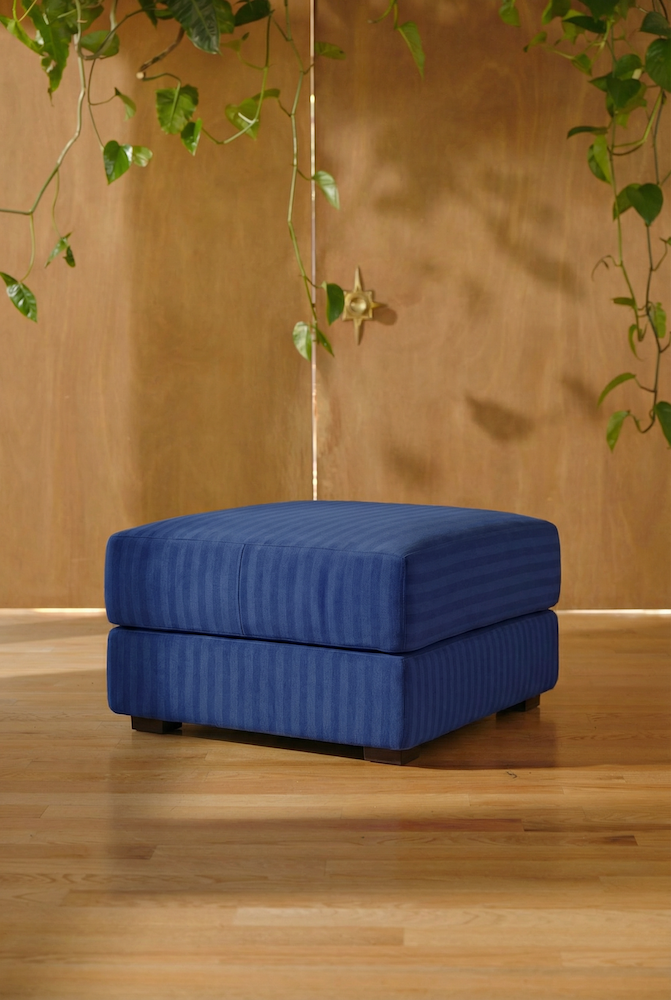
That said, there are home brands that are trying to integrate biomaterials where they can. This year, direct-to-consumer furniture brand Sabai introduced an upholstery option made of cactus leather sourced from Mexican brand Desserto. The company also started using the bio-based Cocolok, a mix of coconut fibers and natural latex, instead of polyester upholstery batting. Sabai founder and CEO Phantila Phataraprasit says it was one of the first American companies to order a container of Cocolok (which is manufactured by Netherlands-based brand Enkev). “We had to commit to taking all of it even if we didn’t have the sales yet to justify it,” says Phataraprasit. “We took a leap of faith and felt like it was worth it. It’s something we believed in and we wanted to try out. And now it’s in most of our collections. We’ve been able to grow a demand for that.”
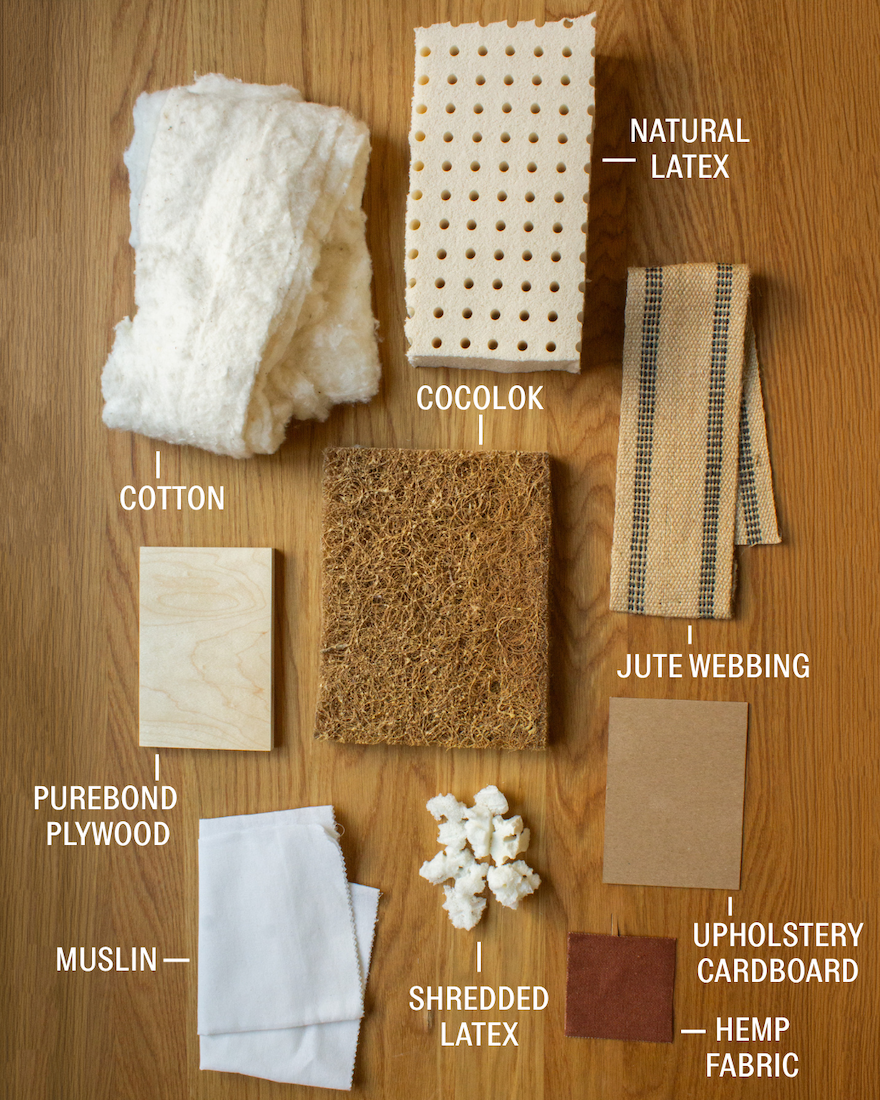
Even when the demand for a bio-based product is clear, getting the construction and durability right means trial and error. “Development takes time, and you have to consider certain standards like flame retardancy—which polyester automatically passes—[whereas] with natural materials, you have to be thoughtful about how you layer it in order to meet those same standards,” says Phataraprasit.
For every success, there are inevitably materials that fall short. The company has tested numerous options that ultimately didn’t work out, such as kapok fibers, which are harvested from the fruit of a tropical tree, but proved too delicate and soft for upholstery. “Cocolok has been great because it comes in sheets, which can be cut and still hold their shape,” she adds. “Finding materials that can work in this setting has been a challenge, but it’s been fun to work through.”
A funny paradox exists in the marketplace today: While funding may have slowed to a trickle, consumer education around material health has grown exponentially. Terms like PFAS, microplastics, and VOCs that once felt like insider secrets are now commonplace. Consumers are ready to believe in material health and, as Phataraprasit will attest, they’re willing to pay more to get a piece of furniture that’s nontoxic. “This is where the market is going,” she says. “It’s a smart investment to start pursuing those types of developments, and it’s also viewed as a premium product. There’s an opportunity to tap into a premium market. I think from a business perspective it’s very justifiable.”
At the Healthy Materials Lab, Ruth refers to the phenomenon as a “green premium.” “We are still at a point where we often have to pay more to get [healthier] materials,” she says. But, as companies do the work of investing in alternative materials and production at scale, the hope is that eventually those costs can come down and the innovation can be applied more widely.
In addition to consumer awareness, Lee has seen a shift in the way manufacturers and product designers think about bio-based materials, eschewing an all-or-nothing attitude and being open to different frameworks. Maybe the entire piece isn’t bio-based, for instance, but uses a bio coating or a dye. She points to a company called Shimber that’s making an iridescent coating derived from wood. “They’re working with some of the best furniture brands in the world, though I’m not allowed to say which,” she says. “They stand out to me because they aren’t even talking about what they’re doing in terms of sustainability. They’re just making beautiful, wondrous products and getting attention because of that.”
Another company that caught her eye recently is Everbloom, which uses chicken feathers, a by-product of the poultry industry, weaving them into a soft, durable fiber. Looking at Everbloom’s website though, you won’t see pictures of feathers or really anything that would indicate the fiber’s origins. What you will see is a section about how it’s using a proprietary AI model in their weaving.
The innovation is still out there—it’s just made over for a new era.










 Withdraw Consent / Manage Privacy Preferences