









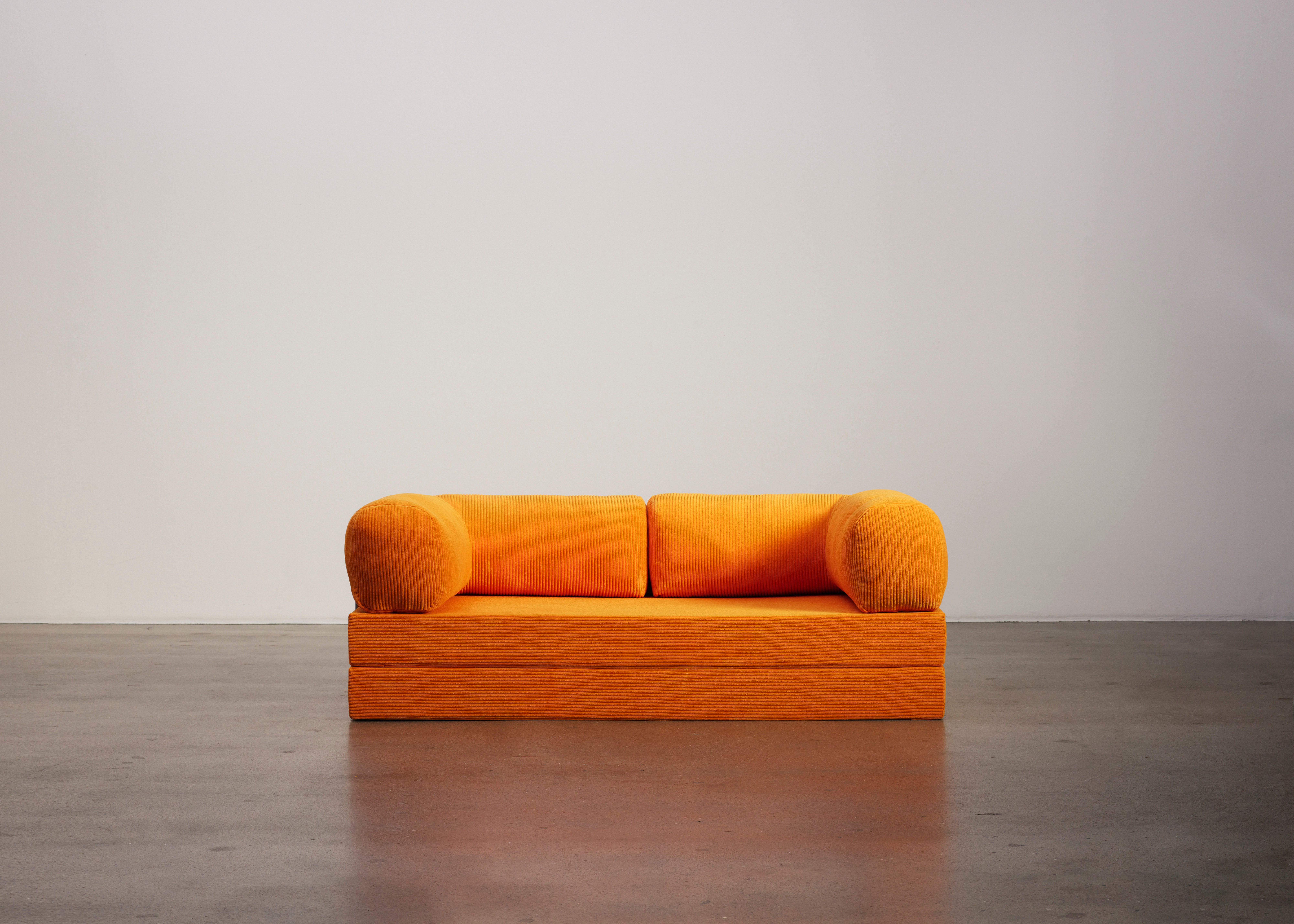
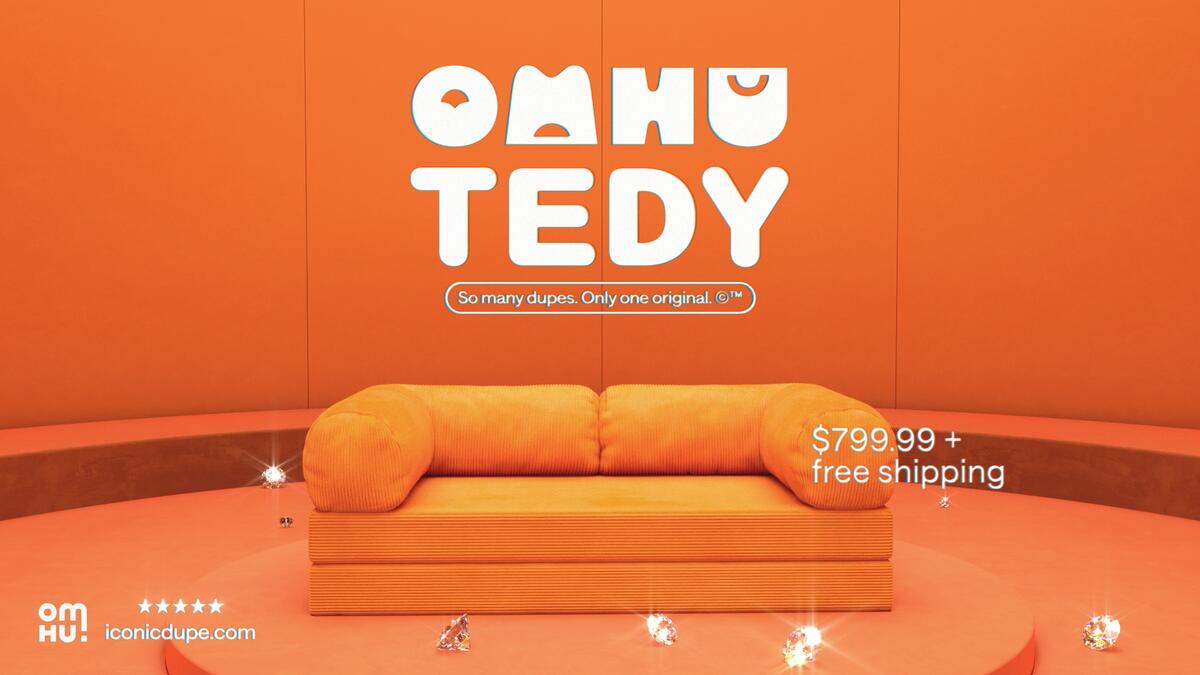
There’s the old adage that imitation is the sincerest form of flattery. Danish furniture brand OMHU, creator of the viral Teddy sofa, took that saying to heart. On Saturday, it launched The Iconic Dupe campaign, a limited-edition (and already sold-out) drop of 50 “duped” versions of its low-seated design manufactured with the same materials and care, only in a bright orange hue. By releasing its sofa at a lower price point, the brand hopes to make a statement.
“With this campaign, we’re saying that being copied is iconic,” Christine Smith, the brand’s creative director, tells Business of Home. “If you’re a viral product or if you’re popular, then you’re getting copied. Instead of just pointing fingers, we’re saying what we’re doing and what the dupes are not doing. We’re trying to [add] a humorous twist, instead of just being super negative about dupe culture.”
Like most brands, OMHU was very aware of the knockoffs circling in the marketplace. According to a recent report by Circana, 58 percent of shoppers have purchased a dupe. After doing market research, the company found that its biggest competitors weren’t rival furniture brands—it was copies of their own designs. “Influencers have been posting about sofas and tagging us when it was dupe, and not our product, [thinking] it was us. And the same in our customer care—when some of the dupe products broke, they contacted our customer care and they were like, ‘Hey, our sofa broke,’ and we’re like, ‘No, that’s a dupe,’” says Smith. “We had quite a few ways to [call attention to the fact] that this is an issue. Obviously there’s been suing some companies for it as well, trying to take them down. [But] we were like, ‘There’s a bigger conversation than this, right?’ It’s something that is not just affecting us, but affecting a lot of different brands that are being copied all the time. Why not do an advertising piece, an awareness piece that talks about this in a more creative way.”
In the era of dupes, established brands are now testing out a new way of combating lower-priced alternatives by releasing a more accessible version of their own highly replicated products.
OMHU priced its Teddy dupes (named Tedy) at $799.99, significantly less than the original design, which starts at $1,995. Some might be surprised to learn that the quality and manufacturing are the exact same as well—the only difference is the color. “We’ve taken inspiration from places like Temu and Etsy that have this bright orange color, because that’s recognizable [as a common shade] within the dupe marketplaces, but we wanted to make sure that nothing else was bad quality or not handmade, and that we still use certified materials,” says Smith. The sofa wasn’t even available on the company’s site—as part of its commitment to the “ruse,” customers could only purchase the pieces on Etsy, Temu and Dupe.com.
Smith hopes the campaign is the start of a much larger conversation. “We can’t get around the fact that dupe culture is a thing. If you look at the direct copying of independent designs and the way that products are being made in circumstances that aren’t great for workers, in general we don’t support dupe culture in that sense, but I think its accessibility for a [larger] number of people [is valid and valuable]. Not everyone can afford products with a high price point,” she says. “[But often what drives up the cost of a product like the] the Teddy sofa [is that it] is made with certified materials, and factories with addresses, with people that are actually getting paid.”
While no future drops are currently scheduled, the company aims to one day collaborate with another duped designer on a project. “What we’re hoping for with this campaign is that we invite other brands or marketing leaders and people that work in the industry, or even independent designers, to join the conversation about being duped,” says Smith.
OMHU isn’t the only company that has duped itself. In 2018, fashion brand Diesel set up a pop-up in downtown Manhattan called “Deisel,” which sold goods to unsuspecting customers thinking they were buying bootlegs, when in fact the pieces were high-quality designs from the brand itself. There’s precedent in the home world too: British designer Tom Dixon debuted the Unbeaten collection in 2024 after seeing countless knockoffs of his popular Beat light. The dupe collection’s prices start at $395—about half the cost of the original, which starts at $795, but still far more expensive than the off-brand alternatives of his designs that go for as little as $55.
“The collection was a success aesthetically and narratively—possibly not quite as huge as I had hoped it would be from a commercial perspective,” says Dixon, who concedes that the line’s performance makes sense. After all, the idea behind Unbeaten was to improve upon the poor quality, finish, components and materiality of the knockoffs, while competing with a product listed at an eighth of the cost of the original design. He would give the concept a go with another product, he says, albeit with a more aggressive marketing campaign and alternative distribution channels.
“The industry remains extremely exposed, and there are very few legal protections, [with] a fragmented and contradictory approach to intellectual property in different countries,” says the designer. “The industry needs to have a bigger voice in its ability to take down listings online—it would be good to get some government support on this.”
In the meantime, as the dupe model becomes increasingly ubiquitous, some brands are taking an even more straightforward tack: embracing the term and its definition wholeheartedly.
The “dupe” rose to prominence in 2023, representing a new attitude among consumers who were proud to have sniffed out an alternative product offering similar value at a lower price point. As BOH wrote at the time, the term—popularized among Gen Z—seemed to evade the shame that previous generations felt around buying an off-brand product, once widely referred to as a knockoff. By contrast, the word dupe has become so acceptable today that at least one furniture and decor retailer—Los Angeles–based Dupe—has incorporated it into its own branding.
The origins of the idea date back to founder and CEO Niki Sepanj’s college days. “I didn’t want to get something boring from Ikea, but I couldn’t afford something really nice, so I was like, ‘Let me just make all my furniture myself.’”
As Sepanj entered the working world (in interior design and creative strategy) and moved into her own space, the gap between mass-produced big-box brands and elevated pieces still felt vast. This time, rather than making her own pieces for her space, she leveraged her newfound connections in the design world, tapping into a network of manufacturers to make a few pieces—inspired by widespread trends, but not exact replicas. Before long, friends, and then friends of friends, wanted to get in on her furniture sourcing strategy, leading to larger orders, and eventually, a budding business.
By that time, it was 2023—and for Sepanj, the new company’s name came naturally. “I was like, ‘Why don’t I just call it Dupe? Because it is what it is,” she says. “Come to us if you want something that’s high-quality, well-designed and offered at a more accessible price.”
When the venture first launched, the name sparked some immediate backlash. Over time, however, Sepanj says the criticism has faded as Dupe has proven that it’s not looking to rip off any pieces or brands directly. Despite starting out with offerings that played into trendy styles, the retailer has since veered more into original designs and customizable pieces. “I think it’s a combination—we’ve proven ourselves as a company, and also dupe culture has become more normalized,” she adds.
In the fashion world, Quince has become a major player in the conversation, embracing the term in its business model and changing the stigma around dupes. The brand offers lower-priced and sustainably crafted alternatives in clothing, jewelry, accessories and now furniture. On the website, each product page even features a section that allows consumers to compare the item’s price to those of similare products by more expensive brands like Reformation and Everlane. It doesn’t claim to produce knockoffs per se, just lower-priced, high-quality alternatives, some of which are even manufactured in the same factories as furnishings from its pricier competitors.
Among Gen Z in particular, Sepanj says, the dupe has come to represent something much bigger than a bit of clever price-comparison shopping. On social media, consumers are becoming clued into the disparity between what it costs to manufacture luxury goods and the eventual sales price of those items. She points to the viral firestorm that took place a couple of years ago when it was revealed that a $2,800 Dior handbag cost the brand just $57 to make.
For those consumers, the dupe is no longer a dirty little secret but rather, a way of staking a claim on good design without buying into a brand’s myth. In that case, the companies that offer those shoppers another avenue of access into their offerings may be paving the way for some much-needed middle ground.
“People should have the right to create a beautiful home,” says Sepanj. “I don’t think that big-box stores or generic furniture should be the only option.”





 Withdraw Consent / Manage Privacy Preferences