









Last month on Long Island, I met luxury retail’s greatest fear. It was at a party celebrating the opening of a home brand’s newest location in the Americana, a high-end shopping center not far from where The Great Gatsby takes place. I was on the second floor, sipping a Vesper martini near a fawn-colored sofa, talking with a local fan of the brand. In many respects, she was the ideal customer for any company that sells furniture: stylish, affluent, a young mother who had recently moved into a new home. We were talking about the pieces she liked, those she didn’t … Then she leaned in to make a confession: “All this stuff is good, but honestly? I just ordered a new leather sofa from Quince.”
In our algorithmically siloed age, it is possible that you have never heard of the direct-to-consumer startup Quince. However, if you fall into the brand’s demographic—millennial-ish, female, a podcast listener, a regular scroller of TikTok or Instagram—it is inescapable. The company now sells a lot of things, including home goods, but it made its bones in apparel, hawking elevated basics at what it calls an “honest” price, aggressively promoted online. If you show the slightest digital interest, its $60 cashmere sweaters will haunt you to the furthest reaches of the internet.
When I started asking around about Quince, several executives in the home industry perked up, telling me they talk about the brand all the time. This is not surprising—there’s a lot to talk about. You could start with the jaw-dropping fundraising the company has done, netting $320 million in the past year alone. Its most recent round, $200 million raised this summer, equaled the sum total of all money raised by all apparel startups in the first half of the year—pegging Quince’s valuation at a reported $4.5 billion, roughly equal on paper to RH and MillerKnoll’s current market capitalizations combined.
You could also talk about the brand’s habit of developing and marketing dupes of popular products, or its factory-direct fulfillment model. Then there’s the sometimes-comical range of its selection. Unlike the past generation of DTC sellers, which focused on going deep in one category and nailing it, Quince casts a wide net. The company sells sweaters and tops, but it also offers vitamins, supplements, Dopp kits and pickleball paddles. You can buy a tin of Quince caviar.
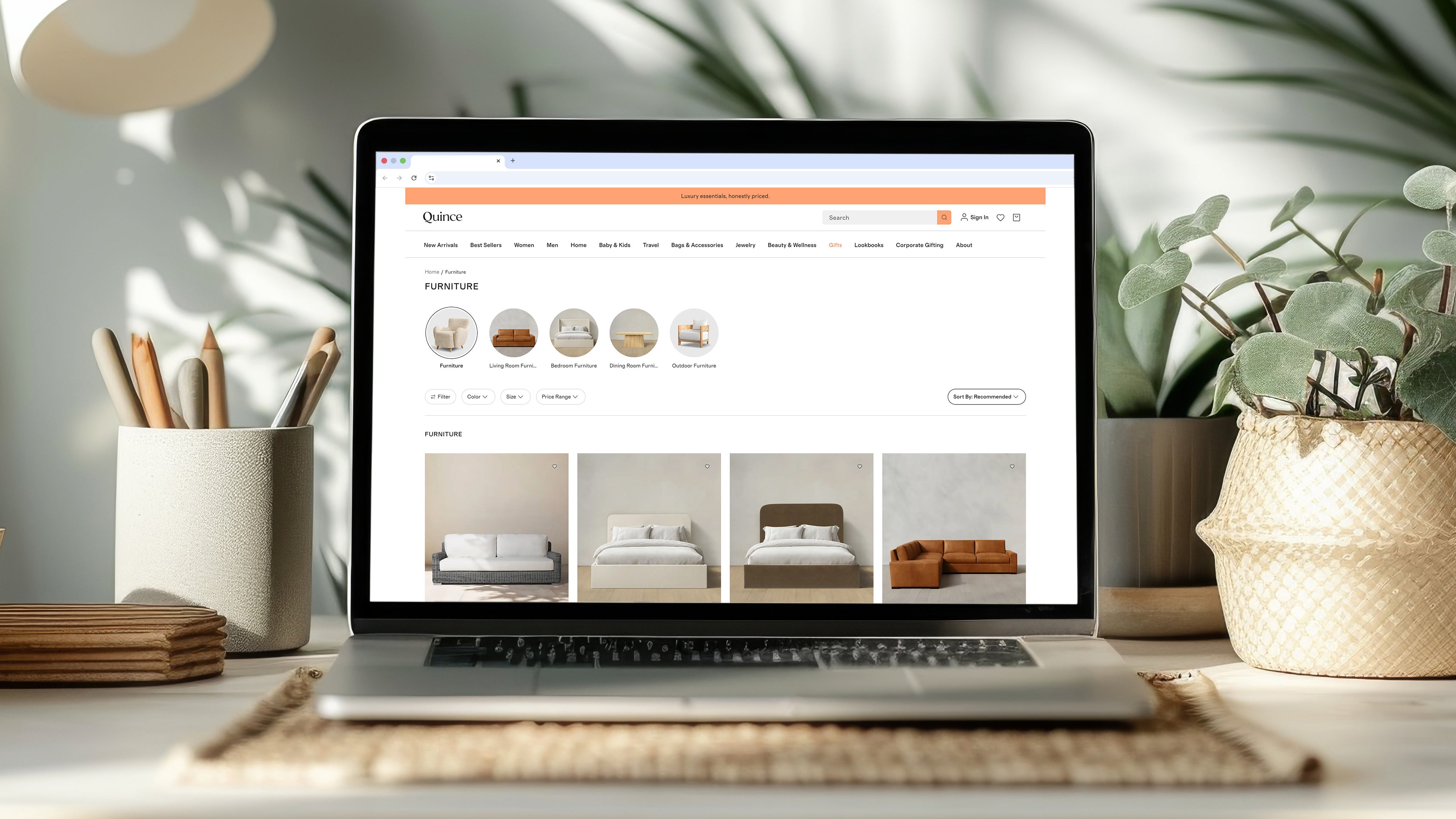
And now, you can buy Quince sofas. Over the past year, the brand has greatly expanded its home selection beyond its robust bedding category, adding lighting, upholstery, case goods, rugs, tabletop, and even some light kitchen appliances. It’s making a serious play for home. Will it work?
Quince (pronounced “kwintz”—the name is a play on quintessential) was founded in 2019 by Bay Area entrepreneur Sid Gupta. He had a background in investment banking, but his more recent endeavor was with a struggling chain of Midwestern candy shops called Candyopolis. In 2007, with no retail experience, Gupta purchased the company and immersed himself in the sweets business. Five years later, he relaunched the stores with a retro look under the name Lolli and Pops. By 2016, it had 37 locations across the U.S. and was nearing $50 million in revenue.
The Lolli and Pops story is not a perfect one. According to his LinkedIn, Gupta stepped down as CEO in 2018; in 2019, the company filed for bankruptcy before being acquired by private equity firm TerraMar Capital. But the experience honed Gupta’s entrepreneurial chops and proved his ability to grow a company. Next came Quince.
In 2021, he told Forbes a version of the brand’s origin story that will be familiar to any student of DTC history:
“My wife and I, we don’t have too many splurges,” Gupta recalls. “But one of them is when we travel, we love to stay at really nice hotels.” The couple woke up one morning in a fancy hotel and thought to themselves, “‘Why is it the five nights a year we spend in a really nice hotel, we have better sheets and better towels than the 360 nights at home?’”
He had something more ambitious in mind than competing with direct-to-consumer bedding brands like Parachute and Brooklinen. In the classic DTC model, brands cut out wholesale markups by bypassing retailers and selling their product directly online. However, they typically purchase inventory from factories in bulk, then package and ship it to customers themselves. Gupta’s twist was to eliminate this step.
Instead of storing products itself, Quince would enlist its overseas factories to ship orders directly to its customers, cutting back on warehousing costs and the pain of unsold inventory. What’s more, by shipping small packages that flew under the radar thanks to the (now-suspended) de minimis exemption, it could avoid tariffs. As a result, the company was able to sell its goods at a lower price than many competitors and still make a margin.
This is, in essence, the same model employed by Shein and Temu, the Chinese marketplace giants that rose to prominence and profit by selling ultracheap direct-from-factory goods. However, Gupta’s other key insight was to observe that customers didn’t always love giant online marketplaces, no matter how low the prices.
“You spend 45 minutes trying to read the reviews and figure it out,” he told Forbes. “The proliferation of this system has also allowed a creeping and increasing amount of bad quality. Anyone can sell, so people can cut corners. Maybe they’re not even selling you a real good. So, what you have is quality going down and so much choice that it’s paralyzing.”
Rather than chase rock-bottom prices and endless selection, Gupta’s plan was to identify hero products. Instead of five hundred sweaters, Quince would find the five sweaters customers actually wanted. They would then seek to optimize the materials, looking for a quality in the ballpark of high-end retail, and fanatically grind down the cost, sometimes leaning hard on suppliers (Quince delivers volume to its vendors, but it is known to be a demanding customer).
Forget chasing “the long tail,” Gupta told Forbes, summing up his thesis tightly. “Let’s just focus on the head, the things that are traded the most.”
“Things that are traded the most” is a good description of what Quince sells—a wide selection of products that started with bedding and apparel, but has since grown to include jewelry, beauty, home goods and accessories. However, the brand’s competitors and detractors would use another description: dupes.
Much of what Quince sells can loosely be categorized as tasteful-if-generic basics: cashmere V-necks, gold hoop earrings, throws, vitamins. However, in its pursuit of finding the stuff people really want to buy, it often identifies a competitor’s bestseller and produces a close look-alike. The products it has credibly been described as copying run the gamut, from Anthropologie dresses to Canada Goose parkas to Away suitcases.
The company doesn’t advertise its products as knockoffs, but it’s not exactly shy about making comparisons either. At the bottom of every product page on its website, shoppers can find a chart allowing them to compare Quince’s price to competitors’—and often, the competitor is the maker of an extremely similar product. As I researched the brand for this article, I was stalked by Quince ads, at least one of which teased, “Restoration Hardware quality for half the price.”
The practice has made the brand more than a handful of enemies. Coach, Yeti (the maker of high-end coolers), and Ugg have all sued Quince for intellectual property theft. Others simply vent to each other and the press, leading to articles like “How Brands Are Taking On Quince” and “Quince’s Imitation Games.” One design industry insider described the brand’s strategy to me as “Ctrl-C + Ctrl-V.”
Customers, on the other hand, don’t seem to mind. Quince is a private company, and doesn’t share its numbers, but Puck reported in August that the brand is bringing in somewhere in the neighborhood of $700 million in annual revenue, an incredible feat for a six-year-old consumer brand. It’s not clear if Quince is profitable, but the rate at which investors are plowing money into it suggests that its internal numbers are enticing.
On its face, Quince’s appeal to shoppers is simple: The stuff you want, for cheap. But there’s a little more to the company’s playbook than that. It has been remarkably good at surfing the cultural waves of the last five years. With its neutral palette, the brand simultaneously evokes the dominant aspirational “look” of the moment (quiet luxury), while also tapping into consumers’ growing cynicism about the value of actual luxury goods. Its compelling price point also happened to hit just as inflation was causing most shoppers to slow down on discretionary spending.
Quince has also proven savvy at online reputation building. It has flooded the internet with influencer partnerships and affiliate deals (the brand is often described as “viral”); its executives are said to be obsessed with online reviews; and its ad buyers do not skimp on Meta placements or podcast deals.
Gupta himself rarely gives interviews to the media, but where he does weigh in is telling. He declined requests to be interviewed by New York magazine for an extensive profile in February (Quince didn’t respond to a list of questions in time for publication of this article). However, when The New York Times product-review site Wirecutter—a powerful tastemaker for the customer Quince is courting—went deep on the company, he corresponded extensively with the writer, even asking for suggestions on how to improve the product.
For competitors, it’s tempting to chalk up the brand’s success to good marketing, ruthless copying and lucky timing. But customers do genuinely like Quince, and seem to accept the brand’s core promise: decent quality at a great price. Stepping outside the world of paid influencers, you will find extensive Reddit threads and Facebook groups dedicated to largely positive discussions of the brand’s offerings. In a quick survey of my own acquaintances, I found that a surprising range—from millennial women to baby boomer men—were repeat Quince customers. Few were obsessed with the brand, but most trusted it.
That trust has allowed the business to leap categories in a way that sometimes seems almost goofy. What is a cashmere sweater company doing selling protein powder? But that kind of juxtaposition is mostly funny if you think of Quince as a fashion brand—which it isn’t, really. It’s more of a set of supply chain strategies, a curation approach and a value proposition than a look.
In many respects, the company it most closely resembles is not Brooklinen, J.Crew or even Shein, but Costco. The retail giant famously features only a small number of brands in every category and aims to sell in bulk—similarly, Quince’s selection is a mile wide but an inch deep. And like Costco—which fanatically cuts down its own costs, squeezes suppliers, and sells everything from salmon fillets to flat-screen TVs—Quince is price-obsessed and essentially category-agnostic.
Finally, just like Costco—quietly one of the U.S.’s biggest purveyors of fine wine—I suspect that Quince secretly has a large fan base of affluent customers. Like the young woman I met on Long Island, rich people tend to love a good deal.
Given the ambition implied by its fundraising (according to Crunchbase, $461 million and counting), it’s perhaps no surprise that Quince has leapt aggressively into home over the past 18 months. Even so, it is still somewhat shocking to see how robust the company’s selection has become. It now sells everything from bedding to lighting to rugs to outdoor furniture to kitchen appliances. As is the case across its categories, the vertical selection is not deep, but it has the width of a true home brand. This is not an experimental toe dipped into the water.
In home, it appears that Quince is following more or less the same playbook that has worked in its other segments: identify winners, grind down supplier costs, blast social media with ads and influencer collabs. And, of course, the dupes. The brand’s website consistently draws comparisons to higher-end retail and DTC brands like RH, Serena & Lily, West Elm and Maiden Home. As in apparel, many products are simply tasteful basics. Then there are things like the “Organic Cotton Jacquard Floral Coverlet,” a dead ringer for Schoolhouse’s Stillwater Floral Quilt.
In one respect, it’s silly to question whether Quince can work for home, as the brand has clearly already had success in bedding. Its linens take up real estate on the company’s list of bestsellers, and the line has resonated even with home’s most demanding customers: designers. Few have tried its case goods or upholstery, but many have explored the linens. (A smattering of feedback, collected via DM: “So far, so good and we had tons of guests and washes.” … “[The bedding] is honestly pretty great.” … “We love it, especially the price.”)
But bedding—relatively inexpensive and UPS-shippable—is one thing. Convincing a customer to make the leap to a 12-foot leather sectional for $5,200 is another. Quince’s upholstery has gotten some decent reviews so far, but it’s not a given that its magic formula works as well on sofas as it does on sweaters. Sixty bucks is about as cheap as you can get for a cashmere V-neck. The value there is obvious. A base of $1,450, which is what the company charges for its 7-foot curved-arm sofa in performance velvet, is a good deal for an American-made piece with its specs, but the customer has to know what they’re looking at. And while this is less than what RH would charge for a similar sofa, it’s not wildly cheaper than entry-level pricing from some of Quince’s DTC and retail competitors.
Bulky categories also present unique challenges. Most of what Quince sells plugs easily into the robust nationwide small-parcel delivery system. Furniture is another beast entirely, requiring brands to navigate a complex web of third-party logistics providers to get their goods from the factory into the customers’ homes. Returns are also notoriously expensive and complex. While the company extends a 365-day window for most soft goods, it limits its furniture window to seven days—though even offering a return policy at all may prove to be a generous mistake.
Home in general is a tough category. It seems to offer tantalizing similarities to fashion that lure in brands at all levels of the market. But the cadence of purchasing is slow, the consideration process arduous, the margins tight, the logistics wonky, and the vendor landscape fragmented. Household retail names—Banana Republic comes to mind—have tried and failed. DTC players like Parachute have dabbled in furniture only to pull back quickly.
“If you’re used to selling apparel, the home business is just smaller—and slower,” says veteran home retail journalist Warren Shoulberg. “That’s something the fashion companies find out right away. Even if you don’t go deep within any category, it’s not going to sell as quickly, and you’re not going to do as much volume with sheet sets and sofas as you are with cashmere sweaters. Furniture requires a different distribution model, and a different cost structure, which is hard to do if you’re only selling a couple of sofas as opposed to the volume of an Ashley or Wayfair.”
To tackle the particularities of the industry, Quince appears to be breaking some of its own rules. While much of the brand’s core premise is to work directly with factories to develop its own product, that’s not always the case in its approach to the home sector. In SKU-intensive categories like rugs, where it’s too labor-intensive to build every product from scratch, it works with importers to help fill its digital shelves. In other categories, it sells other companies outright—including French cutlery maker Jean Dubost and, surprisingly, cult-favorite North Carolina pottery brand East Fork. Quince’s drop-ship marketplace appears to be growing quickly.
Working with importers and setting up drop-ship arrangements with outside brands means that the company can only do so much to cut costs to the bone (it sells East Fork at the same prices available everywhere). Not everything it offers in the home space is quite as outlandishly low-priced as a $200 leather jacket—in that regard, so far, the category is a little less Quince-y than apparel.
It’s not exactly clear what’s behind these moves, whether this is a prelude to the company’s producing its own version of these products, or whether it is looking more to capture the reflected glow of these consumer-loved brands, burnishing its own home bona fides. Or perhaps, to stretch the Costco analogy further, Quince simply went at it backward, starting with its own version of Kirkland, and now building up a more classic retail play.
Whatever the underlying rationale, the strategy demonstrates that the brand is approaching home seriously—with a lot of stuff—and nimbly. Both will likely be necessary in an environment loaded with extracurricular challenges, like a roiling tariff landscape and a stagnant housing market. That’s to say nothing of pressure from investors or the fact that few if any consumer startups have achieved real scale selling DTC and online only (Shoulberg predicts that Quince will open stores or explore wholesale within 24 months).
If Quince’s home play fizzles, many in the industry will likely cheer. There are plenty of ways to paint the brand in a negative light: It’s a dupe engine, it makes customers doubt luxury pricing, its pieces will only add to the landfill, and so on.
However, the brand has also come along at a pivotal time in the home industry. Multigenerational mom-and-pop retailers are folding by the week; DTC players are getting gobbled up in fire-sale acquisitions; and the biggest disruptors struggle for profitability. Amid that landscape, Quince has captured the closet of a desirable customer, and is making some headway into other rooms of the house. Ignore its appeal at your peril.





 Withdraw Consent / Manage Privacy Preferences