













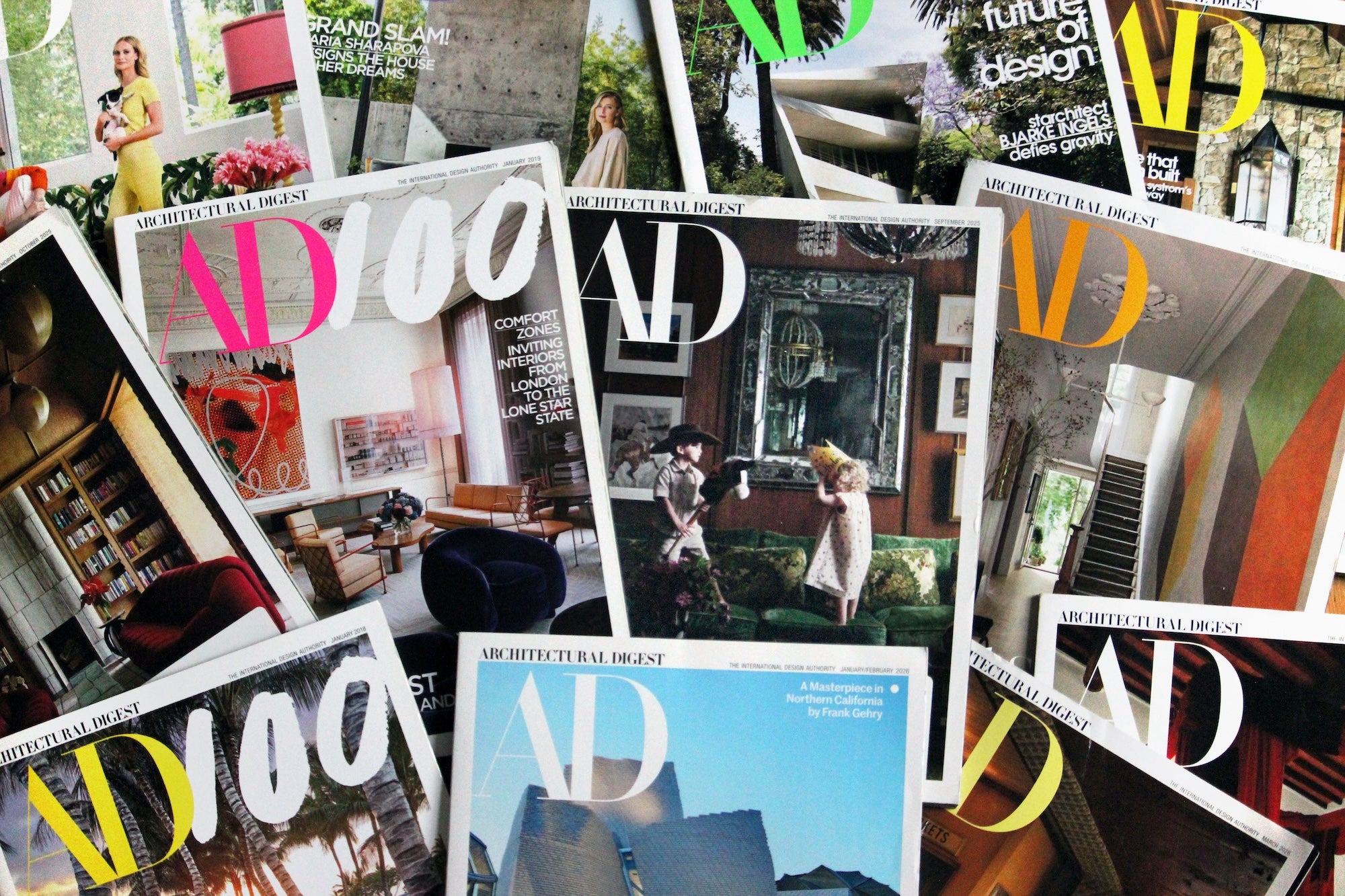
I have a confession to make. Every year, like the rest of the design industry, I eagerly await the release of the AD100, Architectural Digest’s high-profile honor roll. Only, I do something slightly different: I track it. For the past decade-plus, I’ve kept a running spreadsheet where I note the debutantes, the long-running names, and those who dropped off.
I do this partially for professional reasons. I’m a design journalist, and the list is a good way to chart the shifting winds of favor in the industry. I also take a nerdy satisfaction in getting the information organized—putting it all into a spreadsheet allows one to look at the list as “data,” then examine its patterns and trends. (Curious who’s been on the list the most times, or what city boasts the most entries? Read on.) But almost as much as who’s on it, I’m fascinated by the list itself.
The AD100 does not measure anything tangible, like revenue or number of employees. Nor is it a tally of votes from peers, like the Oscars or the Grammys. It is the subjective opinion of a group of editors at a design magazine at one moment in time. Yet it has real objective power. Inclusion can level up a designer’s career, helping them net high-profile clients or score licensing deals. It is also a favorite marketing hook for real estate agents, who use even the faintest connection to the list to justify the price of a property. Within the industry, the sway is the strongest: How many recruiters, business coaches and vendors flex their bona fides by saying they have AD100 clients?
No surprise then that every year, designers and their PR agents wage quiet campaigns to get on the AD100—or back onto it, if they’ve fallen off. As one designer told me, “It’s the list that matters.” There are plenty of other media rankings, awards and accolades for designers to collect. What is it about this list that has captured the industry’s imagination?
THE LIST
A casual observer might assume that the AD100 is a venerable institution as old as Architectural Digest itself. In fact, it was launched 70 years into the magazine’s history, and 15 years into legendary editor Paige Rense’s tenure—long after she had done the hard work of transforming a sedate trade journal into a glamorous gotta-be-in-it publication. There have only been 21 lists over the course of AD’s century-plus in business.
The very first AD100 was released in August 1990, as a stand-alone special issue dedicated only to the list. The cover, featuring a gilded classical scene silhouetted against a black background, advertised “an exclusive guide to the world’s finest interior designers.” The following year, Rense published a similar issue celebrating 100 architects. If she was aware that she had created an institution, you wouldn’t have known it. AD didn’t release the next edition for another four years.
The basic idea—100 firms, the crème de la crème of the industry—was there from the beginning, but the original AD100 edition is strikingly different from what AD puts out today. For one, there was the sheer size of it: At 456 pages, it was absolutely jam-packed with ads, a reflection of magazine publishing’s fat years. (The 2026 AD100 issue is less than half as big.)
But even more noticeable is how the firms themselves were presented. Instead of a biographical blurb, each designer answers a series of questions that reads almost like a job interview, spelling out how big their firm was, how many projects they took on at once, and even what fees they charged. We tend to think of the 1990s as a more buttoned-up era, but the original AD100 is surprisingly candid about money. In it, a young Vicente Wolf notes that he charged “cost plus 35 percent in addition to a design fee,” while Tom Britt charged “retail.”
Whether the average subscriber to the magazine would find much practical use in comparing Carleton Varney’s pricing model with Axel Vervoordt’s is doubtful. But a voyeuristic peek into the glittering world of high-end design is the hook that made Paige Rense’s Architectural Digest such a hit in the first place.
And some readers certainly had the resources to do more than gawk. “It was very quickly understood by all of us that it was going to be used as a reference,” says New York designer David Kleinberg, who made his debut on the list in 2012. “You’d hear from clients, ‘I was looking for a designer, I didn’t know who was out there, I saw you on this list, and I started looking into your work.’”
That was the original genius of the AD100. Unlike many honor rolls, which typically pile accolades on the talents everyone already knows, it was useful. To an opaque and fragmented industry, Rense’s list brought clarity and simplicity. “Here,” it seemed to say, “I’ve done your homework for you: 100 names—pick one and hire them.” Rense’s 2021 memoir of her time at Architectural Digest includes testimonials from more than a dozen blue-chip designers and architects, many of whom extoll the power of the AD100. “It continues to be the best calling card in the business!” exclaims Stephen Shadley.
The AD100 was good business for Architectural Digest too. The issues were embraced by readers and often kept as collector’s items—but they were downright obsessed over by designers. This in turn made them a magnet for trade brands, which would flood the magazine with ads, some taking out full-page listings congratulating those who had made the cut.
In 2000, the magazine shifted the AD100 into its January slot—making it a bright spot in a typically dim period for magazine ad sales—and has kept it there ever since. After Rense was replaced by Margaret Russell in 2010, the list officially became biannual. Then, when Amy Astley, the current global editorial director and editor in chief, took over in 2016, annual.
Over the years, the editorial treatment of the AD100 has slowly shrunk on the pages of the magazine. Information about fees and project minimums disappeared long ago, replaced with pocket bios of each firm. Today, it’s mostly a list of names, though first-timers are still pictured and profiled.
These changes are likely more about the economics of print media than the relative importance of the AD100 to AD. Now, a lot of the action happens online, where the reveal is celebrated across platforms on social media and widely shared by the honorees. And even though the pages dedicated to it are far fewer, Architectural Digest still trumpets the list on its January/February cover—as do its global editions, which now publish their own lists. Almost four decades in, the AD100 is still deeply intertwined with the identity of the magazine.
THE PEOPLE
The AD100 has always been a fascinating X-ray of the design industry, or at least a certain slice of it. In Rense’s time, the list was populated by what many called “her people,” a roster of interior design’s upper crust whose work regularly graced the pages of the magazine. She was known to both give and demand loyalty. If a designer was so bold as to go to another publication with their work first, they risked excommunication. If they stuck with her, she returned the favor by publishing their work over and over and keeping them on the list.
That Rense’s AD100 was occupied by the profession’s biggest names was a given. You were in Architectural Digest because you were a top designer; you were a top designer because you were in Architectural Digest. If there were any complaints about one editor wielding authority over an industry-wide list, most kept it to themselves. Among the tributes in the editor’s memoir, architect Alexander Gorlin writes admiringly that she had created the list “by fiat.”
“That was the top design work being done in the country, and in the world,” says New York designer Jamie Drake, who made his first appearance on the list in 2012, and was inducted into the AD100 Hall of Fame in 2023. “The projects were jaw-dropping. It was meant to be jaw-dropping; it was never meant to be cozy in those days.” Designers wanted to be on the AD100, he explains, not just because of the economic opportunity, but because the list was a genuine professional honor in an industry without many of them.
Almost like a stack of high school yearbooks, you can trace the surface history of the design industry by following the AD100 over time. In it, you can see the tragic death of Mark Hampton in 1998—he disappeared from the next list—and the rise of his daughter Alexa Hampton, who took over the family firm and made her AD100 debut in 2002. Peter Marino first appears on the list in 1995, as a preppy young architect (in the photo accompanying his blurb, he’s wearing a bright red jacket and holding a white terrier); by 2012, his embrace of leather was complete.
The list also reflects a design industry that, for much of its history, has been fairly homogeneous at the very high end. In the early days, it was mostly populated by white architects and designers, slowly becoming more diverse over the years in fits and starts. Following the nationwide racial reckoning that came after the 2020 murder of George Floyd, it became more so; Astley referred to the 2021 edition as the “most diverse list we’ve ever produced.”
THE PROCESS
The makers of the AD100 face a simple-but-not-easy question: Who makes the cut this year? Editors of the magazine have shied away from issuing rigid guidelines about what it takes to be included. In general, though, it’s understood that the AD100 has always been an editorial product—its curators aren’t vetting P&L statements; they’re looking for work that dazzles on the page.
If there is a through line, it comes from AD’s place in the shelter publishing pyramid. The magazine has long nurtured its reputation as the nation’s premier showcase for high-end design. Editors must somehow curate a list that captures a range of styles, while also satisfying a hard-to-define quality of being “the best.” It’s difficult work.
When Margaret Russell oversaw her first AD100 in 2012, two years after she became top editor, she had the daunting task of updating a list that, to many in the industry, had come to represent Rense’s network of relationships more than anything. The first year, Russell cut more than half of the AD100. “It was really, really difficult,” she recalls. “[Deciding who stayed] was about who reflects the point of view where we want this magazine to be going, and also honoring the gravitas of what it has been.”
For all of the names that she cut, Russell introduced notable talents to the list, including Drake, Kelly Wearstler, Gil Schafer, Daniel Romualdez and Darryl Carter. During her tenure, the projects in the magazine shook off some of the formality they had displayed under Rense—it was a more approachable take on what aspirational design looked like. But even as the magazine evolved, picking the AD100 was still a big deal.
“We took it very seriously,” says Russell. “We tried to find people who we could recommend on the basis of the work they did, the thoughtfulness they had. … Design and architecture belong in a museum as a documentation of society as much as anything. We were looking for things that were both of the time and lasting. To me, trendy wasn’t cutting it. Being the flavor of the month—that can be on someone else’s list.”
As in Rense’s years, inclusion could be transformative in a variety of ways. “A designer once came up to me at an event and told me that, while he had so many interesting projects for so many interesting people, his dad didn’t really appreciate what he did until he was on the AD100 list,” recalls Russell. “When people tell you things like that, you realize it’s important—recognition is always important to get.”
Adding to the list has been a perennial perk of the job. The reverse task—who to cut—was a pain point even for Rense (in her memoir, she called the process “a challenging exercise fraught with difficult decisions”). Over the past decade, usually between 10 and 20 firms fall off the roster every year, while a small handful are added to the Hall of Fame. The magazine has made it clear that, similar to an Oscar win, designers who make the list once can bill themselves “AD100” in perpetuity. Still, it’s a delicate conversation.
Kleinberg received the news back in 2017 with an understandable mix of emotions. “I said, ‘I completely understand. It’s a list of 100 people—are you keeping everyone on this list forever?’” he recalls. It wasn’t a financial blow: Being on the roster had helped him get leads, but being off it didn’t seem to make a difference. “Still,” he says. “I was sorry not to be on it.” Kleinberg wasn’t off it for long: His firm was added back to the AD100 in 2023, then named to the Hall of Fame this year.
Personal scandal seems to also have played a role in a name dropping off the list—at least once. In 2023, starchitect David Adjaye was publicly accused of sexual assault. Though he had been inducted into the magazine’s AD100 Hall of Fame in 2022 (ostensibly a permanent honor), Adjaye wasn’t included on the 2024 list, and hasn’t been since.
THE DATA
Looking at the list as an enormous spreadsheet (for this article, I went back to the magazine’s archives and filled in the full history of the AD100) allows one to track firms through the decades. It also lets you see who has been on the list the most—though it depends on how you count.
The longest-running stretch on the AD100 belongs to New York architect Robert A.M. Stern, who passed away in November of last year. Stern made the list in 1991—essentially the first year he was eligible—and stayed on it until 2017, at which point he was put in the inaugural Hall of Fame. His grand total is 20 AD100s.
The designer with the most appearances is Victoria Hagan, who was named to the AD100 in 1995. Hagan made it on the list 16 consecutive times through three editors, before being put in the Hall of Fame in 2024. Her total is 19.
From there, counting becomes a muddle of arbitrary choices—whether to account for a firm changing names and principals, whether being in the Hall of Fame should be weighted “more” or “less” than a regular listing. But the firms who show up again and again will likely be familiar: Martyn Lawrence Bullard, Olson Kundig, Marino, Alexa Hampton, Annabelle Selldorf, Ellie Cullman—all have made the list more than a dozen times.
Taking the list as a set of data also allows you to see patterns over time. The most obvious is that the AD100 skews male, especially in the early years. Of the 112 principals featured in the very first AD100, 22 were women; the follow-up issue, which was dedicated to architects, included only 10. Across the full historical scope of the list, approximately 75 percent of the featured principals have been men. In recent years, the balance has shifted, though not flipped entirely: Since 2021, it’s been roughly 65 percent men.
It will likely surprise no one to learn that the AD100 is geographically concentrated around the coasts—but it’s interesting to see just how concentrated it is, and which coast wins out. Of all 2,100 listings, almost half are occupied by New York firms. California is the runner-up, but it’s not even close: It takes up about half of the space as the Big Apple.
From there, a handful of other states break into double digits, including Illinois, Connecticut and Massachusetts, but France and England both can boast more honorees than each of them. The list is surprisingly light on designers from the American South. Texas boasts serious numbers, with almost 30 listings, but there’s only a handful from Florida, and a lone AD100 designer from Georgia (Suzanne Kasler, who has made the list seven times).
Many states have had only one listing ever, a product of the 1991 all-architects issue, which included firms in Missouri, Oklahoma and Arkansas. Meanwhile, 21 states have none—Kansas is still waiting on its first AD100 honoree.
THE FUTURE
The AD100 debuted in an era before Google, Yelp, Pinterest and Instagram—and eons before you could ask a chatbot for a tip on the best designer in your area. It predates even HGTV by four years. At the time, Architectural Digest’s authority, especially over the high end of the industry, was singular.
The past two decades have seen the market flooded with new ways to access and assess designers, whether that’s competing lists from other publications and brands (even 1stDibs has an honor roll), directory-like consultation platforms like The Expert or Tald, or, more potently, social media. Many of the industry’s most recognizable names—Amber Lewis, Athena Calderone, Shea McGee—have built their careers without ever appearing on the AD100.
Seth Kaplowitz, an attorney and strategic advisor to design firms (some of whom are on the AD100), is skeptical about the commercial impact of being on the list. He’s seen what happens internally when firms get added: “It increases [designers’] visibility, and deals with the issue of some people wanting external validation of a designer they’re considering hiring,” he says. “But I think what it really does is increase the volume of inbound traffic, not necessarily the quality of it.”
But the list has undeniable cachet in the trade. Whether they think it will immediately net them a billionaire client or not, designers still want to be on it. The AD100 functions as a kind of shorthand—a credential that signals legitimacy to anyone in the industry, and some outside of it. The fragmented media environment has introduced a lot of competition for Architectural Digest, but it makes for a messy landscape, and “AD100” remains one of the few titles that can be added to a bio and be instantly understood.
The AD100 also carries commercial power for AD. In 2022, the magazine launched the AD Pro Directory, a listing of architects and designers (later expanded to include contractors and garden designers), which costs firms $1,800 per year for membership. Though AD maintains a formal separation between the two, it’s hard to ignore the halo effect: The prestige of the AD100 lends authority to AD Pro’s recommendation, and to its ability to charge for inclusion. Architectural Digest’s marketing sometimes makes the connection explicit—a recent Instagram campaign urging followers to “Meet the AD100” includes an “Apply Now” button that leads to AD Pro.
In recent years, the AD100 has seemingly embraced fresh faces. In my spreadsheet, I don’t attempt to track how long inductees have been in business, but several designers told me that they have noticed a growing number of buzzy up-and-comers on the list. This in turn led to off-the-record speculation that, rather than presenting a list of veterans who have reached the pinnacle of their powers, AD is now using the list to celebrate emerging talent and look ahead.
It’s hard to say (Architectural Digest declined to participate in this article). Whomever they choose, the editors of the list face a series of conflicting impulses: Honor the old guard while making way for new blood. Signal both authority within the industry and cultural relevance outside of it. And do it all every year, amid a turbulent era for shelter media. In creating the AD100, Rense handed its future editors a recurring dilemma.
However, she also gave the magazine a durable asset. Forty years and 21 editions later, both the AD100 and the cultural context around it have shifted, but the most crucial thing hasn’t changed a bit: You’d rather be on the list than off.










 Withdraw Consent / Manage Privacy Preferences