














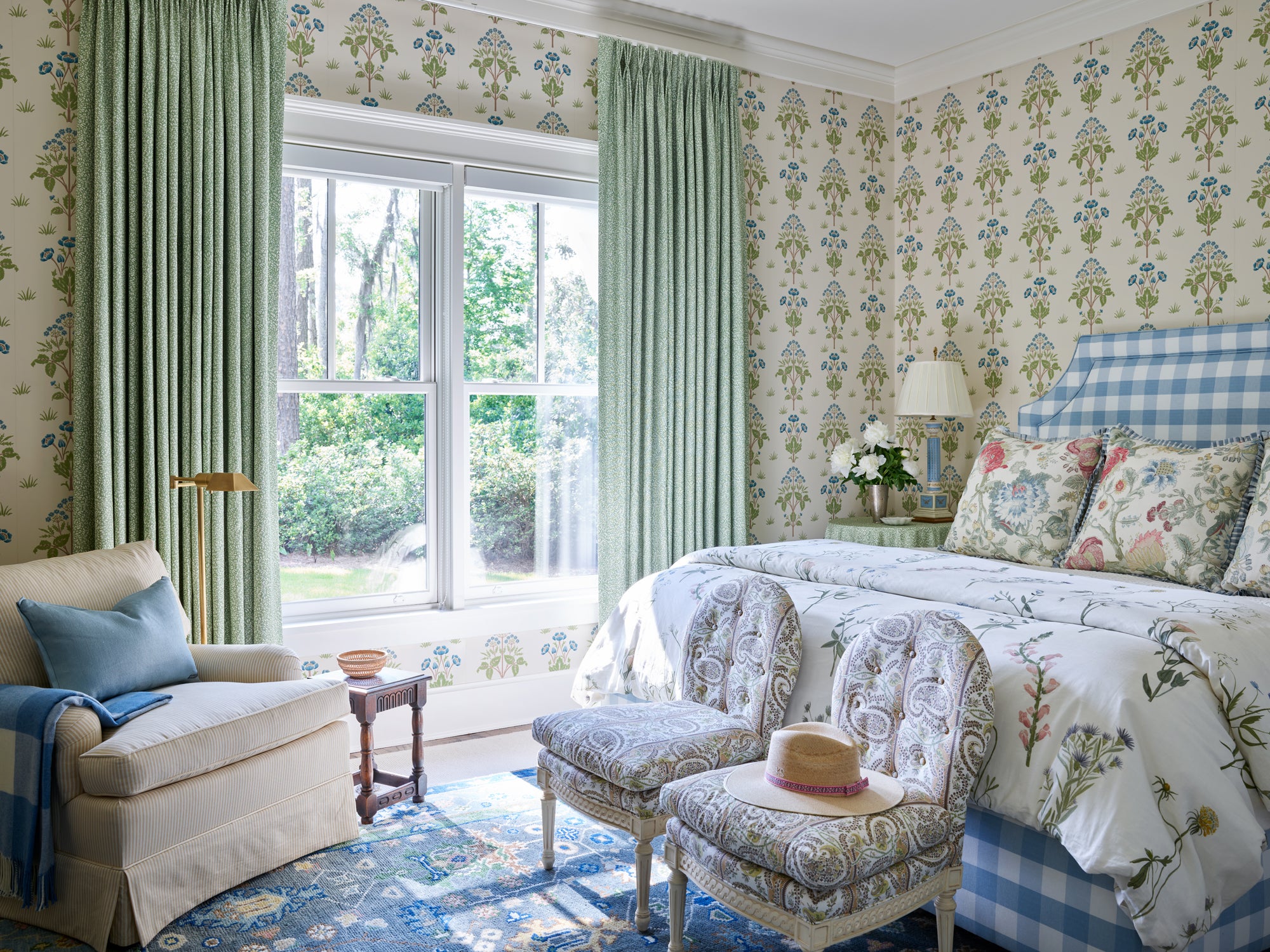
New York–based designer Leslie Banker’s summer home in Rhode Island had seen better days. Poor insulation, no air-conditioning, and single-pane windows left the 1890s Victorian cottage drafty in winter and humid in summer. “We redid a bathroom that looked like it was going to melt into the ground,” she says with a laugh. Still, the house was hers, and she wasn’t willing to quit it. After replacing the roof, she and her husband put on solar panels and added air-conditioning, heat pumps and as much insulation as they could manage. “We didn’t want to move—we loved the quirky charm of our house, and the idea of completely moving or building was very daunting in this real estate market. We thought, ‘We’re going to hold tight to what we have.’”
Banker is one of millions of Americans who are choosing to stay put—and put in the not-insignificant work of home improvement—rather than chase the greener pastures of a new address. Headlines from The New York Times to the National Association of Home Builders herald an increase in renovation spending by homeowners, citing everything from an inventory of aging homes and a lack of available housing to punishing mortgage rates. The Harvard Joint Center for Housing Studies estimates that renovation figures will top a record $524 billion in 2026 alone.
That leaves interior designers and architects who have grown accustomed to a healthy roster of new builds and move-ins with an interesting realization: If it seems like renovations are taking over your project pipeline, that’s because they are. “The renovation market is much more prevalent,” says Chicago-based designer Kim Scodro, who estimates that renovations now account for more than half of her projects, an increase from three or four years ago. “A lot of people bought their homes and got these amazing interest rates, and if they move, they lose that. It just makes so much more sense for people to renovate where they are.”
Scodro says that’s true for every demographic, from growing young families who are already established in a desired neighborhood to empty nesters who find it’s too costly to get what they want elsewhere. “It’s just too expensive to move today, so people are saying, ‘Hey, let’s embrace what we have and make it fabulous.”
Banker cites another interesting reason for choosing renovations over new builds: Older houses are often grandfathered into current zoning regulations. Homeowners who knock down houses and embark on new construction can lose valuable square footage. “If your garage is by a property line and you tear it down, then you’re subject to the new zoning, and you have to observe the setbacks or adhere to the cubic volume,” she says. Banker recalls recent clients who wanted to demolish a home to rebuild, but quickly opted to remodel when they learned that the footprint of the new home would be smaller than that of the existing structure.
Pennington, New Jersey–based interior designer Lindsey Walsh says she’s experiencing a similar uptick in renovation projects, though she attributes it as much to aging inventory as to a new appreciation for older homes. “So much of what makes this area so desirable to live in is the history of homes and the architecture of the neighborhoods,” she says of the centuries-old communities that her clients seek out in the New York metro area and along the East Coast. “There is a certain élan and prestige to living in a home with age that’s enviable.” Homeowners’ enthusiasm for aging homes may be a function of necessity, not simply style: According to real estate brokerage website Redfin, the median age of homes currently on the market is 36 years old.
While these designers say the larger economic landscape of the housing market certainly plays a role in some clients’ shift to renovating, personal financial situations are much more nuanced. For clients who are on a budget but want to refresh their current space, “a renovation can be much more targeted” than moving, both in terms of financial cost and scope of work, says Banker. Across the board, kitchens and bathrooms are the focus of most projects. Nashville-based designer Elizabeth Burch has received so many inquiries for these spaces—often accompanied by unrealistic expectations of the expenses involved—that she has developed a service she calls the “No Demo Reno,” in which she keeps the structure of the existing space, cabinets and all, but alters nearly everything else. By transforming mirrors, lighting and fixtures, she’s able to create a fresh look for clients who don’t have the budget for a complete overhaul. Her method also addresses the considerable inconvenience of clients living in a construction zone for extended periods of time—one obvious downside to renovating a current home—or the delay and costs associated with optimizing a home clients are patiently waiting to move into.
Yet some of the home improvements many other clients are undertaking have a project budget more typical of new construction. “These are major renovations: additions, dropping ceilings for different lighting effects, ripping up tiling and hardwood flooring, replacing windows and moving walls. They’re not inexpensive adjustments,” says Scodro, noting that some of them can run upward of $1 million. “To really change a home is quite expensive, especially when you’re talking about these cavernous great rooms. More people are saying, ‘Well, I can live with the size of that room not being great because I’m going to make it so beautiful that everything else is OK.’”
Elizabeth Graziolo of New York–based Yellow House Architects has seen clients’ values shift in this climate. “It’s less about scaling back and more about value and control,” she explains. “Many clients feel that investing $500,000 to $1.5 million–plus in a renovation allows them to achieve a highly customized, high-quality result versus purchasing a new home at a premium that still requires significant work. It’s often a strategic decision: ‘If I’m going to spend this amount, I’d rather shape something exactly to my needs.’”
The shift toward renovating reflects something deeper than just finances. “What’s most interesting is that renovation is no longer seen as a compromise; it’s becoming a preferred approach,” adds Graziolo. “Clients are thinking more long-term and more holistically about how they live. Renovation allows for a level of thoughtfulness, craft and personalization that is often harder to achieve in a speculative or newly purchased home. In many ways, this shift is leading to better, more considered architecture.”
According to New Jersey– and Philadelphia-based designer and architect Melinda Kelson O’Connor, clients are finding another benefit to remodeling. “Renovations offer something a new build simply cannot: the ability to phase the work. This gives clients genuine power and agency over the process. They can choose to invest deeply in the critical underlying systems—electrical, HVAC, structural changes—and defer other elements, such as a bathroom refresh or a planned addition, to a later phase. A new build, by contrast, typically demands everything be resolved and financed at once.”
To meet the moment, designers are approaching renovation projects with more forethought and consideration than they would a more straightforward new build or move-in, calibrating their processes to ensure a smoother client experience. “Renovations require a much deeper understanding of existing conditions, greater coordination with contractors early on and more detailed drawings to reduce uncertainty in the field,” says Graziolo. “Precision and clarity in our drawings becomes even more critical in renovation work. The more resolved the design is on paper, the more efficiently the project can be executed on-site, ultimately saving time and cost.”
For Kelson O’Connor, renovations also require greater organization and a willingness to adapt. “It’s essential to build the reality of unknowns directly into your billing model,” she says. “As walls are opened and concealed conditions are revealed, you continuously learn more about the home—and that knowledge inevitably affects both the design direction and the budget. Pricing and design iterations must remain responsive to these discoveries throughout the process.” To manage all of the variables, she opts for flexibility during the pre-design and schematic phases, then shifts to fixed billing as unknowns are progressively eliminated. “This approach creates transparency for the client while preserving the adaptability needed to respond to what the house reveals along the way.”
Of course, clients with healthy budgets and plenty of early preparation are ideal. But not every client has pockets deep enough to essentially build out a new house on top of an existing one—or the funds to navigate the inevitable surprises. If you find yourself fielding smaller renovation inquiries or facing a dwindling project pipeline as a result of clients being more conservative, business coach and BOH columnist Gail Doby advises designers to go back to the drawing board.
“If you’re waiting until you’re not busy, you’re about six months too late,” says the Pearl Consulting co-founder. She suggests mapping out the market in your area and shifting your message to the luxury sector. “It depends on what level of client you’re serving. You have to take a look at your market and say, ‘What is the market doing? What is the high end? Are you serving the high end?’ If you’re in the midtier, you’re probably going to need to take those smaller renovation jobs. But if you’re at the high end, you might not be as affected.”









 Withdraw Consent / Manage Privacy Preferences