














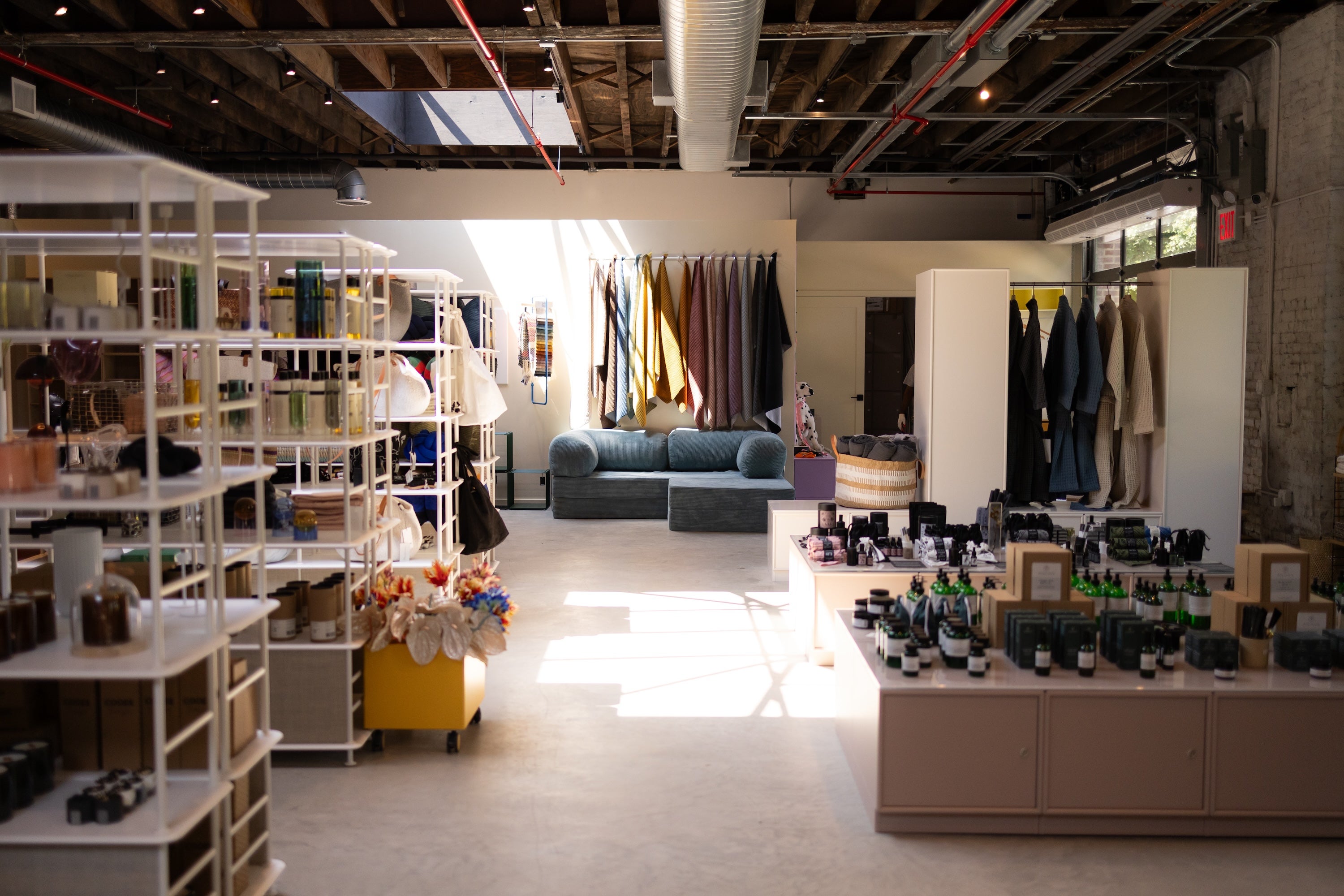

Last month, a depressingly familiar complaint began popping up on Reddit: “Where’s my sofa?” In this case, the sofa was the Teddy, a low-seated and stylishly plush piece by Danish brand OMHU. Buzzy online, it was everywhere on social media, but it wasn’t showing up at customers’ doors. According to the Reddit chatter, a Brooklyn store named Teak was to blame. It had taken payments, but it wasn’t delivering sofas, and emails were going unanswered.
These types of stories have become sadly common in the design industry over the past few years. Turbulent business conditions—the DTC hangover, Covid, tariffs, take your pick—have sunk more than a handful of companies, leaving thousands of customers in the lurch. But in this case, the product was a runaway hit, and the store, Teak, had been growing. What happened?
Teak is the brainchild of Caitlin Maestrini, a 35-year-old entrepreneur who has spent her career in the design industry, putting in time at 1stDibs and Flos. In 2022, she laid the groundwork for Teak, setting up a small business importing and selling contemporary Scandinavian decor at a Manhattan pop-up.
In early 2023, Maestrini had just signed a lease on a small store in Brooklyn’s Greenpoint neighborhood when one of her employees discovered the Teddy on Instagram. It was a new product based on an old look: Two Copenhagen-based vintage dealers, Frederik Frosig and Jonas Larsen, had taken inspiration from 1970s pieces they were selling on Instagram. The two designed the Teddy and in 2022, launched OMHU as a vehicle to sell it.
For Maestrini, the look was right and the price point ($2,000 at the time) was friendly. After a quick exchange of emails, Frosig and Larsen agreed to ship a Teddy to Maestrini, who put it in a vignette at the front of Teak’s new shop. “We weren’t looking to get hard-core into furniture, but we were like, ‘This is cute, this is fun. It turns into a bed. This is great,” she says. “We thought we would sell a few of them a month.”
Instead, the Teddy went viral. In a world full of upholstered furniture options, the sofa seemed to check just the right boxes: It delivered a lot of look, customers liked the coziness of the corduroy and the boneless construction, and the price hit a sweet spot for young buyers willing to spend a little more to get outside of the Ikea bubble. Almost immediately, the Teddy was a hit on social media, and Teak had a flood of incoming orders. “We went from making $1,000 to $2,000 a month to now making $100,000—that was huge for us,” says Maestrini.
She set up an Ex Works relationship with OMHU, meaning that as soon as each sofa left the company’s factory in Poland, Teak took custody of the piece and was responsible for international and domestic logistics. Ex Works deals allow retailers to maintain direct control over the product they sell, but they also add risk: Maestrini’s business quickly went from a small pop-up to an international operation, racking up bills with shipping companies and logistics providers.
Teak had a 40 percent margin on the Teddy, meaning that Maestrini was only able to take in $800 on every sofa—before covering her expenses. Over time, she and OMHU raised the retail price to $2,500; however, rising logistics costs meant that Teak wasn’t banking tons of cash on the success of the Teddy.
But in the early days, none of that mattered. In an industry with few blockbuster products, the Teddy was a genuine hit, and Maestrini was eager to capitalize on the momentum, starting to work weekends on the product. She hired a Danish company, Adflair, recommended by OMHU, to start buying ads on Google and Meta. Tapping industry connections, she got press for the Teddy. Influencers were gifted sofas. All of it worked.
Over the next two years, Maestrini continued to devote much of her time and energy on making the Teddy happen in the U.S. She brought the sofa to ICFF and Design Miami and to a pop-up in Los Angeles, fronting the costs out of Teak’s budget. Her monthly digital ad spend crept up into five figures. She and her team helped finesse the product, suggesting that OMHU fix the sofa’s kludgy zipper and give its upholstery options better names (“Light Orange” became “Tangerine.”)
Maestrini had started Teak to get into the Scandinavian design business. Almost without realizing it, she found herself in the Teddy business.
The Teddy business was good. By 2024, Teak was selling $400,000 worth of sofas a month. At this point, Maestrini had moved the store to a larger location on a more desirable block in Greenpoint. By 2025, she was fronting a small team of retail and operational staff. The vast majority of her revenue—75 to 80 percent—came from the Teddy.
It wasn’t until August of 2024 that Maestrini signed a contract—a simple reseller agreement—with OMHU. She now looks back on the lack of a more expansive agreement as naive, but at the time, it seemed to her like a group of like-minded friends building something together. “We were all very middle-class people, just stumbling upon something that we thought was a really unique product and that we could share with everybody,” she says. “We built a friendship. Whenever we were in Copenhagen, they were like, ‘How cool would this be if the next time you guys come, we get to go to Noma?’”
OMHU was growing too. As the Teddy found success in Europe—sales across the pond were higher than in the U.S—the company expanded from two Danish vintage dealers with a fun idea into a buzzy international design brand. In late 2024, it brought on a CEO, Simon Salomonsson, who began running day-to-day operations. At this point, Maestrini says that the relationship between Teak and OMHU began to change, shifting from a friendly partnership into something more formal. Still, the Teddy continued to perform, and she and Salomonsson met regularly to discuss sales figures.
This year, the dynamic soured. In the spring, a dispute over a held-up shipping container led to a heated email exchange with Salomonsson. Maestrini saw it as a violation of the terms of the Ex Works agreement. A company source familiar with the situation contends that it was part of a broader pattern of unpaid invoices.
“Caitlin was informed clearly and repeatedly that we could not ship without payment,” says the source. “She had been behind on payments for more than a year, and because of repeated missed payment schedules, we held back containers several times, including [this] incident. This was not a single turning point.” Maestrini acknowledges being late on some payments, but disputes the characterization of Teak as “consistently” behind.
Teak had some new problems outside of its relationship with OMHU. The viral success of the Teddy had not gone unnoticed, and competitors began producing dupes at a significantly lower price, cutting into demand. Tariffs—on European imports, plus the steel and aluminum needed to produce the couch’s external frame—began to eat into Teak’s margins, as did increased shipping costs. Delays too began to stack up, as the ports strained under the weight of processing new trade duties.
Then came a bombshell. In early August, after what Maestrini describes as a routine call reviewing sales, Salomonsson told her that OMHU would not renew Teak’s reseller agreement when it expired the following week. After 27 months and over $9.2 million in sales, the partnership was coming to an end—fast.
Maestrini was stunned. She says she believed their agreement included a de facto 90-day notice period if it wasn’t going to be renewed. OMHU disputes that interpretation. “Our agreement with Teak New York was a standard, nonexclusive, fixed, one-year contract that automatically expired without notice in August,” says Salomonsson. “The nonrenewal was not a secret between us.”
The contract itself stipulates that both parties would “meet to discuss a prolongation of the agreement in good faith three months prior to the expiration,” which Maestrini says did not happen. However, it also clearly states that it would automatically expire without notice after one year.
Whatever the interpretation of the contract, the practical effect was the same: Almost overnight, Teak lost the right to sell the product that made up 75 percent of its revenue. Maestrini says that, with no runway, she had no time to taper her advertising spend, slow incoming orders, or prepare for the cash-flow swing that would follow. She negotiated a modest extension through September, but immediately began laying off staff and canceling contracts.
In negotiating the end of the partnership, it became clear that OMHU had been planning for some time to go fully direct-to-consumer in the States. The company had established a relationship with a manufacturer in North Carolina to make the Teddy for the U.S. market, and it was gearing up for a major ad push. In September, it launched a campaign selling the Teddy for $2,000—$500 less than Maestrini’s price, though by that point, OMHU’s lawyers had told Teak to stop selling the sofa anyway, as the two companies couldn’t agree to terms.
When the spigot of Teddy revenue turned off, it created a looming cash crunch. Soon Maestrini didn’t have the money to cover a rapidly growing logistics bill—she says it had ballooned to $350,000—and her freight forwarders refused to release the seven containers of sofas it was holding as collateral in Edison, New Jersey.
Frustrated customers—Maestrini says there are roughly 300 in the lurch—turned into angry customers, and Teak’s Google reviews took a nosedive. Reddit posts began appearing in October. She attempted to negotiate with Salomonsson to pay the bill and get customers their sofas, but the two couldn’t make a deal.
"OMHU offered to produce the remaining sofa units at no charge for Teak, and on top of that, contribute financially toward Teak's debt to its logistics partner so Teak customers could receive their product," says a company source with knowledge of the situation. "This was a significant concession on our side."
Maestrini is planning to file for Chapter 11 to shed the debt and keep Teak’s doors open. She’s been reaching out to customers—on DMs, over the phone, and responding directly on Reddit—advising those who can request a chargeback to do so. Those who have slipped out of the window are in a tougher spot. But she says she’s determined to get them either a sofa or a refund in the long run.
Whether Teak’s customers will forgive and forget remains to be seen. On Reddit, some posted empathetic comments about the challenges of a small business—but not all. “I can sympathize with a struggling small business,” wrote a Redditor. “[But] we are people that have paid a hefty sum for an item that shows no signs of ever arriving.”
Maestrini looks back on her all-in commitment to the Teddy with some regret. “I was naive in the situation,” she says. “I’ve never had to deal with a contract. And you also don’t expect a product to grow as big as it did, as quickly as it did. When you’re in the middle of it, you really can’t see what’s actually going on.”
For her, the fallout has been primarily financial, but the experience has been personally bruising as well—she frames it as the betrayal of a partnership. In her eyes, even OMHU’s new marketing campaign seemed to add insult to injury by subtly erasing the work she had done to break out the Teddy in the U.S. “When they launched their campaign, it was like, ‘Hi America, we’re new here,’” says Maestrini. “They’re acting like they’ve never been in the United States.”
OMHU has continued with its DTC rollout of the Teddy—its ads are currently blitzing Instagram. For her part, Maestrini is in the early phases of launching a new sofa by German brand Snooze Project, the Levi. It’s a modular, low-seated model with a boneless construction that retails for $2,500. Among other options, it comes in a corduroy called Teddy.












 Withdraw Consent / Manage Privacy Preferences