










In Business of Home’s series Shop Talk, we chat with owners of home furnishings stores across the country to hear about their hard-won lessons and challenges, big and small. This week, we spoke with Laura Vogtle of Birmingham, Alabama–based lifestyle brand Odette Collective.
Vogtle has swung from one retail company to another, running her own clothing store for 18 years, then an art gallery for another decade, before pivoting into the home world. She opened her interior design firm and first retail location nearly concurrently. “I had the building, I had the rent, I had the staff—all the overhead. Why am I not also selling product that I could be using in the jobs?” she says. “It was a little bit of the reverse [of] what most people do. I had a retail background, and the interior design came later.”
Now she has a constellation of businesses—Vogtle Design Group, Odette Antiques, Odette Furnishings and her two retail operations, Odette Collective and Galerie Odette (which was rebranded from Design Supply earlier this summer)—as well as a presence at High Point Market, yet still she says that retail is “deader than dead.” So what keeps her going? The entrepreneur explains ahead.
Was interior design something you’d always enjoyed?
Yes, always. In college, my major was fashion design and minor was interior design. When I did the clothing store, there was a huge amount of visual merchandising. I honed in on those skills, which in turn helped with rearranging furniture, hanging a gallery wall, and that side of interior design. I started out doing jobs like that—rearranging for people, finding knickknacks, [styling] shelves and coffee tables. I was a little bit later to the game with wallpapers and fabrics. During Covid, we were really busy, and trying to get enough furniture for people was a thing, so we started designing and [producing] our own upholstery. That’s why that side of the business kicked in gear.
What skills transferred over when you pivoted into design?
Lots on the business side—the buying, budgeting, turnaround time, orders, broken merchandise coming in. It’s the same process as if it was a skirt with a tear in it or a flaw in the fabric. The learning curve is with technology. One of my sons does all of our website inventory and receiving work, and every day I walk in, he’s like, “Oh, my gosh, this is what Claude just learned to do. I just did a month’s work in one day.” It’s like Christmas morning every day to him. And honestly, thankfully so, because it is not my passion to sit in front of a computer.
Lots of our product is complicated: You have a chair you bought in Europe. It cost this much, but how much did it cost to ship it here? What was the tariff? Do you have to reupholster it? How much was the fabric? Did you use nailheads? Is there trim? It’s seven different layers just to get to a price. We have an awful lot of little things to keep up with. The technology is helping us a great deal. I have people on my team who actually have interior design degrees and know how to do the CAD drawings and use AI. I work with people who do that side of the business for me.
How would you describe the aesthetic of the retail business, and does it differ across the three locations?
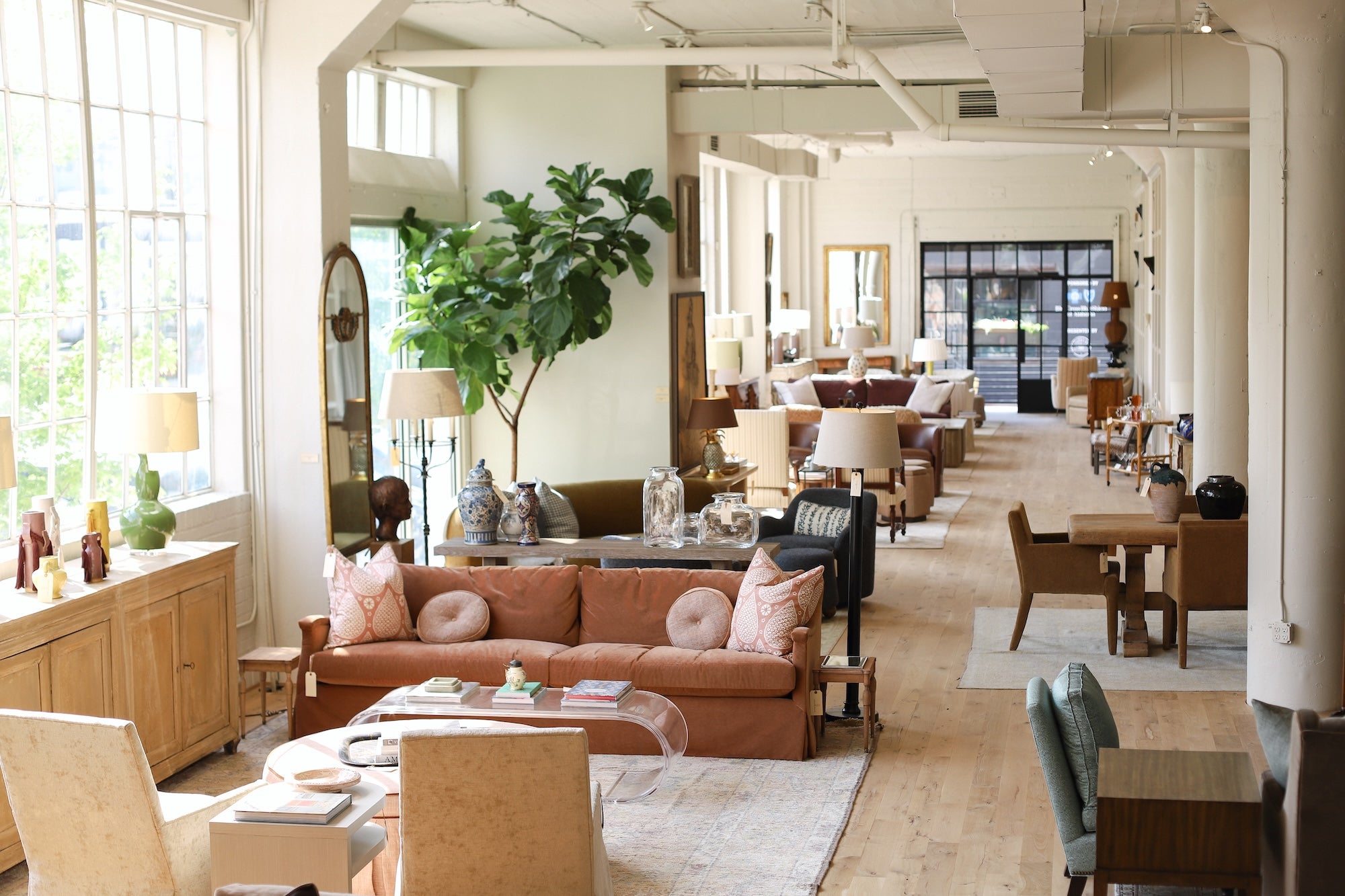
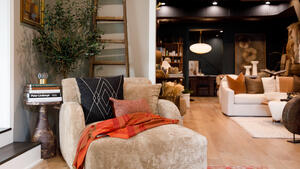
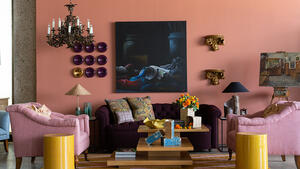
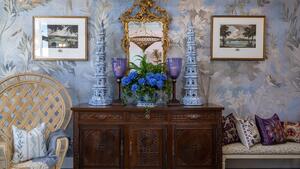
We [differentiate by carrying] one-of-a-kind items. Galerie Odette is full of contemporary artwork—we represent close to 60 artists. That gallery has 15-to-20-foot ceilings and brick walls. [Odette Collective and the High Point showroom] don’t have as much art, or it might be vintage art and mirrors.
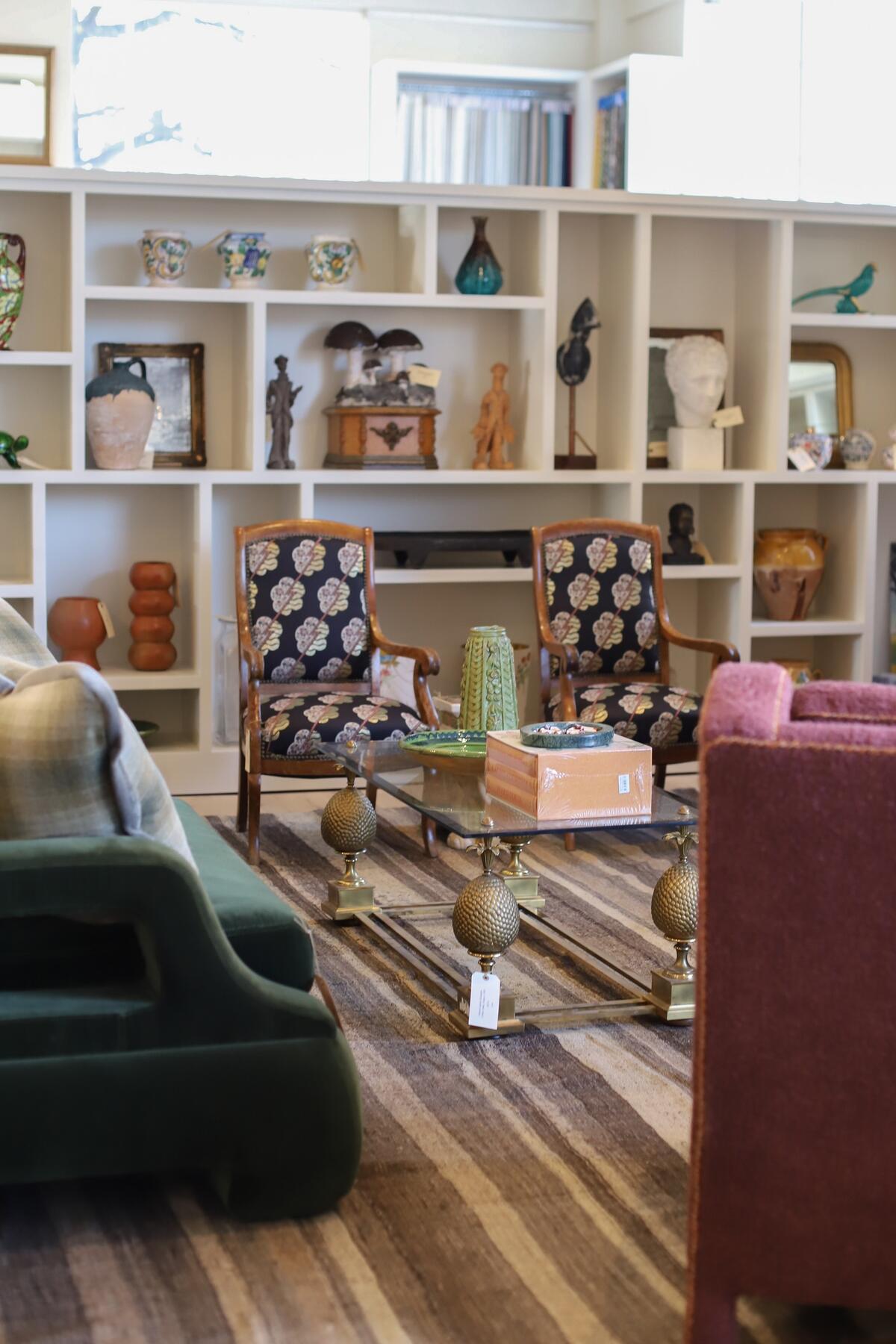
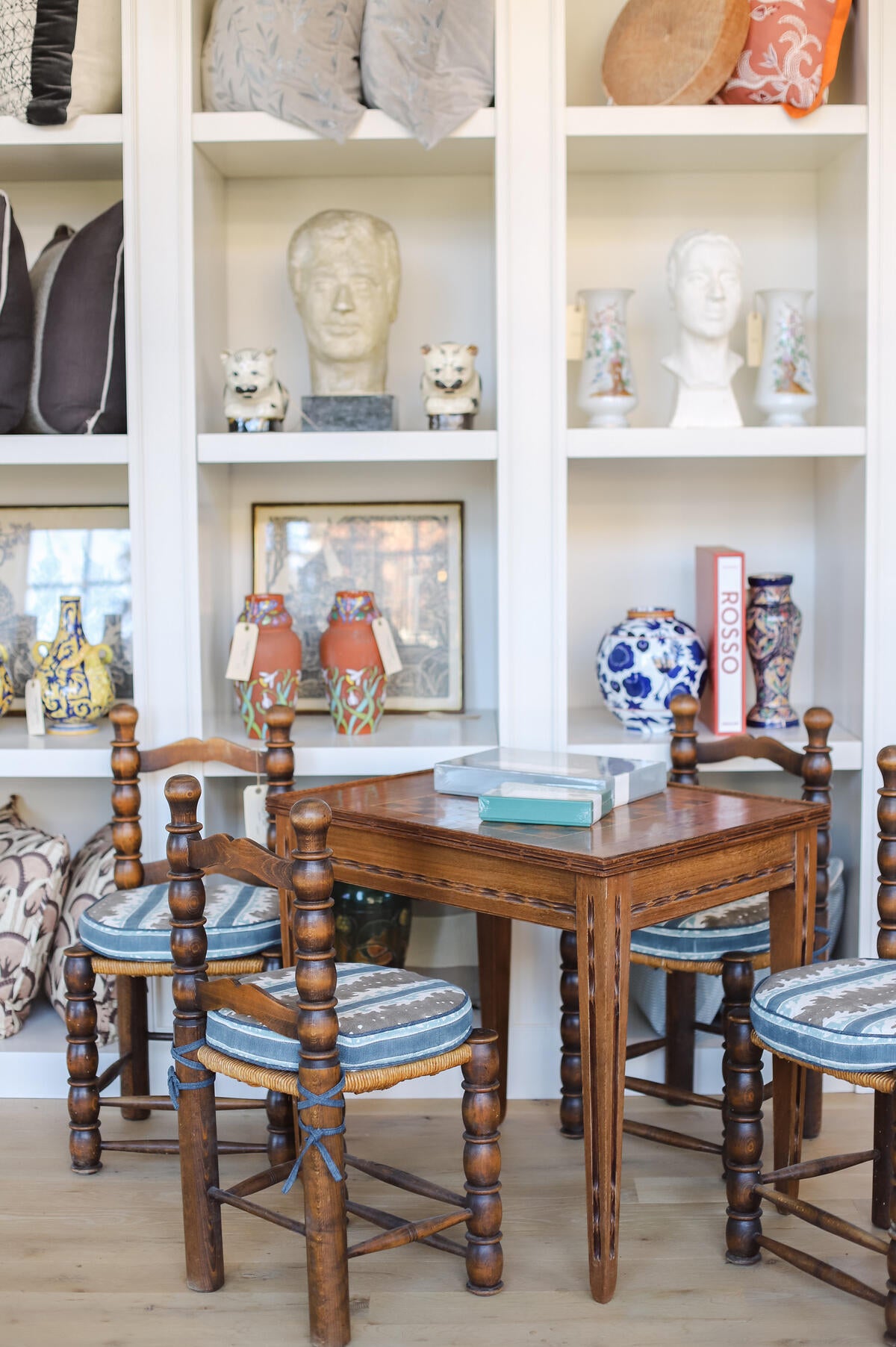
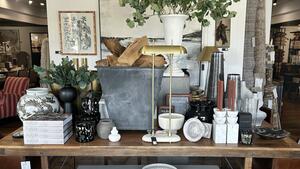
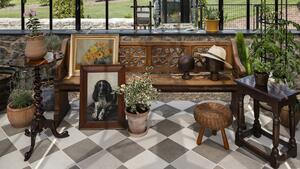
We go to Europe four or five times a year and bring back containers of antiques. I make a point to purchase a lot of accessories when I go on these trips. In my design work, I feel like I cannot find enough to make somebody’s room look different than the next person’s. That probably sets us apart from other retail stores.
What’s your sourcing process like?
Sourcing antiques is a bit of an oddity, because you’re just buying what you see that you think you could sell. It’s a race these days, because more and more people are getting into the business. You’re competitively buying; you’re not debating something for 30 minutes. If you walk away, the next person’s going to buy it.
Going to people’s warehouses out in the country is a little bit easier. However, nine times out of 10, what you buy needs a little work and repair. It’s taken us a minute to find people in the United States, or at least in our area, who have the skill to work on antiques. Since we partnered up with the upholsterer, we have grown to a team of five people in-house. Separately, we have a drapery team and seamstresses. Now, it’s more fun to buy chair frames in Europe and have the capability to turn them around pretty quickly. That’s been a very successful wing of the business.
What about sourcing the art?
We reach out to some artists, and people approach us as well. We look at the work and see if it fits our design aesthetic, and make sure it doesn’t overlap with a person we’re currently representing. For vintage art, I just buy whatever I like.
When did you realize that things were going well enough to expand?
We have had the new store for a little over a year. That was a [design] retail store that had been there for 30 years called Richard Tubb [Interiors]. Richard decided he was ready to retire, and he was so thoughtful about leaving his staff. He came to me and said, “Do you need anyone?” I said, “Well, I’d rather just leave your staff right there and have your store.” It was a no-brainer on my end, because I already had the inner machine: a warehouse where we did our own receiving, a box truck, a van, warehouse staff, the upholstery and drapery teams.
Adding [this] store gave us one more place to display product. I don’t buy deep—I don’t get 12 of a sofa—but I can only put so much in the store at one time. I have to have backstock, because as we sell, the stores get holes in the vignettes. It just made better use of our overhead. Also, Richard [represented] certain lines that I was excited to acquire, like Lee Industries. It opened our list of vendors.
Who are your typical customers, and how much is the trade?
It’s probably half-and-half. We’re in a location near a big farmer’s market on Saturdays, so you can walk your dog through our store, get a cup of coffee, whatever. People enjoy coming in and looking, and we welcome that. I don’t ever want people to feel like they have to buy something. But the trade is a large part of our business—and actually, in the last several years, we’ve been selling a ton of art to the trade online, so we’re doing a lot of packing and shipping.
[When I started] I remember being so nervous about putting the artwork online. Back then, it was viewed as unsophisticated. It was a pretty risky decision. We had to approach each artist carefully and say, “We feel like this is the way to go. Let us know if you feel it taints your business.” Now we sell half of our artwork online.
You just renovated and rebranded Galerie Odette in June. Why?
[With the gallery and Odette Collective] we have been working with two different inventories and two different websites, and I think we realized it was just a very inefficient waste of time. Most of the people shopping online don’t live here, and don’t care if this item is in this store or that store. We were moving toward simplifying things. It all lives online and it’s all one. It’s different branches of one brand.
And why was a presence at High Point important to you?
It’s great exposure. High Point has gotten more and more designer-friendly, and less and less [about] retail stores. My design customers hardly ever even walk in my store, so I pick things and take them over there. To get in front of designers, as far as awareness goes: Our website is nice, organized—and we have all of these products available with good photography, good dimensions. I’m hopeful that we can be a good source to designers who don’t live in Birmingham.
What is the Birmingham design scene like?
The talent here in this small town is over the top. Architects are phenomenal. There’s a ton of interior designers. Our talent outshoots our coverage a little bit. The taste level of the people—not even just designers!—is really amazing. I think we have greater or equal talent to Atlanta, New York, Chicago or Los Angeles.
If you flip that over to my retail situation, I do not think you could pull off what I’m doing in a bigger city, because the expense would be off the charts. There’d be no way it’d be profitable. The way 18-wheelers can come in and out of the parking lot, drop off merchandise or leave a container … And our warehouse is two blocks from this shop—I’ve got somewhere around 70,000 square feet of space. You couldn’t do that in Atlanta, New York, Chicago or Los Angeles. I don’t even think you could do it in Dallas. That is one part of why my business is successful here.
Tell me about working with your kids.
I had five kids in six years, so they’re close in age. My oldest son does not work for me, but his wife does our Instagram, website and photography work. The middle two boys [who still work with me now] graduated during Covid, when I was so busy and couldn’t keep up with my work, so I was like, “Will y’all just come help me for a year or so, and then you can work somewhere else?”
We have a blast. Everybody has their lane of what they’re good at and what they do. And because I have been in business for a long time, I’m less of a control freak and more laid-back than I would’ve been 20 years ago. Everyone I work with is younger than me. But I think there’s value in letting people learn and do it in their own way, rather than me with my thumb constantly on top of somebody. I don’t want to sound like we’re a big happy family, but we have learned how to politely argue. We don’t make it weird for the other staff. We almost act like we’re not related when we’re at work, just to keep that boundary.
Whoever in my family would like to work here, I would like to find a spot for them. They might work part-time. … They might go try something else for a little while and come back. But I love working with family. I extra love traveling with my family to Europe to buy antiques. I don’t know that I would enjoy that process as much if I had to go by myself. Right now, it’s just fun.
This sounds like a dream.
It would be different if everyone were 40 or 50, and you were working with people who had already developed their career. I [hired my kids] when they graduated from college, so they didn’t know what they were doing. You know what I’m saying? You are teaching them a work ethic. I work really hard and I model that behavior for everyone on my staff. We work hard, and no one’s annoying.
What are your dreams for the future of the business?
In the near future, I’m trying to develop new styles of furniture produced fully in the United States. That has been a little challenging, because while all the tariffs are trying to get things back to the U.S., there are not that many people still in the furniture-making business. They’re backed up, and lead times are long. Finding the right people has been a challenge, but I think I’ve about cracked the nut.
And then I’m just hopeful we can grow the online antique business. I’ve seen what happened with the art business and how we doubled our sales. I love buying. I love sourcing. We have fine-tuned our skills and our staff and I feel like, OK, we’re ready to actually get more product and get in front of people who don’t just live in our immediate community.
At a time when everyone is very doomsday about retail, why do you stick with it?
I think it’s close to impossible to make money at retail, period—whether it’s clothing or dishes or tabletop or furniture. You probably cannot sell as much merchandise as your expenses are. So typical retail is just dead. Deader than dead. It’s so much work, and you don’t make that much profit to make it worthwhile. I think what saves us is the one-of-a-kind items, and the interior design business, and our own furniture collection. It’s not like you can go somewhere else to buy what we have. Obviously, if that were to stop or slow down, I might reassess.
Our warehouse rent per square foot is not that different than our retail store rent per square foot. So in my mind, if we want to have a great online business, why would I be storing all this stuff at a warehouse where no one can see it? I may as well have it out for people to come look at. I may as well have a store.
Clearly people are making more money having fewer items for sale, but my problem with that is it’s a little bit of a lower-end product, and mass-produced. While I do want to be profitable, I’m probably working because I enjoy it more than working for the dollar.
What is your favorite kind of day at work?
I have two answers. One: Even though my staff would want to pull their hair out at me saying this, I love a rearranged day, an overhaul. I’m talking about a flat-out, let’s gut the whole thing, let’s change every rug, let’s vacuum every inch. Let’s get the baseboards, move everything around, just completely turn it upside down. It’s not even a day, because it takes more than a day. But that is the greatest thing to me, to rearrange.
Two: Nothing is more satisfying than helping a customer get their home to a point where they are happy with it. A walk-in customer who buys some things, and we get to deliver it and help them rearrange and use their old furniture mixed with whatever new thing they got, and they’re just so satisfied? That’s very rewarding to me.


 Withdraw Consent / Manage Privacy Preferences