













Hugh and Susannah Cameron arrived in Provence speaking a strange kind of French. The two, a married couple from Australia, had purchased a fixer-upper, and were moving to the South of France in search of a new kind of life. Their plan was a mix of impulse and meticulous preparation: The Camerons had bought the house at the end of a rapid-fire four-day search, but they spent the next nine months cramming with a French tutor in Melbourne, with a special focus on the language of residential construction. “We had a very odd vocab,” recalls Susannah. “We couldn’t order a glass of wine in a restaurant, but we could ask for a hammer.”
The Camerons were leaving behind successful corporate careers with a tacit understanding that if things didn’t work out in the lavender fields, they could always slink back and rejoin the rat race. But after spending a year acclimating to life in Provence, they decided to reject a job offer that would have allowed Susannah to fly back and forth between France and Florida.
“We suddenly had this purpose, where our main life goal was to continue to live in this little French village,” says Hugh. “It’s that old proverb about the army burning the ships so they have to stay and win the war. How could we set up a life where we could earn an income [from there]—we just couldn’t fail.”
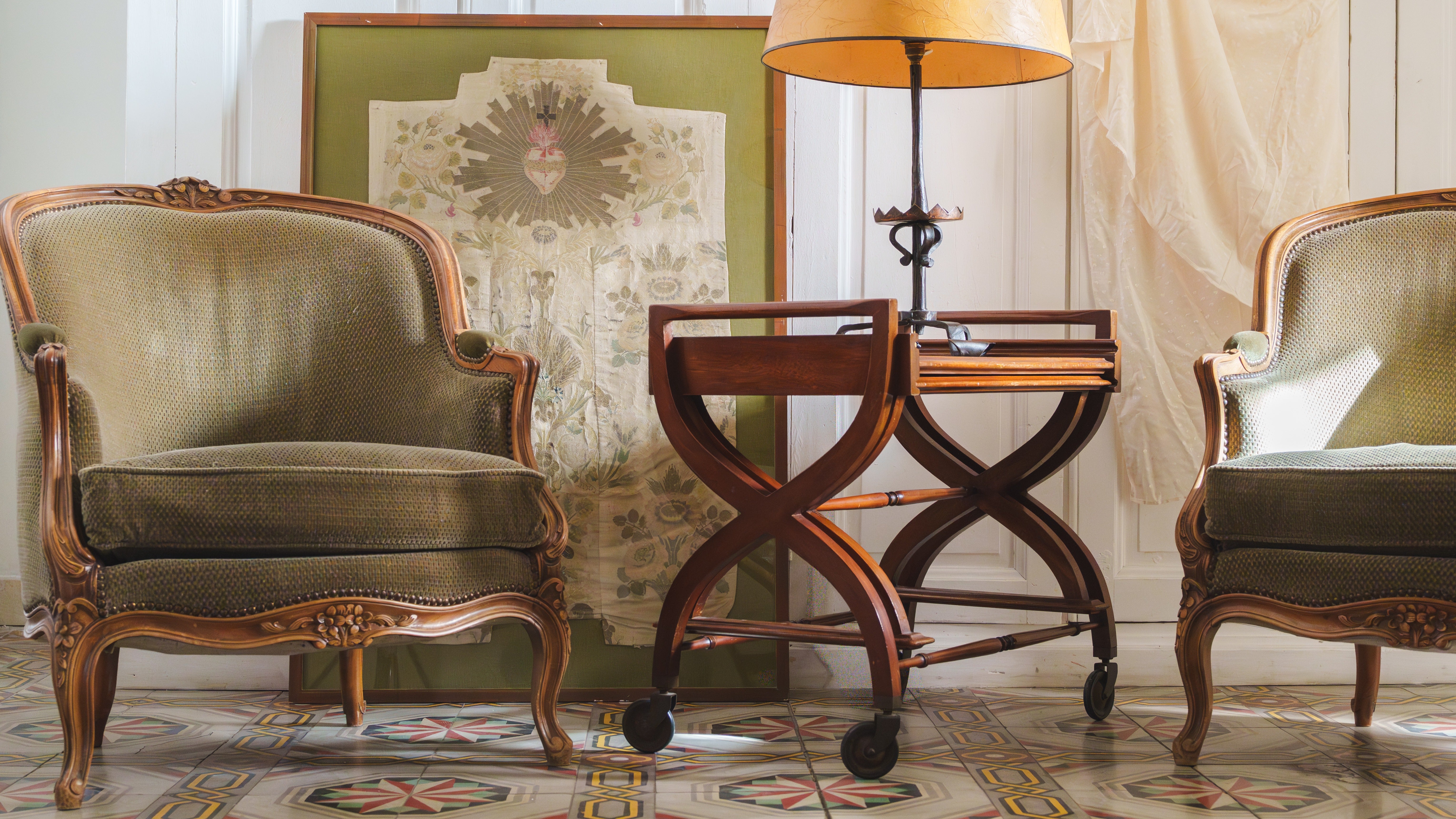
Luckily, the Camerons didn’t have to fight a war, they just had to sell antiques. In 2016, they launched Chez Pluie, a business dedicated to curating French vintage pieces and selling them online, largely to American buyers. It was scrappy—the two tested the market by listing on eBay while they tried to develop a network. “It was really hard,” recalls Hugh with a laugh. “We had no suppliers and no clients.”
Though it was not long ago, in the old-school world of French antiques, 2016 often felt more like 1996—the Camerons helped some dealers set up their first email addresses. In other words, a certain amount of digital marketing savvy gave them an edge. But they were hardly the first to try to sell French antiques online. 1stDibs had beaten them to the punch by more than a decade, and European marketplaces like Proantic and Pamono were up and running by then—not to mention countless individual dealers and galleries with their own online presences. This was not an empty playing field.
As they sussed out the marketplace, the Camerons realized there was an intriguing pain point in the business—and a white space behind it. “The thing that was really shocking to us early on is that people were expecting a percentage of their shipment to arrive broken,” says Susannah. “It was just part of the deal. And we didn’t want to break something that’s two or three hundred years old in a week’s transit.”
“The biggest area where a lot of people in this business come undone is the logistics,” adds Hugh. “Everyone tries to [solve] this by outsourcing their shipping. We tried every available shipper and none could provide the level [of quality] we were trying to give our customers.” So the Camerons decided to do it themselves.
The business of shipping antiques from France to America is not exactly an empty playing field either. However, the market has a barbell shape, with a lot of concentration at both ends of the spectrum: shipping a few small pieces, or filling entire giant containers. The Camerons decided to focus on the underserved middle, for customers who wanted to order a few midsize pieces—and get them quickly.
Chez Pluie’s approach is to pack everything in-house, often building custom-sized timber crates with internal padding. “In our experience, no matter what you do, you have an individual forklift driver at some point in the chain who makes a mistake. So the key is to make the packaging as bulletproof as possible,” says Hugh.
The order is then sent to Paris, and often shipped through FedEx to Memphis, where it’s then delivered to customers’ doors, sometimes within a week, with Chez Pluie acting as the importer of record. It’s certainly not always the cheapest option, but having a relatively simple chain of custody, say the Camerons, is not only quicker than a container; it also cuts down on the hassles and risks.
“You often have all these complications around customs because you’ve got different recipients sharing a container,” says Hugh. “You could have one item that requires fumigation because it’s not up to standards, and then everything needs to be fumigated, and the breakage rates are higher because you’ve got more people handling it at multiple stages. … We found that when we asked those shippers to help with sending our items, they would often say things like, ‘Well, we can get it to the nearest port, and your customer needs to drive to the seaport and pick up the item from there.’”
As Chez Pluie grew, the company found another edge, this time in marketing. While large platforms had serious marketing budgets to spend on digital ad campaigns, the Camerons were bootstrapping their business. And while individual dealers and influencers built big followings on social, the duo were not “the performing type of people,” says Susannah with a laugh. “I don’t want to be filming myself running around doing backflips in antique markets. It’s not me, probably to my detriment.”
Instead, the Camerons decided to narrowly focus on SEO, so that when searchers typed “French antiques” into Google, Chez Pluie would come up near the top. They had a simple strategy for clawing their way up the ladder: tons and tons of customer reviews. “One of the biggest levers in SEO is how good are your verified client reviews that are left behind after a purchase,” says Hugh. “We use Trustpilot, which is hooked into our online store, which we give Google direct access to so Google can see real customers leaving the real reviews.”
The arrangement became a simple flywheel. If the Camerons could deliver a shipment quickly and successfully, then add a touch of delight (they’ll often include a gift, like a locally made lavender soap), first-time customers would be more likely to leave a glowing review. Reviews would help them rank higher in search, which would convince other first-time customers to take a chance. Rinse and repeat.
A decade later, what started as a scrappy business has become a bustling operation. The Camerons employ 10 locally, and have constructed a purpose-built warehouse they use for packing and shipping. They’ve also spun up a side business, Provence Export, that allows clients to use their logistics operation for purchases through other antique dealers. And though early customers were mostly homeowners, the business has come to be split evenly between consumers and designers, and Chez Pluie now sells to some notable names in the trade, including Corey Damen Jenkins, Ariel Okin and Neal Beckstedt.
Looking ahead, the Camerons want to keep up the growth at an even clip. “At the time we started, there was capital floating around everywhere,” recalls Hugh. “I remember at the time feeling sick in the stomach because I was looking at some of our peers who also launched businesses around about the same time as us, and they were scaling a lot quicker. … But if we had [raised capital,] I’m convinced that we would have failed. As it is, we made all of our mistakes in our early years on a small scale. If we had gone out and got external funding, we would have made mistakes on a huge scale. … In hindsight, now, 10 years on, we’ve had steady growth over a decade, and we’re in a much stronger position.”







 Withdraw Consent / Manage Privacy Preferences