




Gary Friedman favors bold moves. Three years ago, he opened RH’s first overseas location in the remote English countryside, on a spot of land frequented by more deer than people. Debuting the company’s first Italian gallery in the thick of Milan Design Week was audacious in exactly the opposite direction. RH Milan swung its doors open for a grand party at the precise moment that the design world’s most discerning minds and sharpest critics were all in town, ready to pounce.
This being an RH party, there were celebrities, liberally poured Vesper martinis, an ice bar loaded with caviar, and a famous French DJ. This being Milan Design Week, there were lines outside. One was for ticketless local fans hoping to get a glimpse of Margot Robbie—she dashed by in Armani—another for partygoers impatiently waiting for security to give the go-ahead. The building, it seemed, was crowded.
I waited alongside two jovial Milanese tax accountants who seemed to have no idea what RH was, but were nonetheless thrilled to be there. A chic older woman, dressed in red, emerged from the party and called out something in Italian to the waiting crowd. My accountant friends translated: “She says it’s fabulous and crazy in there.”
Milan is a critical stop in Friedman’s campaign to conquer Europe. Though the company first established a beachhead in the Cotswolds and has debuted galleries in Munich, Dusseldorf and Madrid, the linchpin of the strategy was always to open blockbuster locations in three of the continent’s most stylish—and richest—cities: Paris, London and Milan.
Based on his rhapsodic descriptions of the gallery on earnings calls, it’s clear that Paris—its RH gallery opened last fall—is near and dear to Friedman’s heart. But Milan matters too. The city is a fashion capital of Europe, an architectural mecca, and the spiritual home of Italy’s storied design industry. A video “letter to Milan” announcing the gallery proclaimed: “In Milan, the measure is mastery. This we know. And have designed accordingly.”
RH Milan sits on a dramatic corner of Corso Venezia, one of the grand boulevards framing Milan’s fashion district. The building it occupies is, quite literally, a palace—a neo-Renaissance residence built for the prince of Piombino, all arches, columns and aristocratic grandeur. In more recent years it has sat unused, adding to the sense of anticipation for locals.
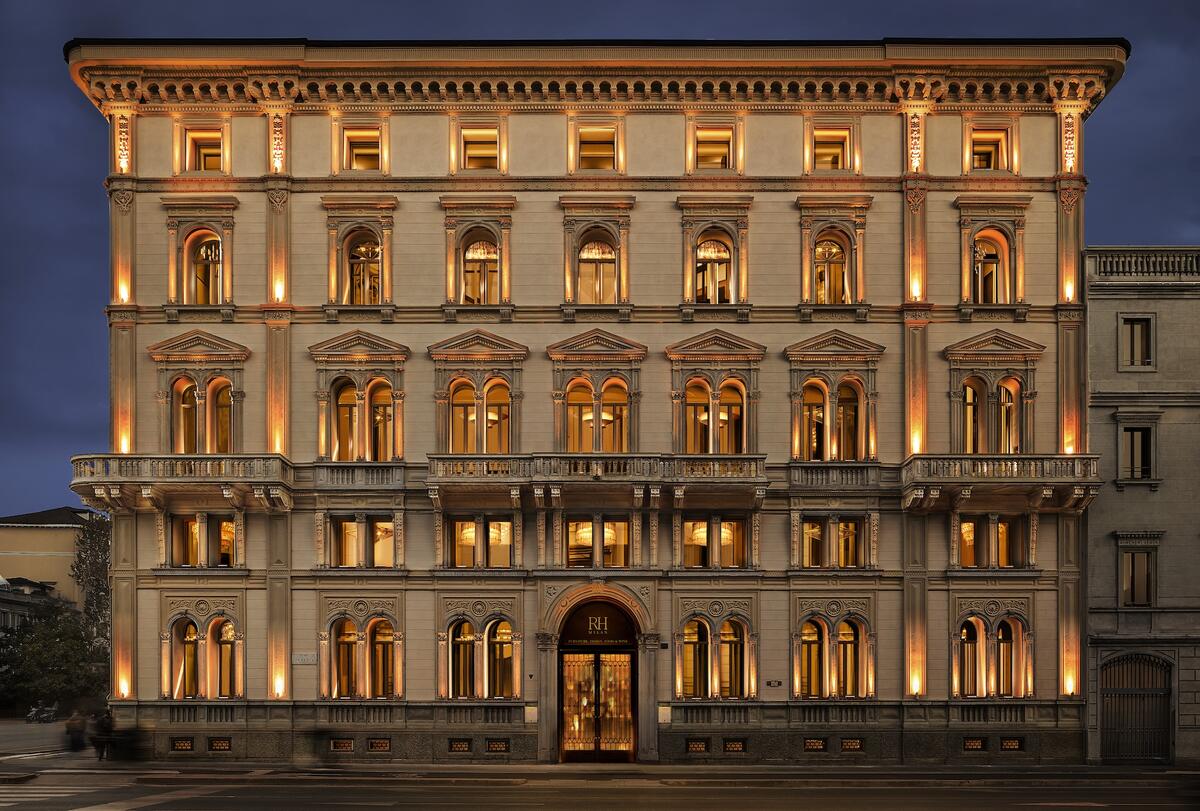
In the days leading up to the party, there had been rumors bouncing around Milan that RH was behind schedule, and that the gallery wouldn’t be ready for its own debut. But save for a few strategically placed curtains blocking off a room or two, it was hard to detect any signs of last-minute panic. It looked and felt very much like what it was: a carefully refurbished 19th century palazzo full of 21st century furniture.
It would be wrong, however, to say that I—or anyone—was able to get too close a look at the finials. The party was packed with a wall-to-wall mix of Italian society figures, designers, and the stray editor. Brunello Cucinelli made an appearance, as did architect Piero Lissoni. My accountant friends gave me the thumbs-up from the caviar bar.
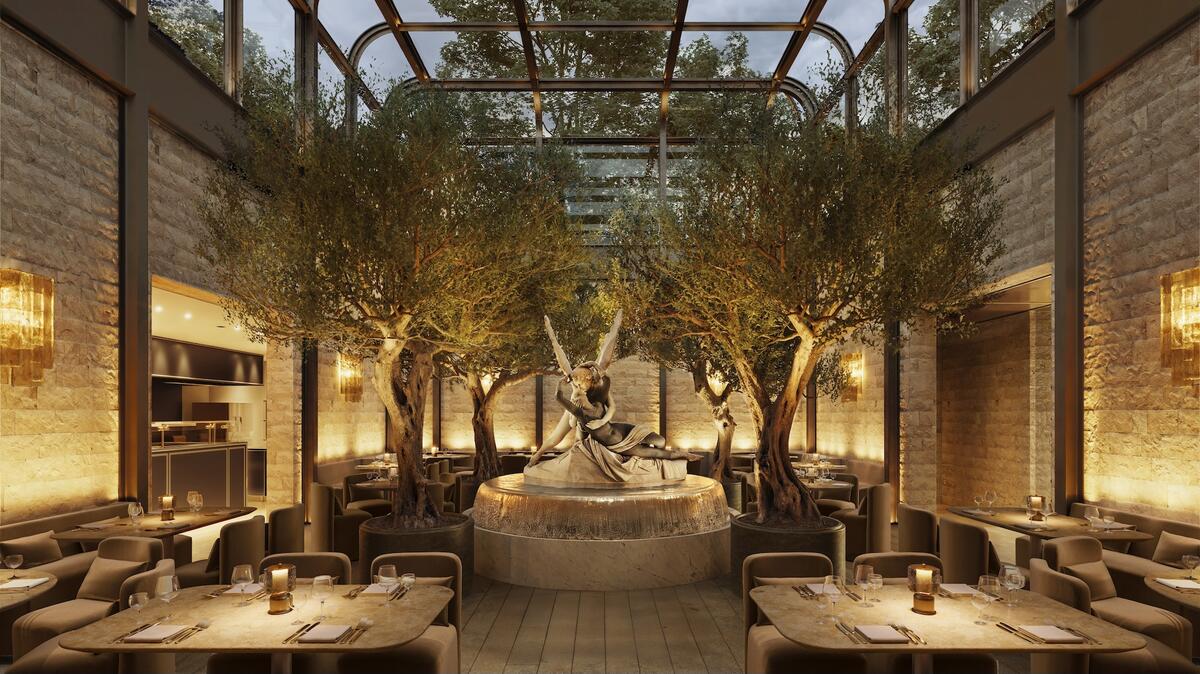
Wading through the crowds, I did my best to take in the palazzo’s seven levels, including a subterranean restaurant with a vaulted steel-and-glass ceiling poking out into a tree-lined courtyard. Like most of RH’s recent galleries, Milan is laden with features, including a wine bar, a rooftop terrace, and a dedicated office for its interior design division. On the ground floor, there’s an architecture and design library with an important modern printing of De Architectura by Vitruvius. Amid the throngs, I didn’t catch it.
It’s been observed that while RH’s grand Parisian gallery is heavy on hospitality features, it is relatively light on actual furniture. The same can’t be said of Milan, which felt chock-full of room settings, sprinkled liberally with statuary, including an enormous head displayed like a spoil of war atop a hearty stone table. Behind it, a white sofa.
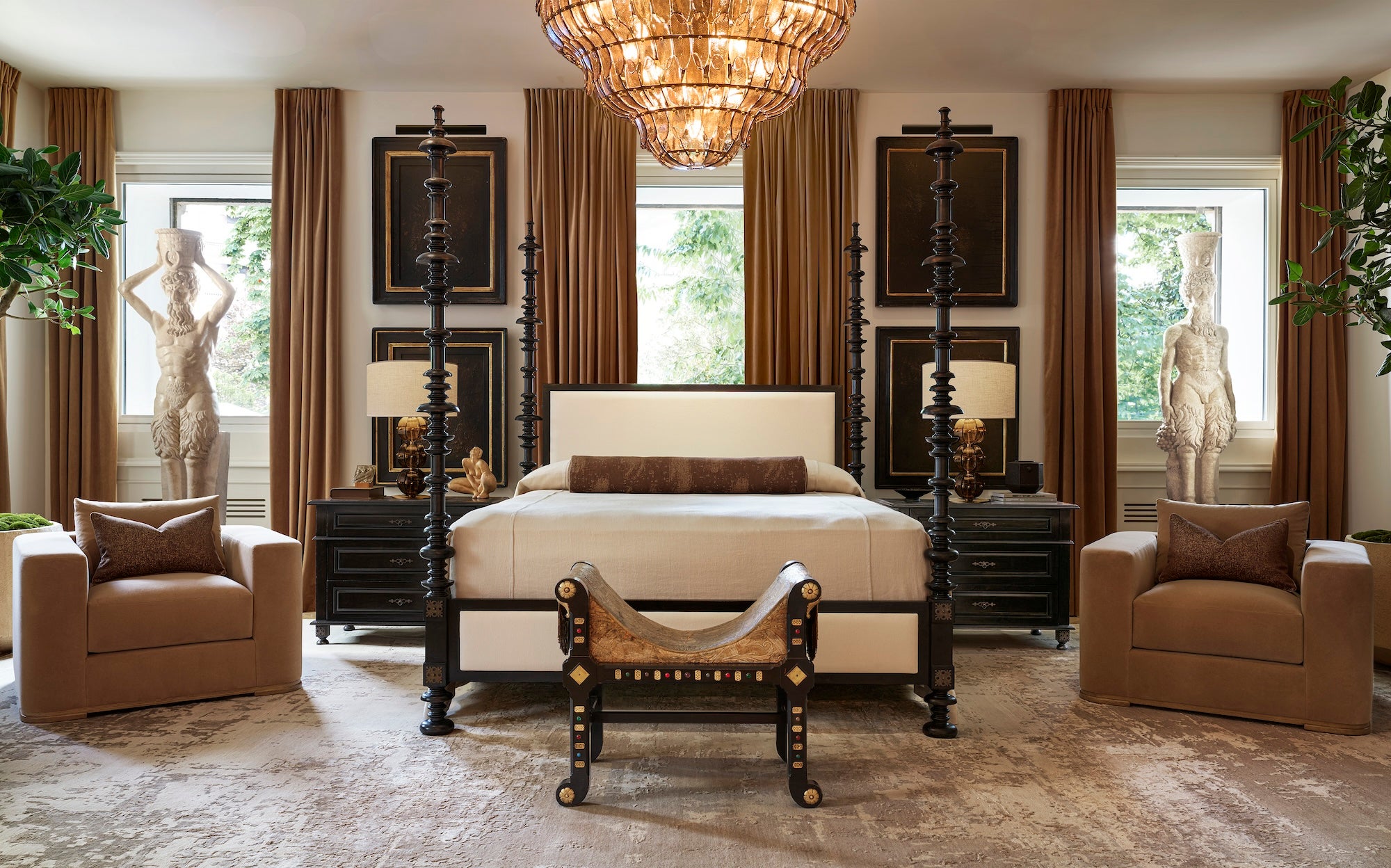
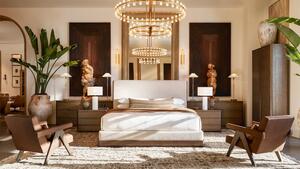
The party also marked the debut of RH Estates, the new traditional-leaning line that Friedman has said could be the biggest launch in the company’s history. Pieces from the collection were placed throughout the palazzo, including a grand four-poster bed designed by Richard Hallberg and Daniel Cuevas, the duo behind RH’s recently acquired Los Angeles trade favorite, Formations.
For the big event, RH had tapped Milanese institution Bar Basso—the unofficial late-night watering hole of Milan Design Week—to serve fizzing Negroni Sbagliatos next to a replica of Basso’s iconic neon sign. I got a few snarky texts about the decision to miniaturize a local institution only blocks away from the real thing, but the bar was busy.
And this was not a gathering for the snarky. In the building’s courtyard, a disembodied voice announced, “Straight from headlining Coachella … Hugel!” Music throbbed from loudspeakers, and the crowd began to sway. I kept catching locals making a version of the same expression—a mix of delight and confusion, a face that seemed to say, Wait, this is a furniture store?
Whether they’ll shop there is the mystery. The now-familiar critique that RH’s furniture is simply too big for European homes was repeated to me every time the subject came up. And there was a certain audacity, people told me, in an American company trying to sell sofas to Italians. (“Everyone here says they have a guy who will do it better, for less.”) On my way out of the festivities, I approached two sharply dressed women who had just slipped out themselves. Their review was pithy: “The party? Yes. The building? Yes. The furniture? No.”
At a dinner the next day, however, I spoke to a local designer who had a more nuanced take. He was somewhat skeptical of RH’s razzle-dazzle, and perplexed by the business model, but pointed out that the brand relied on some of the same Italian factories he did for upholstery. Moreover, the designer told me, yes, there were in fact a few RH pieces he would buy.
So, we’ll see. As Friedman has pointed out on earnings calls, the company’s bread and butter isn't really city dwellers anyway, but suburbanites and second-home owners who fill their rooms, floor to crown molding, with RH. Though the company took pains to find the right address in Milan (and to photograph the city’s notables at its opening party), the target market likely lies outside the city limits.
Or perhaps it’s farther away still. One of the core reasons to come to Europe in the first place was to place RH in the same cultural context as brands like Hermès, Louis Vuitton and Chanel. If it works, the luxury halo will hover over the company wherever it does business—including back home. Maybe the real audience for RH Milan is not a Vespa-riding Milanese sophisticate, but a well-off American tourist, in the city for the weekend, picking up ideas for how to decorate her six-bedroom home in Dallas.
We’ve seen this before. RH’s playbook—meticulously refurbish a palatial historic building, pull out all the stops for a dazzling opening-night party—is established. The critiques—locals won’t go for it, the stuff is too big—are baked in as well.
What has changed is RH’s financial position. When the company unveiled its Cotswolds estate, RH stock was off its Covid home boom highs but holding steady. Investors—many of whom were on hand in England to sip Vesper martinis and sway to the music at the launch celebration—seemed inclined to give Friedman the benefit of the doubt. Three years later, share prices have shed half their value, and the stock is hovering just above a five-year low.
RH’s most recent earnings report was rough. The company missed both its revenue and earnings-per-share targets, and pulled back on its forecast for the coming year. The day the report was released, shares tumbled 17 percent in after-hours trading, and some analysts have cut their targets even lower. Investors are getting impatient.
RH’s financial woes are not solely a result of its European campaign. In the U.S., we remain stuck in a brutally frozen housing market (the worst in 50 years, by Friedman’s reckoning) that has chilled the entire home industry. The company is also sitting on a mountain of debt, and has grappled with tariffs like the rest of its peers.
But Europe has undeniably taken a toll. In its most recent earnings release, RH suggested that its international startup costs would drag down its adjusted EBITDA margin by 270 basis points over the coming year (in plain English: they’re spending tens of millions to open these galleries). Meanwhile, aside from a few dribs and drabs, the company has not shared much hard sales information from its overseas adventure.
Soon Friedman will complete his trilogy and open a London gallery in Mayfair, just off Savile Row. Predictions: The interiors will be meticulously staged, and the opening party will be a banger. A DJ will keep fashionable Brits dancing. Someone will make a crack that the beds are too big for a London flat while spooning up free caviar.
But for close watchers of the company formerly known as Restoration Hardware, the most intriguing question won’t be which celebrity swans in to toast RH—but what numbers show up in its next earnings report.



 Withdraw Consent / Manage Privacy Preferences