








Exactly one year ago, Donald Trump took to the Rose Garden wielding a poster, and the world trembled. It was “Liberation Day,” and the president was announcing a sweeping array of tariffs on countries across the globe. Vietnam: 46 percent. Switzerland: 31 percent. Angola: 32 percent. It was only the beginning.
The tariffs were not a complete surprise. Trump had already made use of them in his first term, and his reelection campaign was heavy on tariff talk. But the speed of their implementation and haphazardness of their application—not to mention the wild swings in numbers in the days and weeks that followed—had the home industry reeling. Tariffs became the inescapable news story of 2025.
Twelve months later, they occupy a strange space in the collective consciousness of the design business. Tariffs clearly matter, but the industry has kept calm and carried on. Prices went up, but not as much as many feared, and affluent clients kept spending. A handful of businesses went under citing tariff pressure, but there was no mass wave of bankruptcies. Everyone is tired of talking about it—the subject has lost some of its oomph at cocktail parties.
Two things are true: The tariffs were an industry-changing black swan event and if you walk around design centers and job sites, you might not think much had changed since March 2025.
Of course, the story’s not over yet. The Supreme Court’s recent ruling has already kicked off a scramble for refunds, and likely inspired the administration to pursue new tariffs under new laws. It will be years before we can look back clearly and truly assess just what mattered and how much. But a one-year anniversary is a good excuse to explore what the tariffs have actually meant to the design industry—so far.
Small Businesses Took the Biggest Hit
In every respect, tariffs have been harder on small importing businesses than on large ones. Small companies have less leverage with their vendors, less free cash to pay hefty tariff bills, less credit to borrow to pay hefty tariff bills, less margin to sacrifice, and—obviously—fewer employees on hand to grapple with it all. For many, the past year has been a white-knuckle affair.
“We had just done a trade show, and we had all these orders that were being manufactured in our studio in India,” recalls Deepali Kalia, a co-founder of the Portland, Oregon– and Delhi, India–based textile brand Filling Spaces. This was just as the administration announced a shocking new 50 percent tariff on imported goods from India in August 2025. “It was very tough, but we couldn’t go back to all our customers and raise prices, and all our artists are in-house, they’re like family.” Instead, Kalia, her husband and her sister—who all work in the business—took pay cuts.
Tariffs roil other parts of a small business, as well. “It’s not necessarily that the higher costs have been the problem; it really is cash flow,” says Winn Galloway, who, alongside his wife, Lindye Galloway, runs the Newport Beach, California–based furniture brand Le Maé. While the duo, who make most of their furniture in Vietnam, were able to fold tariff costs into their business, having the actual cash on hand to pay the bill at port was a continual challenge. “When capital requirements increase like this because of tariffs, it naturally favors scale and efficiency,” he explains. “And that’s just the reality of it. My hope is that the industry continues to make space for both larger platforms that operate at scale, but also smaller brands like ours that push design forward.”
Cara Barde, president of Crow Canyon Home, is more blunt. The San Francisco–area enamelware company’s product, which is manufactured in China, was subject to not only country-specific duties but also a 50 percent charge on imported steel—duties too steep to allow her to maintain the boutique brand’s status quo. The most stark adjustment: She has laid off five employees over the past year because of tariffs. “It changes the math on the entire business,” says Barde. “The impact of tariffs on my business has been devastating. The cash flow piece is what keeps me up at night. We have to pay for the goods and the tariffs upfront, sometimes months before anything actually sells. So my job, which used to involve a lot of thinking about strategy and growth, has basically become figuring out how to keep the lights on, manage what we owe, and figure out next month.”
Designers Adapted
Clients having access to information has not always been seen as a positive in the design industry, but it has certainly helped during the tariff era. Most designers say their clients were up to speed on the news, understood the reality of tariffs, and came to accept them as an add-on charge to budgets.
While prices for most home goods did not skyrocket over the past year, they certainly went up, and the cumulative effect is simply that clients get less for their money. “I would say it’s somewhere around 30 percent more expensive this year to do a remodel than it was last year—even for furniture,” says Portland, Oregon–based designer Kevin Twitty. “[Clients are] still spending the same amount as they were before, so what that does is it shrinks our projects or updates our scope.”
To combat the effect, Twitty shifted his sourcing strategy to focus on going deep with a smaller number of vendors, which allows him to get better pricing. Others ramped up their use of local workrooms and vintage furnishings. Through it all, designers honed their communication chops, learning to work uncertainty into presentations without killing the vibe.
“I always say when I present: ‘This piece is from [this country] and it will take longer,’ or ‘It’s coming from [this country] so there’ll be a tariff or a tax,’ because I don’t want a client to fall in love with something that I can’t get expeditiously or without an outrageous price tag,” says Lindsay Olson, founder of Newport Beach, California–based Lulu Designs. “I’m not going to bury the lede.”
U.S. Makers Got a Look
A year ago, Gat Caperton was cautiously optimistic that tariffs could play a role in reigniting American manufacturing operations like his own. Today, the owner of the West Virginia–based furniture brand Gat Creek is still encouraged about the possibility—but the impact of the tariffs has been modest. Caperton says his revenue is up, but that he’s been cautious about not trying to get ahead of growth: “Someone that comes to us because they want to avoid high tariffs are highly likely to be the same people who run away from us when tariffs go down.”
His experience echoes that of many U.S. manufacturers over the past year. Most have seen a surge of inquiries as retail buyers look to diversify their supply chains, but the interest has rarely turned into a revenue bonanza or an explosion in hiring. His hope is that, in the long run, a renewed interest in American makers will pay off. “There is a greater appreciation today for American-made things than there was a year ago,” he says. “I think we get a lot of indirect benefit from it.”
Time Was Wasted
At the onset of the tariffs, the focus was on percentages and dollar figures. But for many companies, the real cost can be measured in minutes and hours. Home furnishings executives discovered that through a combination of cost sharing with vendors and belt-tightening, they could avoid massive price hikes and the subsequent revenue hit. However, the time spent re-sourcing, filling out customs paperwork, reading up on new policies, and communicating with shipping agents would never be recovered.
The time suck of tariffs is still going on today. “We can send two packages with the exact same documentation, and one will inevitably get stuck because someone did not review a document properly or suddenly needs something additional,” says Mallory Solomon, co-founder and CEO of Salam Hello, a Moroccan brand that exports rugs. “It has created a lot of unnecessary work on our end, along with delays for customers, which has been incredibly frustrating.”
Designers aren’t immune to the time sink, either. Olson estimates that she’s spent 20 to 25 percent more time over the past year tracking down alternate products from domestic vendors or antique dealers to bypass tariffs, or negotiating for lower shipping costs. “Sometimes we can double- or triple-bid the freight to try to get a less expensive cost, but on the back end, it’s really time- and labor-intensive for us to do that,” she says. “It’s been a very cumbersome extra five steps of project management.”
It’s difficult to measure the precise impact of these lost hours. Still, there’s no question that there were countless new products left undesigned and new ventures quietly shelved because a famously creative industry was busy with paperwork.
The Map Shifted
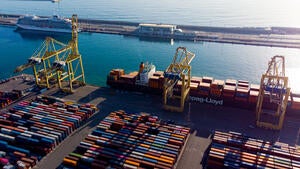
Even for professionals who specialize in sourcing and logistics, it has been difficult to keep track of the wildly shifting tariff landscape of the past year. But there’s no question that companies have looked to re-source their imports to minimize the tariff burden, and that most of the movement was away from China. The manufacturing powerhouse exported $130 billion less to the U.S. in 2025 than it did in 2024. By contrast, Vietnam exported $57 billion more. To some extent, these shifts were already underway—and their real effect is complicated, as a good portion of Vietnamese furniture manufacturing is owned by Chinese companies. But the tariffs had a real impact on where America’s home goods are made, which will be felt for decades to come.
Everyone Got Better
Most of the industry businesses that have had to confront tariffs in some form over the past year wish they hadn’t. But almost universally, leaders say that dealing with an uncertain landscape made their operations stronger, or helped reinforce a core conviction.
“It’s scary when changes like that come at you and you’re a small business,” says Galloway. “It required a level of intentionality that, frankly, made us better, and for that, I’m grateful. We’ve become much more thoughtful about reorders, MOQs, and really planning out our buying in a much more detailed, calculated way. It forced us to refine some of our internal processes and systems: how we go about developing new products, but also how we go about reordering existing products. … In that sense, it’s impactful in a good way—it just made us a little bit smarter.”
Kalia says that while Filling Spaces could have shifted to digitally printing its collections for far cheaper than importing hand-blocked textiles from India, contemplating the change reinforced her faith in the business. “We could have done it for a fraction of the cost, but that’s not the core of our business,” she explains. “We can’t water ourselves down. It’s very personal. This period has made us realize we have to double down on our strengths.”
Additional reporting by Caroline Bourque








 Withdraw Consent / Manage Privacy Preferences