



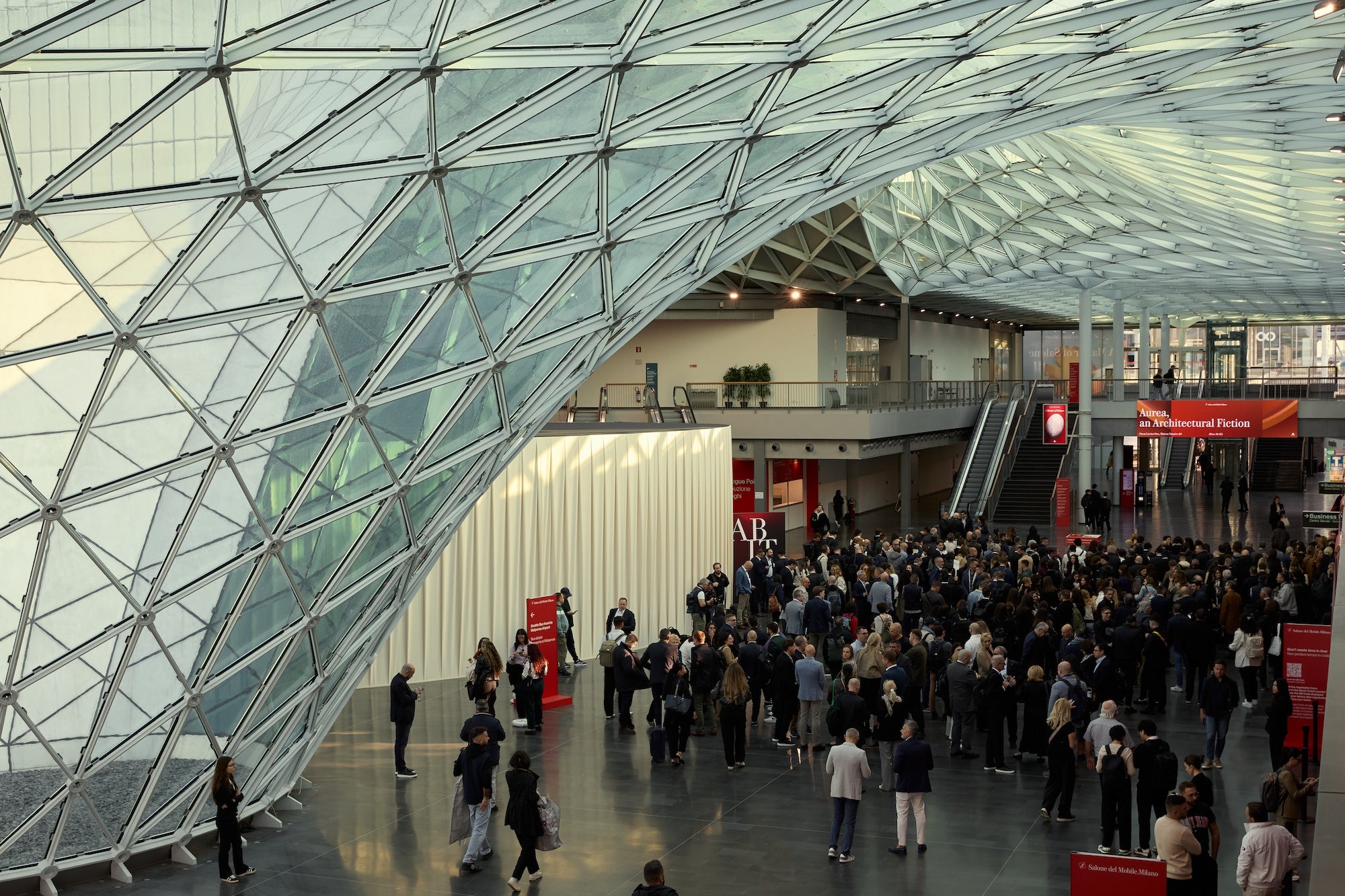

Last year, the knives came out for Milan. In a scathing editorial, Dezeen editor Max Fraser wrote that the city’s design week had become bloated with “superfluous stuff” staged in “vapid installations.” Philippe Starck was apparently shocked by the degree to which luxury brands had taken over the city. You heard the same from designers and editors who had been going for years: The world’s biggest and most prestigious design event had become overcrowded, overrun by influencers, and dominated by crass commercialism and empty spectacle.
This year, the facts on the ground were largely the same. The fashion brands were out in full force, TikTokers preened in front of furniture, and McDonald’s fielded a Damien Hirst–inspired ball pit. Everywhere you turned, there were lines—lines to get into buildings where still more lines awaited, all to finally line up in front of The Object and dutifully Instagram it.
But the weather was good, spirits were high, and the critique seemed to have lost a little of its bite. This time around, Fraser wrote a more conciliatory take on Milan’s ability to surprise and delight. At dinners and cocktail parties, there was plenty of chatter about the big fashion brands sucking the oxygen out of the room, but it was a subject quickly agreed with, then dropped. That Milan Design Week has become a carnival no longer seems like an emergency, but a simple reality.
Maybe it helps that there are other things to worry about. This year’s edition came amid a bruising period for the global design industry. China’s housing market is struggling to recover, while tariffs have made the past year a trial for any brand doing business in the U.S. An old war in Ukraine has kept a handbrake on Europe’s economy, while a new one in Iran has sent fuel prices shooting up.
To be clear, this was far from an austerity event, but the challenges of the moment showed up in the margins. At Rossana Orlandi’s rabbit warren of a gallery, I overheard two dealers exchanging tips on evading U.S. tariffs and bemoaning a trade landscape that was “still a mess.” Off the record, several CEOs told me that buyers from the Middle East—recently a hot market for many design brands—were still placing orders, but that the conversation had gotten “complicated.” Complaints about the inflated price of shipping were a steady drumbeat.
Against that backdrop, many executives were happy enough that the circus was in full tilt—long lines can be a bother, no lines would have been a catastrophe.
AROUND TOWN
The global macroeconomy may be wobbly, but in Milan, the attention economy was booming. That’s particularly true of Fuorisalone, the unaffiliated constellation of exhibits, activations and flat-out stunts that fill the city proper while the official trade fair, Salone del Mobile, hums along in the suburb of Rho.
Fuorisalone and Salone del Mobile are economically symbiotic, but the degree to which they feel culturally divorced is striking. In my comings and goings between the events, it was common to encounter people who were only vaguely aware of one or the other. For many in Milan, the trade show was a faraway novelty (“Oh you’re going?”), while at the fair proper, some dismissed Fuorisalone as a mess of tourists, influencers and dilettantes—a place where no real business is done.
There is business being done at Fuorisalone, but it rarely takes the form of a purchase order. In the city, the coin of the realm is attention: Brands compete for eyeballs, Instagram reels, clout, editorial coverage and the length of the lines outside of their venue. In this world, it makes a certain kind of sense for a retailer to rent a sprawling palazzo to display furniture that won’t hit the market for months, or for a fashion brand to debut a darkened vault full of rare books.
The result of this competition is a carnival of spectacles around every corner, some sublime, some absurd. It’s easy to laugh at the most crassly commercial non sequiturs—Chiquita put up a banana-themed immersive installation; I didn’t go—but the pressure to stand out in a crowded field does genuinely push brands to intriguing places.
“With so much going on, you either do something quite exceptional which leaves a mark, or it’s a waste of energy,” says Nicolò Favaretto Rubelli, the co-CEO of Venetian fabric house Rubelli. Last year, the company showed a collection by Peter Marino—a beautiful but conventional move. This year, Rubelli worked with expat Chinese artist Ai Weiwei to create a striking series of textiles that commented on government surveillance and freedom of expression (Weiwei was famously detained and surveilled in his home country following his critique of the state). One pattern, rendered in a dazzlingly intricate gold-on-red silk, featured security cameras, handcuffs, and the Twitter logo. Another depicted Weiwei’s outstretched middle finger.
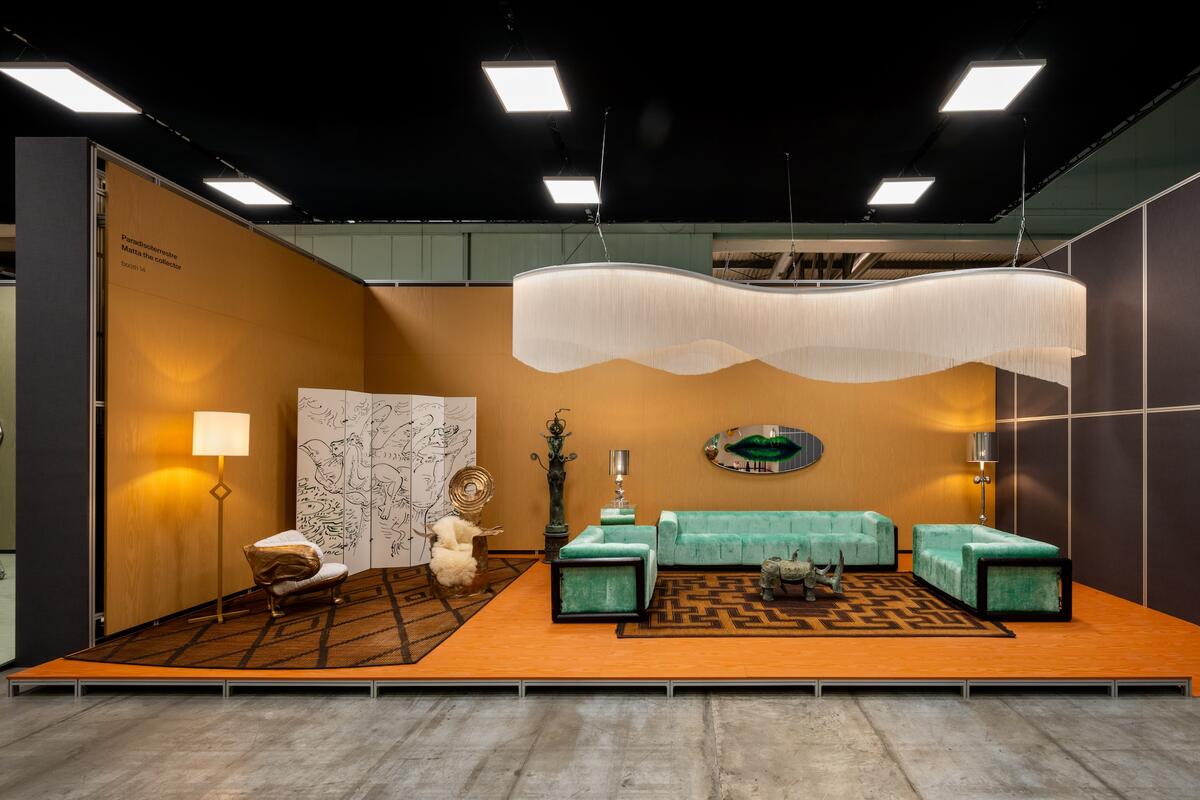
That a family-run Italian fabric house would team up with a globally recognizable artist is interesting enough. That it would drench its showroom with silk-rendered surveillance cameras is the kind of exclamation mark moment that only the crucible of Milan Design Week could produce. It worked, too. “It was possibly five times more visitors than we had last year,” said Rubelli. “We’ve never had as many editorials, and in most ‘best to see in Milano’ lists, we were among the top 10. That, to us, showed we’ve done something new and unexpected.”
Not all Fuorisalone exhibitions were as surprising or provocative, but many were as delightful. The critique of Milan Design Week as a parade of empty spectacles tends to underestimate the human appetite for novelty and raw beauty—things the city delivers in wave after wave.
Much like the attention economy we all carry in our pockets, it can also create a frantic, anxious feeling. Wandering from venue to venue at Fuorisalone can feel suspiciously like scrolling through an Instagram feed, chasing the next hit of stimulus, always wondering if you went to the wrong palazzo. As design writer Leonora Epstein pointed out in her newsletter Schmatta, it’s the rare event where you can experience profound FOMO even if you’re actually there.
The arms race for attention has economic consequences as well. Luxury fashion houses (and car companies, and watch companies, and Google) come to Milan with marketing budgets that dwarf most furniture brands’ annual revenue. Their willingness to pay top dollar for venues drives up rents for everyone else, pushing smaller brands to smaller venues, or out of the city entirely.
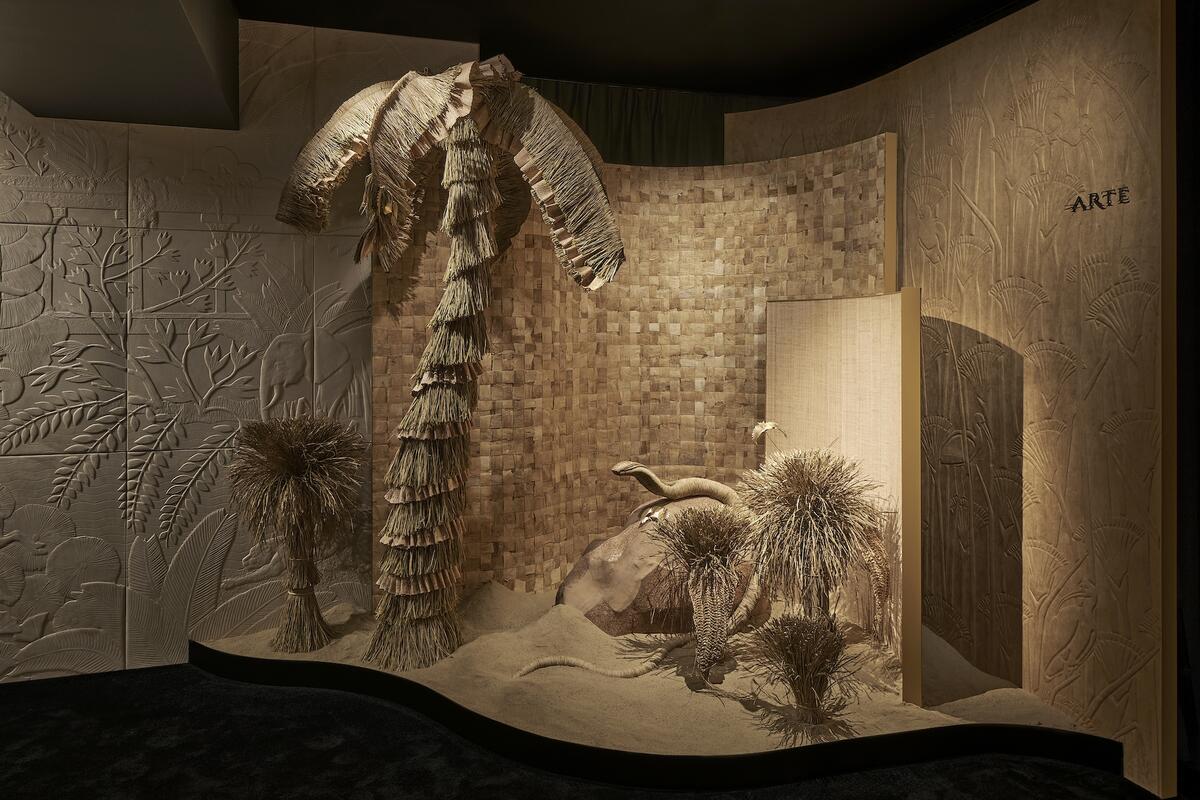
Then there are the lines. For the week, the city was defined by lines, winding up and down Milan’s narrow sidewalks. A long queue is a point of pride for brands who draw them, but also a potential business hazard. In the Brera district, the Belgian wallcoverings brand Arte made its Fuorisalone debut with a monochromatic installation by Basque artist Gabriela de Sagarminaga inspired by the ancient Egyptian capital of Memphis. In a darkened room that smelled of incense, Philippe Desart, Arte’s managing director, discussed the double-edged sword of a line outside your door. “You want lines of course, but it becomes a problem if designers see the line and keep walking,” he said. “Because of course there are many things to see. And it’s no guarantee they’ll come back, and those are our real customers.”
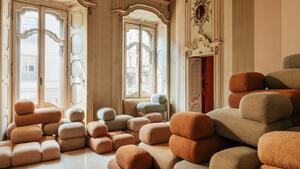
At Artemest’s L’Appartamento, a winner of the attention wars, the e-commerce platform had tasked five design firms with creating a miniature showhouse in a 19th century palazzo. The result—especially the Palermo-inspired salons by “it” firm Charlap Hyman & Herrero—was stunning. Outside, a line snaked around the block, and then some. All in, more than 50,000 people had signed up for the event.
One floor up, designers John and Christine Gachot had re-created their New York studio and living room to debut their first-ever furniture line, a collaboration with Artemest. There, Artemest founder and CEO Marco Credendino described a complicated system of managing the crowds. The company’s staff vetted the enormous list to identify and greet trade clients, ushering in press and VIPs to cut the line entirely. Milan’s firehose of humanity requires brands (at least the popular ones) to act as bouncers at their own exhibits.
How you feel about all of it—the spectacle, the luxury intruders, the influencers, the tourists, the crowds—depends on where you sit in the ecosystem. For veterans who recall a simpler time, it’s a pity. For design purists, it’s a shame. For the brands who rely on Milan as a launchpad, it’s more nuanced.
“The circus which is going on distracts from the main focus, and you don’t always see design as it should be,” Rubelli told me. “But it’s a celebration of our industry. … It’s good that it attracts other people, and new generations.”
And attention is a slippery thing. In the historic central district, the Italian brand Interni Venosta staged its collection in a faithfully preserved apartment by midcentury Milanese architect Osvaldo Borsani. There, a fireplace housed within an elegant spade-shaped nook became one of the week’s most Instagrammed moments—I saw it shared dozens of times on my feed, far more than most of the new product unveiled at Fuorisalone. Jill Singer, the co-founder of Sight Unseen, called it “the fireplace that broke the Internet.”
This year’s breakout star from Fuorisalone was not a luxury bauble housed in a rented palazzo, or the product of an expensive hype campaign, but artful millwork from 1948.
AT THE FAIR
Salone del Mobile has its spectacles too. On the day I attended the trade fair, Italian appliance brand Smeg had partnered with American robotics startup 1X to bring the company’s much-hyped humanoid robot, Neo, to its booth. For a throng of observers that rivaled a White House press gaggle, Neo slowly loaded a glass into a dishwasher, waved, then retreated to a green room. In another hall, Italian furniture brand Alchymia had hired two models in evening gowns to endlessly open and close enormous golden doors in a come-hither fashion.
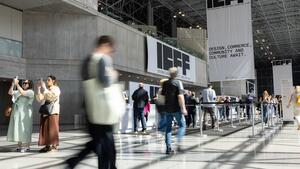
But amid its own version of an attention economy, Salone has a raw dollars-and-cents business to attend to. By most accounts, that business was surprisingly good. Official attendance at the fair is tricky to gauge, as the show alternates every year between a larger kitchen edition (EuroCucina) and smaller lighting edition (Euroluce). Covid creates another distortion. Since canceling in 2020, the show has seen big swings in attendance, from a sparse 263,000 for 2022’s EuroCucina to a post-pandemic high of 370,000 in 2024.
This year’s figure—just over 316,000—was down from that peak, but up 4.6 percent from last year’s Euroluce. In its official communication, the fair framed the number as a sign of resilience in uncertain times, and highlighted a strong international trade contingent (68 percent of attendees), further making the point: This is where the professionals are.
A cliché of Milan Design Week is that everyone tells you Fuorisalone used to be smaller, while Salone used to be bigger. By the numbers, that’s true—the exhibitor count and the physical footprint of the show have shrunk since its pre-pandemic highs. But the feeling in the halls was propulsive and energetic; the popular booths were circled by—what else?—long lines; and while trade show reps are not known for their candor, most said that business was steady and seemed to mean it.
If there was a nod to the complexity of the moment, it was a tendency for brands to highlight product that was on sale here and now, ideally at a palatable price point. Like most trade shows, Salone del Mobile has been accused of being a place where prototypes are trotted out to be oohed and aahed over, but never put into production. This year, exhibitors were eager to see a quicker leap from hype to cashflow.
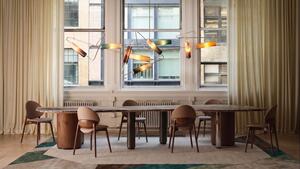
A case in point: Cyprus-born, London-based designer Michael Anastassiades unveiled a surprising new line for B&B Italia called Metric, a wooden chair for a famous producer of upholstery. The piece itself was as delicate to the eye as it was solid in the sit; just as notable was the fact that it was production-ready. “The challenge is to enter the market with a certain price that’s reasonable—it doesn’t normally happen, a chair of this level in solid wood,” Anastassiades told me. “The idea was to come out with a product on the market. … Usually you’re showing something, but if somebody wants to order, it’s impossible. Here, all the details are resolved.”
Also notable: After a 25-year absence, B&B Italia had returned to the fair to celebrate its 60th anniversary. Recently, Salone has faced a minor exodus of tentpole Italian furniture brands who have decamped to Milan proper to show in their own spaces during design week. This year, Kartell’s booth in Rho was as big and busy as a Manhattan city block, but there used to be more like it.
The fair’s organizers haven’t been standing idly by. In recent years, Salone’s young president, Maria Porro, has unleashed a flurry of new initiatives, including a Middle East edition, a presence at Art Basel in Miami Beach and Hong Kong, a forthcoming pavilion focused on the contract market, and an exhibition of antiques and collectible design.
The latter, called Salone Raritas, debuted this year in a space designed by Netherlands-based studio Formafantasma. It was an intriguing experiment—nestled between gargantuan European commercial furniture players, a band of artists and galleries showed work that, historically, would have more likely found a home in a venue in the city.
There, the multidisciplinary design duo Draga & Aurel collaborated with Italian heritage glass brand Salviati for a wildly colorful array of pieces. Co-principal Draga Obradovic was on hand to greet fairgoers—traffic was brisk on Wednesday morning. “It’s a good mix of people, designers, curators, students,” she said. “Everyone is very curious about the work, so you have a lot of different kinds of conversations.”
In another corner of Raritas, Austrian gallerist Markus Zippenfenig was showing a collection of idiosyncratic work by designer Heidulf Gerngross, including a vintage rug with an ear-shaped strip cut out (the piece’s extremely literal title: Ohrentippich, or “Ear Carpet”). When asked why he had chosen to show at the fair instead of in town, Zippenfenig’s answer was practical. “Here, it’s a more focused audience,” he said. “Walking through town there’s a certain sense of, ‘I’m looking at this, I’m looking at that, I’ll stop for a coffee, whatever.’ Here, people need to take a train, to register, you have to be dedicated to be here.” This, in essence, is Salone’s critical leverage. In the city, excitement is overflowing. In Rho, it is channeled (and ideally converted into revenue).
Raritas is also an example of the shifting boundaries of Milan Design Week. At Salone del Mobile, ostensibly the more commercial event, they’re showing collectible design. At Fuorisalone, ostensibly the artsier event, Pringles has an aperitivo bar. Kelly Wearstler’s presentation for H&M Home seemed to combine all things Milan in one package: a high-end designer showing a collection for a mass-market fashion retailer in a 17th century palazzo, styled with the panache of an up-and-coming gallerist.
That everything-everywhere-all-at-once quality contributes to buzz and the overwhelm of Milan Design Week. Throughout my time in the city, I kept encountering American interior designers wearing an expression I recognized from the mirror: a little awed, a little dazed. Some told me they were glad to have come, but weren’t planning to return anytime soon. Others couldn’t wait to buy a ticket to the next carnival.



 Withdraw Consent / Manage Privacy Preferences