









In 1937, faced with another harsh Wisconsin winter, Frank Lloyd Wright made one of the most fateful decisions of his career: He packed his bags and chased the sun west. There, in the northeastern foothills of Scottsdale, Arizona, he and 30 students translated his trademark Prairie-style architecture through a Sonoran lens—anchoring redwood beams in cement fortified with desert sand and local limestone, hoisting flat canvas rooftops above truncated walls to mimic the surrounding mesas, and embracing a then-novel indoor-outdoor approach to capturing the humbling landscapes in every sightline. The result was Taliesin West, Wright’s winter home, studio and apprenticeship headquarters, a kind of glorified campsite that he characterized as “a look over the rim of the world.”
It seems Americans are once again eager to get a glimpse of those vistas. As it did in the century before Wright’s arrival, the West is drawing a new wave of settlers, who are seeking a refuge from the claustrophobic confines of the digital and urban structures that dominate modern society. According to Redfin, in March, the number of homes sold in Idaho was up 14 percent year over year; in Montana, it was 32 percent; and in Utah, the rate was closer to 8 percent. Idaho also leads the nation in new construction, according to a recent study by insurance company Construction Coverage.
Those wide-open spaces and emerging frontiers also loom large in the creative consciousness of a clutch of designers, artists and artisans, who draw inspiration from its rugged geography, romanticized history, and spirit of adventure and exploration. As a result, Western design motifs are once again having a moment. During Paris Design Week in January, Holland & Sherry collaborated with designer William Peace on Western Skies, a collection of sunbaked textiles, wallpapers and decor, including saloon-worthy plaids, wooly mohairs, and a hand-painted wallcovering that evokes the banded beauty of bison horns. The 160-year-old Western-wear brand Stetson recently debuted a line of country-themed bedding, complete with longhorns, cowboys and mountain peaks. A surrealist cactus pattern popped up in Milton & King’s latest wallpaper launch with British design duo Poodle & Blonde, and the interiors photographer Douglas Friedman partnered with Viennese glassware brand Lobmeyr and e-commerce platform Abask on a pitcher and tumblers hand-painted with iconography from the traditional cowboy culture of Marfa, Texas.
“In the 2020s, things got really minimal and faceless,” says Max Humphrey, the Portland, Oregon–based designer who has built his career on incorporating an Americana-inspired aesthetic to interiors. Next week at High Point Market, he will debut new furniture pieces that channel the rustic beauty of the national parks, his third collection produced in collaboration with Indiana-based rustic-furniture brand Old Hickory. “Now people want spaces that feel like they’re from somewhere. Americana and Western style does that naturally because it’s so connected to history. It’s specific, it’s regional, and clients want their homes to feel tied to a place.”
Part of the understanding of that place is an acknowledgment that it can be punishing to live there, it being at the mercy of the elements, so durability is key. “There’s an appetite for things that feel like they’ll last, which has always been part of Western style,” says Humphrey. “It’s about solid materials, visible construction, and things that don’t feel disposable. There’s an acceptance of things that should age.”
In design, that translates to comfort and a newfound respect for imperfection. “Things that are more open, more relaxed, and a little rougher around the edges,” says Humphrey. “You want to be able to spill your coffee without freaking out.” It also tends to mean earthy colors, rustic textures and visual references to the region, but the designer says people can get as literal or playful as they want. “In terms of interiors, if I’m working in a place that has a real Western history, I can lean into [the reality of it] more directly,” he explains. “There’s a story there already.” But in product, you can dive into the kitsch—like the Cowboy Toile wallpaper he designed for Chasing Paper. “You can put that in a living room in Washington, D.C.,” he says.
Humphrey feels Western-inspired ideals transcend location as well: “The West goes beyond design. It’s an idea as much as it is a place. It’s part of the American psyche whether you’ve spent time in the West or not—it goes back to the Gold Rush and westward expansion. The West pulls you toward it.”
Designer Jennifer Hoey, who steered west herself 22 years ago and started Suede Studio in Ketchum, Idaho, has experienced that sentiment firsthand. In recent years, she has also seen it among her clientele. “Covid was a real turning point,” she says. “The change was driven by the fact that people are comfortable working remote, they have the ability to work remote, and it’s no longer ‘We take vacations’; it’s ‘Well, how about we live in the vacation? How about we find the place that we love, and we have a second home there?’”
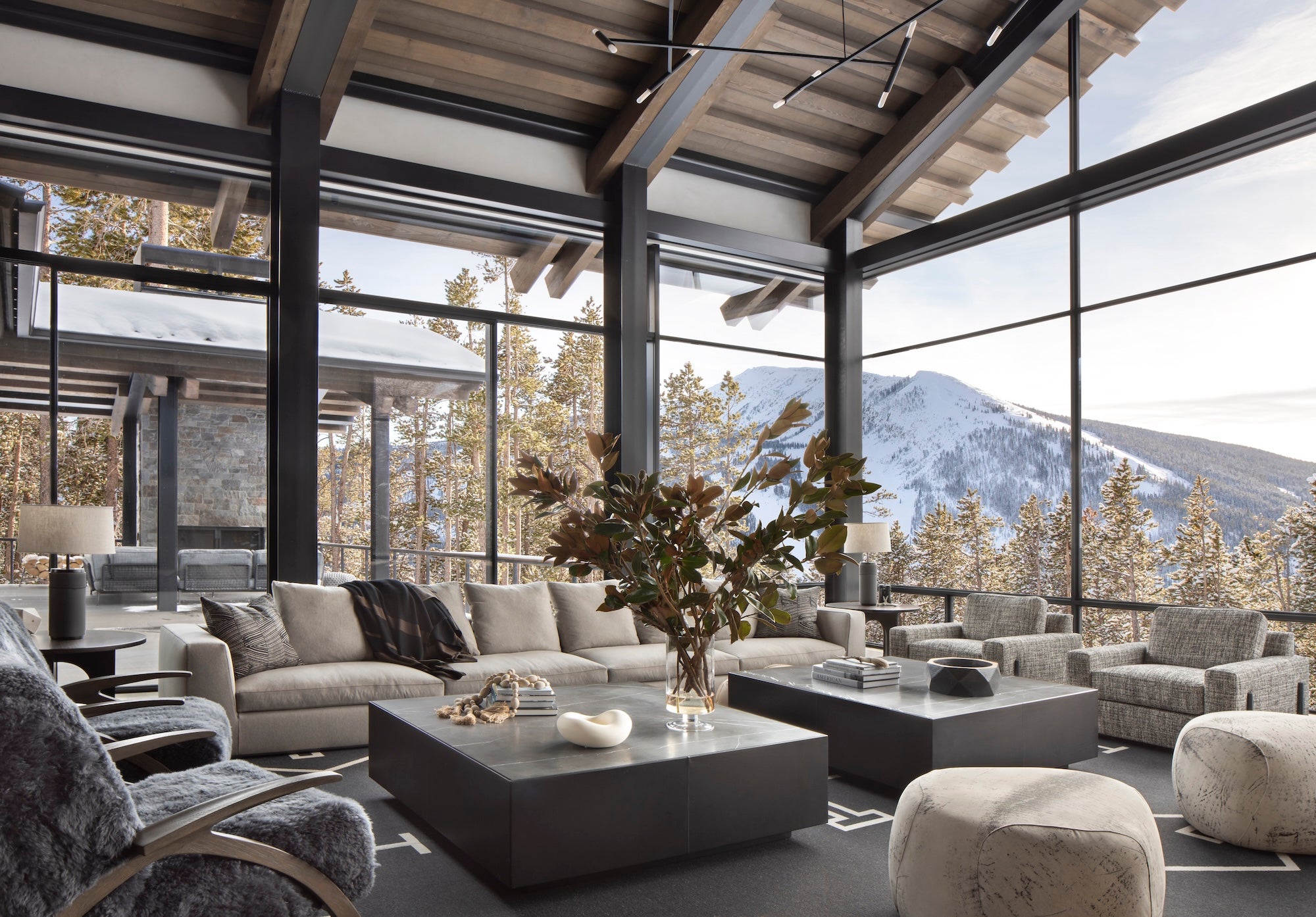
According to Hoey, the second-home (and third- and fourth-home) market is booming in Sun Valley—as well as in her firm’s sister location in Bozeman, Montana—as people look to build a generational home “where they can make memories somewhere besides their primary residence.” Drawn by the promise of freedom, more access to nature, and perhaps a break from the digital grind, many of her clients have purchased lots in private resorts like Yellowstone Club in Big Sky, Montana, and The Club at Crested Butte in Colorado. In her experience, the Salt Lake City–Park City market is the hottest in the West.
No matter where they choose to set up residence, clients in the region seem to want the same things: “They tend to gravitate toward a lighter aesthetic and what they know they like, but then they want a little Western spin on it—anything from a hint of a Western motif in a rug, or a little bit more texture or a hint of a rustic material, to using local Western artists,” says Hoey. “And that doesn’t have to be cowboys—there are so many great galleries in the West.” What comes to mind for her are reclaimed materials, and those that patina—things with organic reference points: “It could be [anything from] an antique French oak flooring that’s been planed down so it’s somewhere between rustic and refined, to full-on corral board that we use on the ceilings, to sculptural slabs of wood that we make custom furniture out of.”
Another hallmark of Western homes? Significant size. “Everything is scaled up, which feels very Western to me,” says Hoey. “You’re looking at giant scales [of furniture] to fit that Western lifestyle, because it’s a giant great room and a giant rec room. The same is true of the windows—the better to capture those wide-open spaces and candy-colored skies. What you won’t find in her interiors: regional caricatures. “Where I see it most is in wallpaper, or sometimes some sculptures of horses and such, but for us it’s more mountainous,” she adds.
It seems the farther away you get from the actual West, the more opportunities there are to have fun with the camp of it all.




 Withdraw Consent / Manage Privacy Preferences