












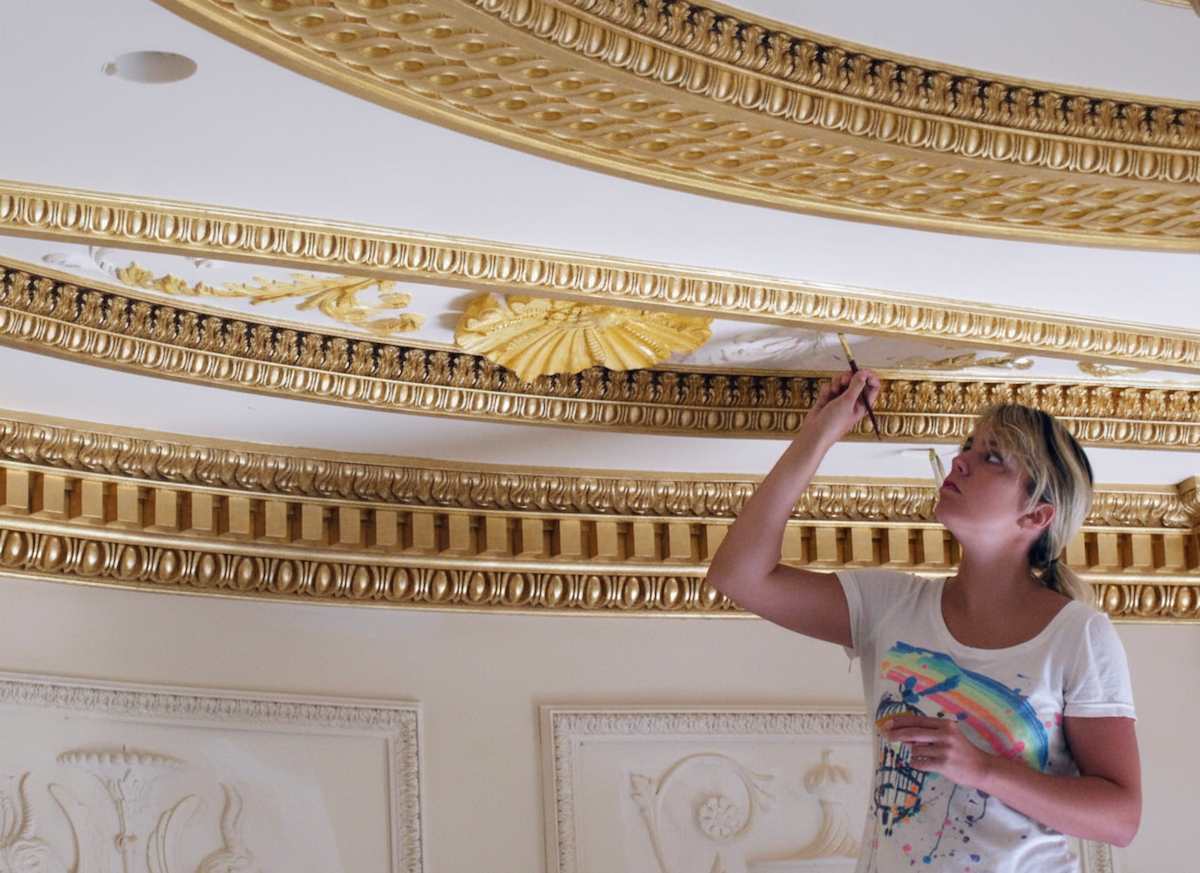

Painters don’t have to check the market for daily fluctuations in the price of tempera. Sculptors need not fret the cost of sandstone. But gilders work in a more economically excitable medium—and with the price of gold racing to all-time highs in recent months, they’ve been along for the ride.
“Normally we’d only experience a pricing change once or twice a year,” says Tobias Freccia, the founder of GildedPlanet.com, a website that sells gold leaf and gilding equipment. “In the last two years, we’ve been getting them every three or four months. In the last six months, we’ve had pricing changes every week, and in some cases daily.”
One way to think about the price of gold is as a barometer of fear. In times of instability, investors rush to the asset as a safe haven—and these days, there’s no shortage of worry. Between 2021 and 2024, gold was trading in a relatively stable range centered around $1,800 per troy ounce. Then a combination of geopolitical instability, a weak dollar, and aggressive buying from central banks started sending the price upwards. It gained momentum last fall, and in January the precious metal spiked to the once-unthinkable price of $5,500 per troy ounce.
Gold leaf—the paper-thin sheets of gold that gilders use to ply their trade—is a unique artistic material with its own idiosyncratic supply chain. Most contemporary gold leaf comes from either Europe (often Italy) or China, where manufacturers—called “beaters” in the parlance of the trade—process and press the raw metal until it’s thinner than a thousandth of a millimeter. The sheets are then cut and bound into small booklets (imagine the most expensive Post-it notes in the world).
Because goldbeaters buy gold at close to its commodity price, they’re subject to swings in the cost of the raw material. And because gold leaf is imported into the U.S., tariffs apply. Those two factors have seen the price of some leaf more than double. Freccia says that a pack of 20 books of 24-karat gold leaf from Europe—500 sheets—would have sold for roughly $1,400 two years ago. Today it hovers around $4,000.
The swings in pricing have presented several challenges for gilders. One is that the soaring costs have pushed some customers out of the market, or steered them toward alternative materials, like “metal leaf,” often a mixture of copper and zinc that comes at a fraction of the price of real gold. Bill Gauthier, a master gilder from New York, says that he “expect[s] to lose the mid-level client whose budget depends on a lower material cost, or they will consider the less expensive option.”
Lauren Sepp, the owner of SeppLeaf Products, a third-generation family business that specializes in importing gold leaf, agrees. “It’s definitely affecting the market,” she says. “We’re quoting a lot of large projects as we always do, but once the architect or the end client hears the price, they will sometimes change to an alternative. … A lot of proposals don’t come to life. Maybe the client budgeted for it two years ago, and then here we are today and it’s totally different."
In many cases, the problem is less the cost and more the volatility. Gauthier, working alongside art restorer Marc Roussel, oversaw a regilding of the famous Prometheus statue in Rockefeller Plaza last fall. The team was able to lock in pricing for the 20,000 sheets required before the price of gold swung up. This year, he is advising his clients to purchase immediately, even for projects that are several months out.
“We have to basically tell the customer, ‘We’re quoting you the price for today,’” says Freccia. “And if you don’t purchase it, we have to requote you tomorrow. … People have to run it through an approval process, it takes a week, they come back, and the price has changed 10 percent.”
For gilders—and the industry that supports them—the silver lining is that while the market will have its ups and downs, there’s a core client who is both savvy and as close to price-immune as it gets. Customers who want to cover their dining room ceiling in thin sheets of gold will rarely balk at an invoice.
More good news: Courtesy of the Supreme Court, some of the tariff burden has been relieved, and the price of gold has dropped from its staggering highs to the relative bargain of $4,700 per troy ounce. Last week, Freccia updated his prices again. For the first time in a year, they went down.










 Withdraw Consent / Manage Privacy Preferences