














Ernesta is adding to its war chest. The direct-to-consumer custom rug brand launched in 2022 by Peloton founder John Foley has announced a $20 million investment. The Series B round, led by the company’s original lead investor, venture capital firm Addition, brings the fundraising total to $45 million.
“We weren’t actually looking [to raise] money,” Foley tells Business of Home. “We’re in good shape financially and we’re profitable as of this year, but this $20 million is kind of opportunistic to strengthen the balance sheet and accelerate growth.”
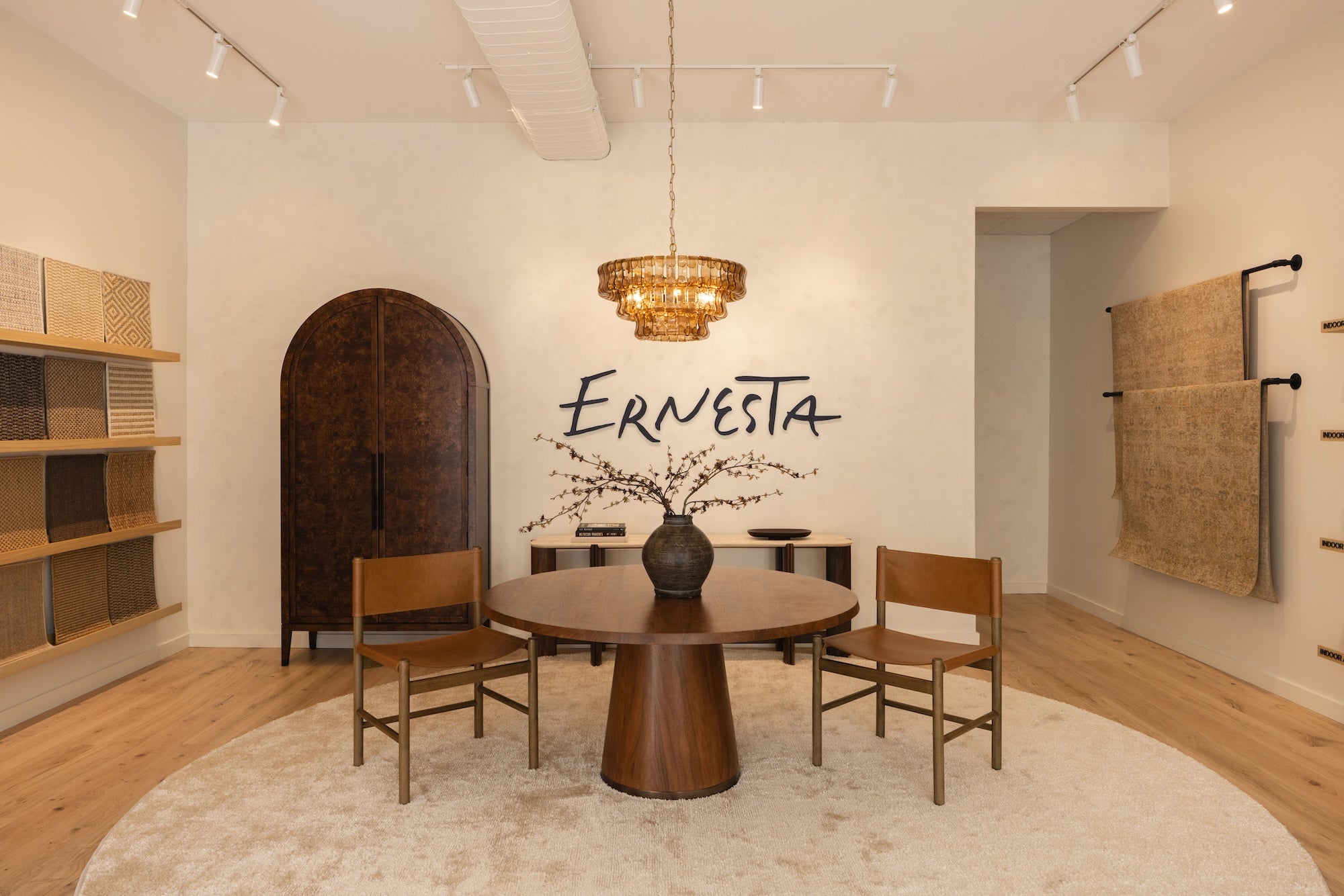
Growth is very much on the menu. Ernesta, which currently operates six showrooms, plans to bring its footprint to 30 by the end of 2027. At the same time, it will invest heavily in technology—whether that’s building software that helps the company work efficiently with local installers or tools that can be deployed at the manufacturing level.
“We should do 70,000 custom rugs this year through our platform,” says Foley. “When you’re doing mass customization at that scale, you need technology to make it more efficient—it’s things like making the remnant utilization and the Tetris of cutting rugs off of rolls more efficient, so that your waste is minimized. All that requires investment.”
Ernesta will also spend some of the financing on its online trade portal. Like many DTC home brands of the past decade, the company launched with consumers in mind, but soon embraced designers as a key demographic. “Interior designers disproportionately know how good custom is. They understand the value of having a rug that fits your space as it’s supposed to,” says Foley. “In a lot of ways, it’s a better customer.”
A focus on the trade and an ambitious brick-and-mortar rollout are an evolution from Ernesta’s strategy at the outset, which was focused primarily around reaching consumers online. However, the company’s core premise—custom-sized rugs at scale—has not changed. Nor has Foley’s intuition that a seemingly niche premise is a huge opportunity.
“We are focused. We’re not going to do standard-sized rugs, we’re not going to do other categories,” says Foley. “Say there’s 100 million rugs sold in the U.S. every year. The vast majority of those are standard-size rugs. But let’s say we could get one percent of that 100 million—one million rugs at an average order value of $2,000 is a $2 billion top-line business, with a 25 percent EBITDA margin. That’s $500 million of free cash flow, which at a 20 [times] EBITDA multiple would be a $10 billion company. We’re not playing for a small opportunity—we think this can be one of the bigger companies in home goods.”
The brand’s primary challenge at the moment is mainly the broader economy. Ernesta had the misfortune of launching just as the pandemic era home boom was petering out, and with a stubbornly frozen housing market, tariff chaos and geopolitical instability, it’s hard to predict when Americans will start spending aggressively on furnishing their homes again.
“I think ordinarily it would be easier to build a business like this,” says Foley. “But to flip [the issue,] our investors want to put more money in because they see us succeeding in the face of a lot of headwinds. They’re saying, ‘This is a strong business, the fundamentals are great, the unit economics are great, the profitability timeline is great, and it’s really hard.’ When things ease up a bit, this thing is going to go, and they wanted to get money in now.”