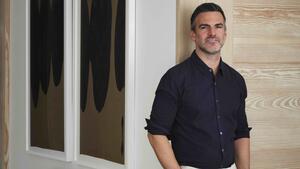




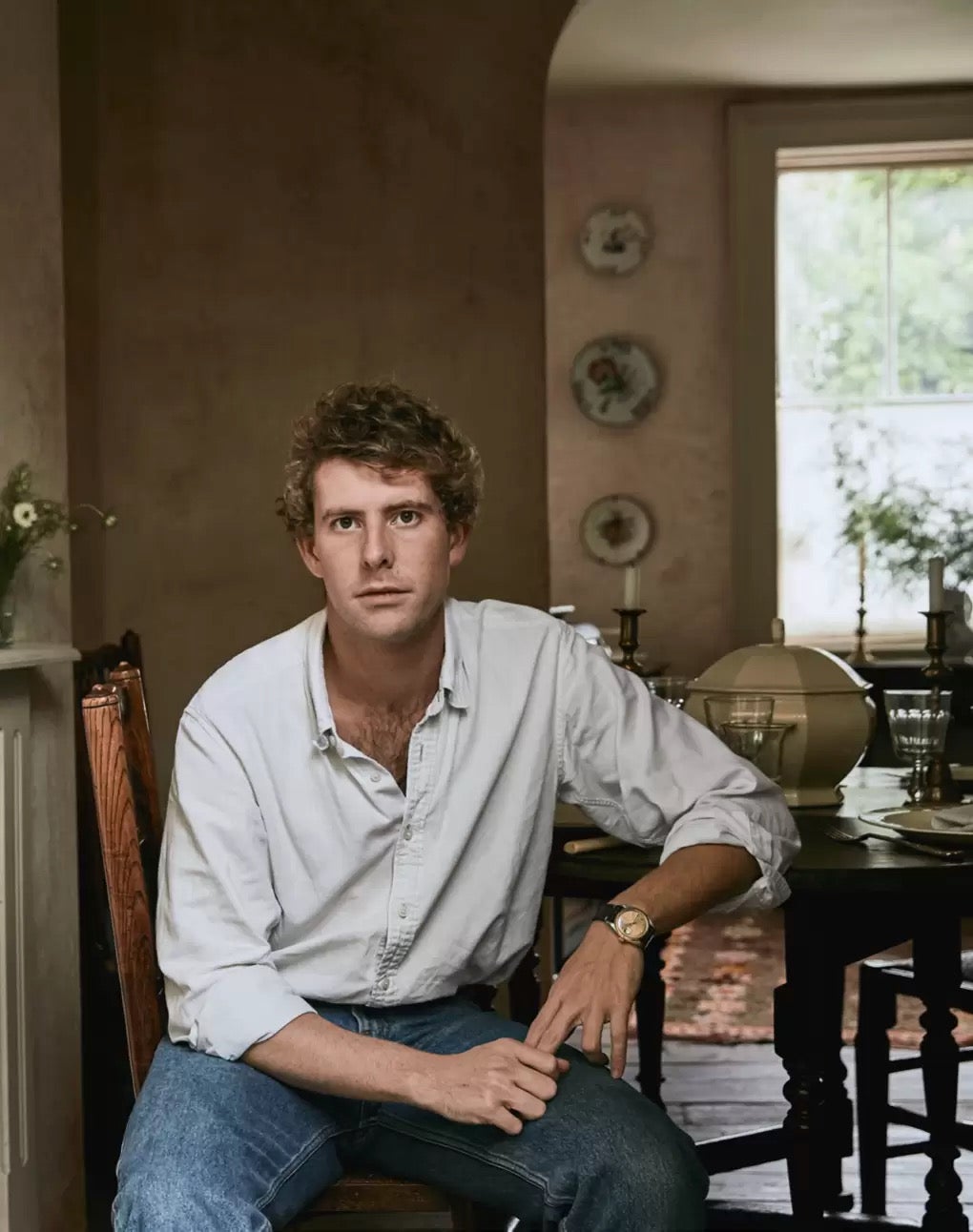

Fitting that Remy Renzullo makes his living designing homes—he was born in one. The family homestead was an eclectic rural abode in Litchfield County, Connecticut, that was decorated by his parents (his mother was a designer, his father a furniture maker) and featured 18th century European furniture, Palissy ceramics, taxidermied birds, and a hornet’s nest suspended from the ceiling. To say the place made an impact on him is an understatement. “What’s so compelling to me in interiors, and what I try to create with mine, is this notion of atmosphere, which is something that’s really hard to define or to quantify or to make a mood board for,” he tells host Dennis Scully on the latest episode of The Business of Home Podcast. “I think that’s because I grew up in this house that was by no means perfect. It was not the grandest of houses, but it had tremendous atmosphere, and that left a massive imprint on me.”
Renzullo studied fashion design at Parsons and dropped out after two years to work for his friend Wes Gordon’s label. But the pace of the industry overwhelmed him, and five years later, he pivoted to the interiors world with a push from his close friend Lauren Santo Domingo. In 2016, he launched his firm with no formal design training, but through word-of-mouth and quick learning, soon built up a thriving business. Renzullo now employs a team of six people in New York, London and Italy, and just landed a spot on the AD100.
Despite the entirety of his design career existing in the age of social media, Renzullo doesn’t worry about his online appearance—he doesn’t even have a portfolio website. “I do this work for my clients,” he says. “I don’t think I appeal to a broad spectrum of people, and I don’t think that will ever change. For somebody to entrust me with their house, there has to be a little bit of a personal connection there.” The designer also doesn’t chase fame. “I think it’s important to celebrate people for their talent, but the pure notion of being famous or recognizable is completely ridiculous,” he adds. “I’m not here to market myself. This is a service industry. They’re not hiring me to be famous; they’re not hiring me to be glamorous. They’re hiring me to work hard and give them a beautiful house.”
Elsewhere in the episode, he discusses how Covid helped him reset his business, what it was like working on the historic English estate Castle Howard, and why his research-based design process stays the same regardless of a project’s style.
Crucial insight: In an effort to keep hard skills and craftsmanship alive, Renzullo doesn’t allow AI use in his office. “People need to know how to write an email, even a difficult one,” he says. “You need to be able to draw something or figure out a way to communicate it that isn’t punching a bunch of stuff into a computer. Maybe I’m really archaic, and that’s a really, really terrible business strategy, but I believe this has to be an industry that will be one of the last to be fully replaced by something like AI. I’m hired for a certain level of technical expertise, but I’m really hired because of my aesthetic and my eye. That cannot be replaced. It has to be so tactile, and there is so much emotion involved—I’d like to think that humanity will remain in this business.”
Key quote: “I’ve always found that if we’re very honest and upfront with people, and people see how hard you’re trying to work and how you’re trying to improve things, people are generally very forgiving and very understanding. On the reverse side of it, with people who work for me, I never expect everything to be done perfectly, but as long as I can see that there’s a level of interest, a level of dedication and the desire to do better, that’s enough for me.”
This episode is sponsored by Ernesta and Crypton. Listen to the show below. If you like what you hear, subscribe on Apple Podcasts or Spotify.
The Thursday Show
Host Dennis Scully and BOH executive editor Fred Nicolaus discuss the biggest news in the design world, including Nordic Knots’s big fundraise, RH’s dramatic earnings call, and how designers are finding opportunity in a frozen housing market. Later, GreenRow vice president Jaimee Seabury joins the show to talk about Williams-Sonoma’s sustainability-focused brand.
This episode is sponsored by Loloi and Chelsea House. Listen to the show below. If you like what you hear, subscribe on Apple Podcasts or Spotify.