















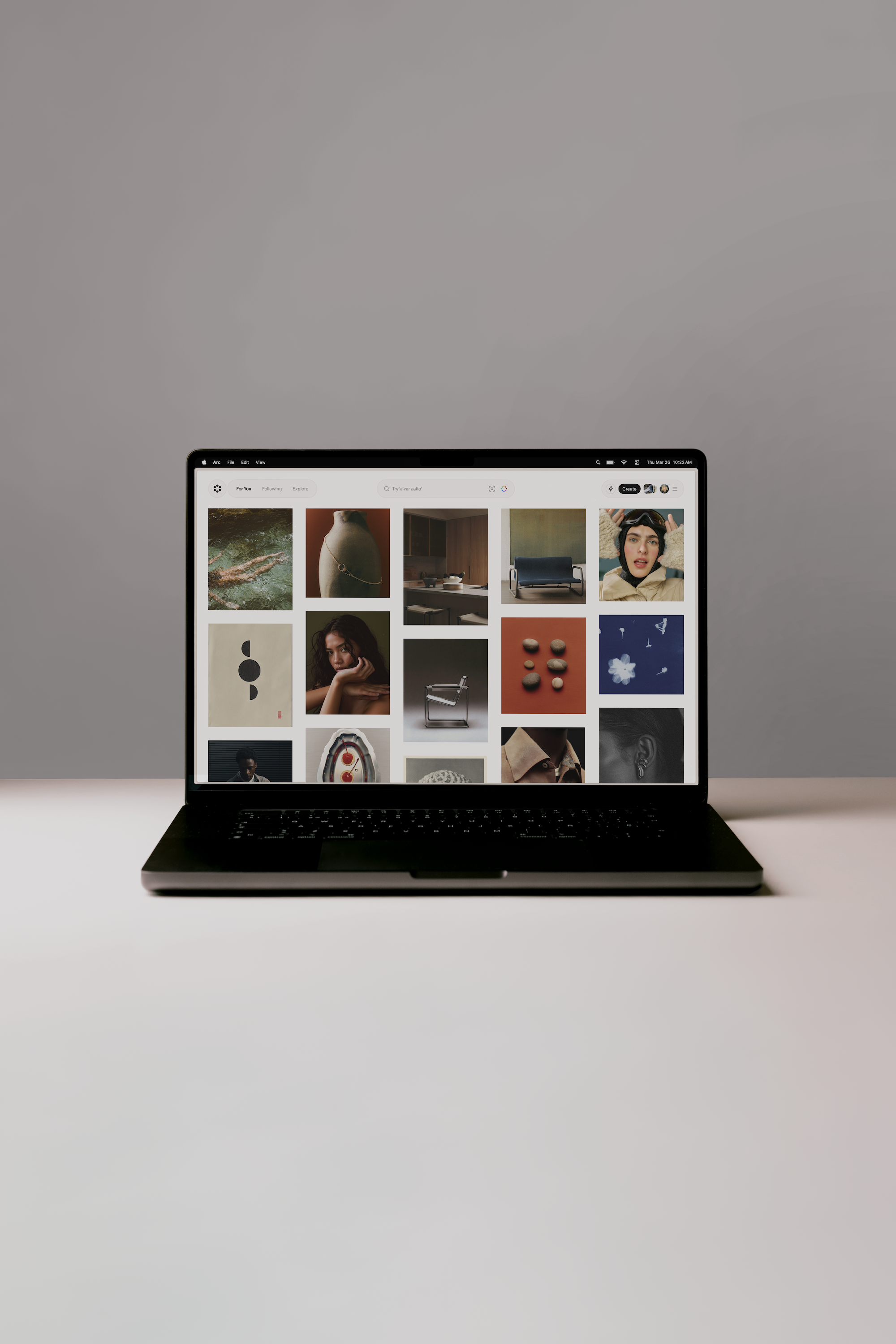

TikTok is overwhelming. Instagram is crowded. Pinterest is battling AI slop. These days, where’s a design lover to go for a nice, clean place to look at beautiful pictures on the internet?
Andy McCune is hoping the answer is Cosmos. In 2024, the young entrepreneur—he has founded and sold multiple software startups—launched the platform after several years of development. “Cosmos started out as me just building a tool to solve my own problems,” he says. “What I wanted it to be was this place where I could bring in references from around the web. … I started working on different projects and inviting other collaborators—I was building a house with an architect and building a brand with an agency, so I started inviting everyone into this system. And a few folks were like, ‘Oh, this is great. I use Pinterest for this right now, but I could see this replacing that.’”

Cosmos has since raised $21 million and generated buzz among the creative cognoscenti. McCune says the platform is used by teams at Nike, Apple and Chanel, and that several high-profile interior design firms—including Jeremiah Brent, Woods + Dangaran, Yabu Pushelberg and Athena Calderone—are on it too. But with the release of a new version of the platform this week, McCune has his sights set wider than tastefully minimal offices in Tribeca and DTLA. Ultimately, he says, “we’re trying to be the new home for visual culture on the internet.”
Though McCune’s vision for Cosmos has a philosophical bent, the most obvious first impression of the platform is simply that the taste level of its “inventory” is elevated. You will find very little AI slop, Wojak memes or chintzy influencing. In their place: vintage magazine spreads and Bauhaus tabletop. Of course, what individual users see will vary depending on their algorithms, but Cosmos is much more Salone del Mobile than Mall of America.
The aesthetic level, says McCune, is the result of a machine-learning tool that rates everything on the platform. Images that score below a certain level are de-ranked in search results. Essentially, Cosmos uses AI to fight AI slop.
The platform’s basic mechanics will be familiar to users of existing curation sites. Like Pinterest, Cosmos users can install a browser extension that allows them to save pictures as they bounce around the internet, and it has a variety of ways to search and sort through feeds of images. And like most platforms with a social dimension, users can follow other users.
But it also has several features that feel uniquely attuned to the wants, needs and fears of designers. Some are small but handy, like a function that allows users to sort results with a color palette. (Want to see art deco interiors in green? Cosmos has you covered.) Others are more ambitious—the platform’s big swing is a feature called “research captions,” which uses AI to tag all of its images with contextual information. For example: Click on a fetching green art deco staircase and you’ll find it’s from the Cranbrook Academy of Art, designed by Eliel Saarinen in 1925.
Like all AI-generated content, Cosmos’s captions aren’t always perfect—if you look hard enough, you can spot misattributions. But for the most part, the feature works to create a web of interconnection between its trove of images. Users can click on “Eliel Saarinen” to view more work by the Finnish-American architect, or “Cranbrook Academy of Art” to see other rooms from the property.
With the feature, McCune also hopes to right one of social media’s original sins: the severing of an image from its makers. On most platforms, users have to proactively credit the designer and photographer whose work they’re posting—as a result, many don’t. By designing a native system of crediting images, his hope is that Cosmos can be a haven for creatives of all stripes.
"I think one of the biggest problems in visual culture is the lack of provenance, and the idea that as an artist or a creative, you upload your image onto the internet and you’re under this weird invisible contract that your thing is going to be ripped off and reposted, and you’re going to kind of lose control over that thing,” he says. “We’re trying to serve the creatives and make them the pillars of the platform.”
It’s precisely that concept that attracted Brooklyn designer Melissa Lee to the platform. “This has been an issue, especially in the design world: Images are being widely used by people without crediting the source. … It’s happened to us,” she says. “Our projects get shared without credit—it’s not rare. That was the hook for me. … I got interested because whenever we use an inspiration image, we certainly want to credit the right people.”
At the moment, Cosmos is in growth mode, and McCune seems more focused on new features and new users than squeezing the system for cash. He is keenly aware, however, of the dynamics that can spoil a platform of this nature. Startups launch with the best of intentions, then need to make money, which often means turning on a firehose of ads. The site has a paid tier with advanced tooling—because of the platform’s early adoption by professional creatives, McCune is optimistic that it can become a significant revenue generator. But he’s also hopeful that Cosmos can embrace commerce while keeping its cool.
“We’re running hundreds of thousands of searches a day right now on the platform; a good percentage of those are people looking to buy things,” he says. “And rather than putting Windex ads in your For You, it’s when you’re searching for a brown leather couch, you’re seeing something that you can actually buy.”
Ultimately, his goal is to build an engine that knows its users so well that ads will feel more like helpful suggestions than unwelcome intrusions. “We’re really excited about the future of commerce on the platform,” he says. “I think Cosmos will have more aesthetic and taste context on you than any other platform on the internet.”












 Withdraw Consent / Manage Privacy Preferences