











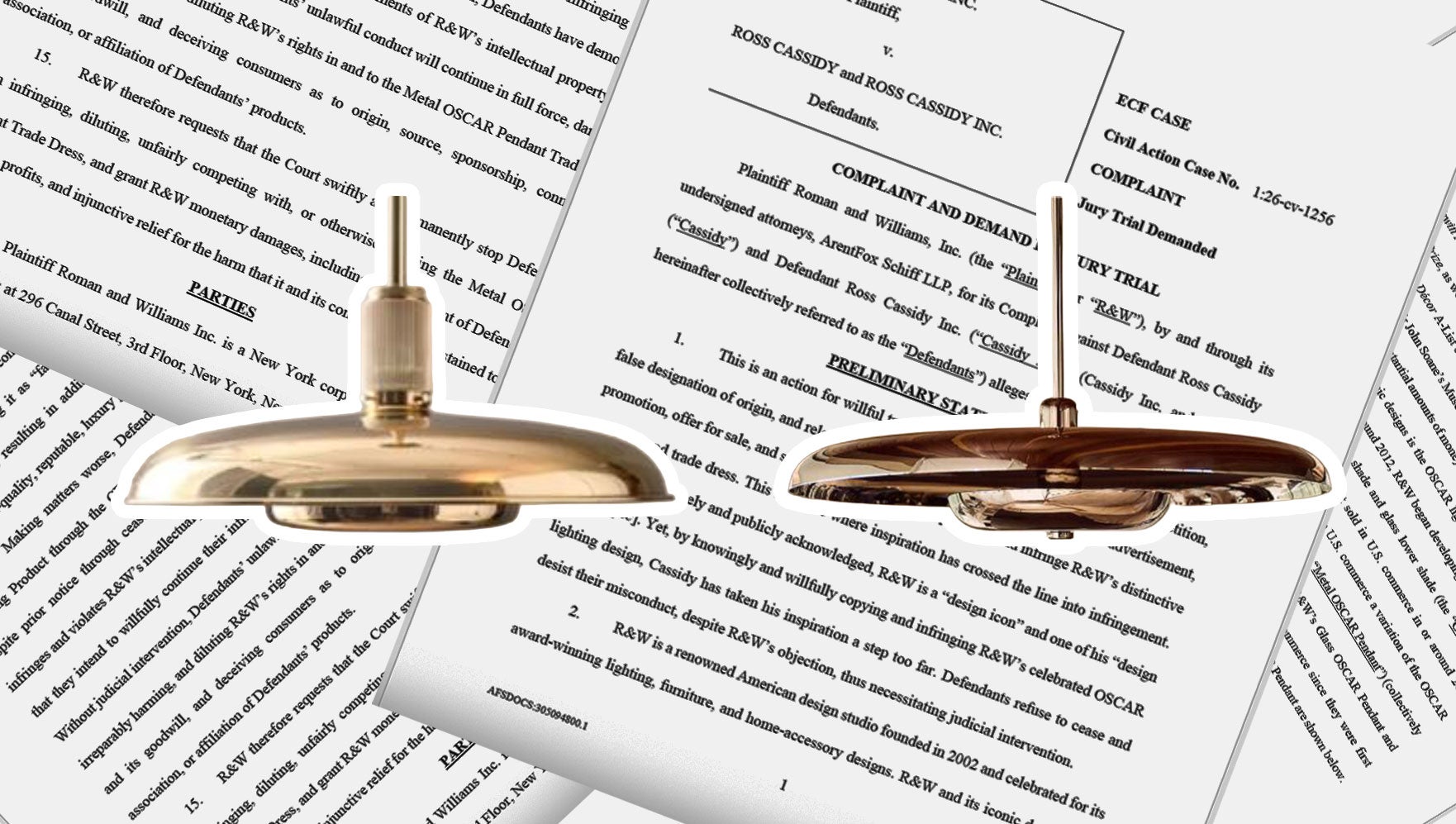

A dispute between two high-profile design firms has slipped out into public view. Last month Roman and Williams, the New York–based design studio founded by Robin Standefer and Stephen Alesch—filed a lawsuit in federal court alleging that Los Angeles designer Ross Cassidy had knocked off their Oscar lighting line for his collection with CB2.
“This is a case where inspiration has crossed the line into infringement,” states the 41-page complaint against the designer and his firm. “As Cassidy has freely and publicly acknowledged, R&W is a ‘design icon’ and one of his ‘design hero’s’ [sic]. Yet, by knowingly and willfully copying and infringing R&W’s celebrated Oscar lighting design, Cassidy has taken his inspiration a step too far.”
According to the lawsuit, Roman and Williams began developing the Oscar pendant light—featuring a wide metal shade with a softly curved rim and a handblown disc-shaped diffuser—in 2012 before releasing it in 2017. In the suit, they detail the rollout and expansion of the design into floor lamps and sconces, and tout its commercial success, calling it “among R&W’s most popular and best-selling designs.”
Cassidy is no stranger to collaborating with CB2—his work with the Chicago-based retailer dates back to at least 2017, with the debut of a 33-piece collection of lighting, rugs, pillows and furniture. The design at the center of the lawsuit, the Tennant pendant, appears to have debuted in the summer of 2025. It was still on sale on CB2’s website at press time.
Roman and Williams’s legal complaint outlines the similarities between the Tennant and the Oscar, pointing out that it comes in the same sizes (16 inches and 24 inches) and similar finishes (brass and polished nickel). According to the document, the similarities have caused “actual confusion in the marketplace.” Standefer and Alesch write that they sent Cassidy a cease-and-desist letter last summer, but that it was “rejected,” prompting legal action.
Cassidy and CB2 both declined to comment. A spokesperson for Roman and Williams provided a statement to Business of Home, noting that the legal action was “not a step we take lightly.”
“Like many studios working at this level, we have encountered instances over time where our designs have been copied without permission and, whenever possible, we address those situations directly, constructively, and privately, and have been able to resolve many such matters without the need for litigation,” read the statement. “However, there are rare occasions—particularly where we believe there is clear and willful appropriation of our work and intellectual property rights, and where prior efforts to resolve the issue amicably have not been successful—where we have a responsibility to our clients and to our intellectual property rights to act more formally.”
The case is far from the first time an IP dispute has emerged in the high-end design world, though frequently these matters play out behind closed doors before reaching a court of law. Designers often win the support of peers and even the public by crying foul on an alleged knockoff, but winning a legal battle is a much higher threshold to cross—and a far more expensive one.
“Only a tiny percent of lawsuits that are ever filed actually go to trial. A lawsuit is really a tool, it’s a means of creating leverage,” says attorney Seth Kaplowitz, who specializes in working with designers and design industry brands. “You want to start taking depositions and engaging in thousands of pages of discovery, that can be really expensive really quickly, and it can drag on a long time.”
The Roman and Williams suit has some interesting elements to it. Though it asks for the cessation of sales and all existing Tennant lights to be donated or destroyed, the complaint does not name CB2 as a defendant. Another detail: The duo stake their infringement claim on “trade dress,” a form of legal protection that covers the distinctive look and feel of a product. It’s a more complex claim than copyright, requiring designers to show that a specific combination of visual elements is uniquely associated with their brand (the lawsuit does not reference a registered copyright for the Oscar).
The Roman and Williams spokesperson declined to comment on the specifics of the case, but wrote, “We recognize that pursuing these matters can be complex, but we believe that protecting original design is essential—not just for our studio, but for the health and future of the design community as a whole.”








 Withdraw Consent / Manage Privacy Preferences