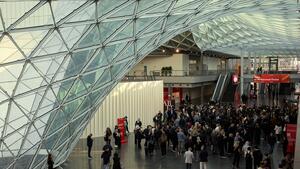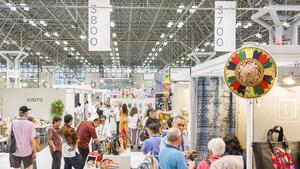



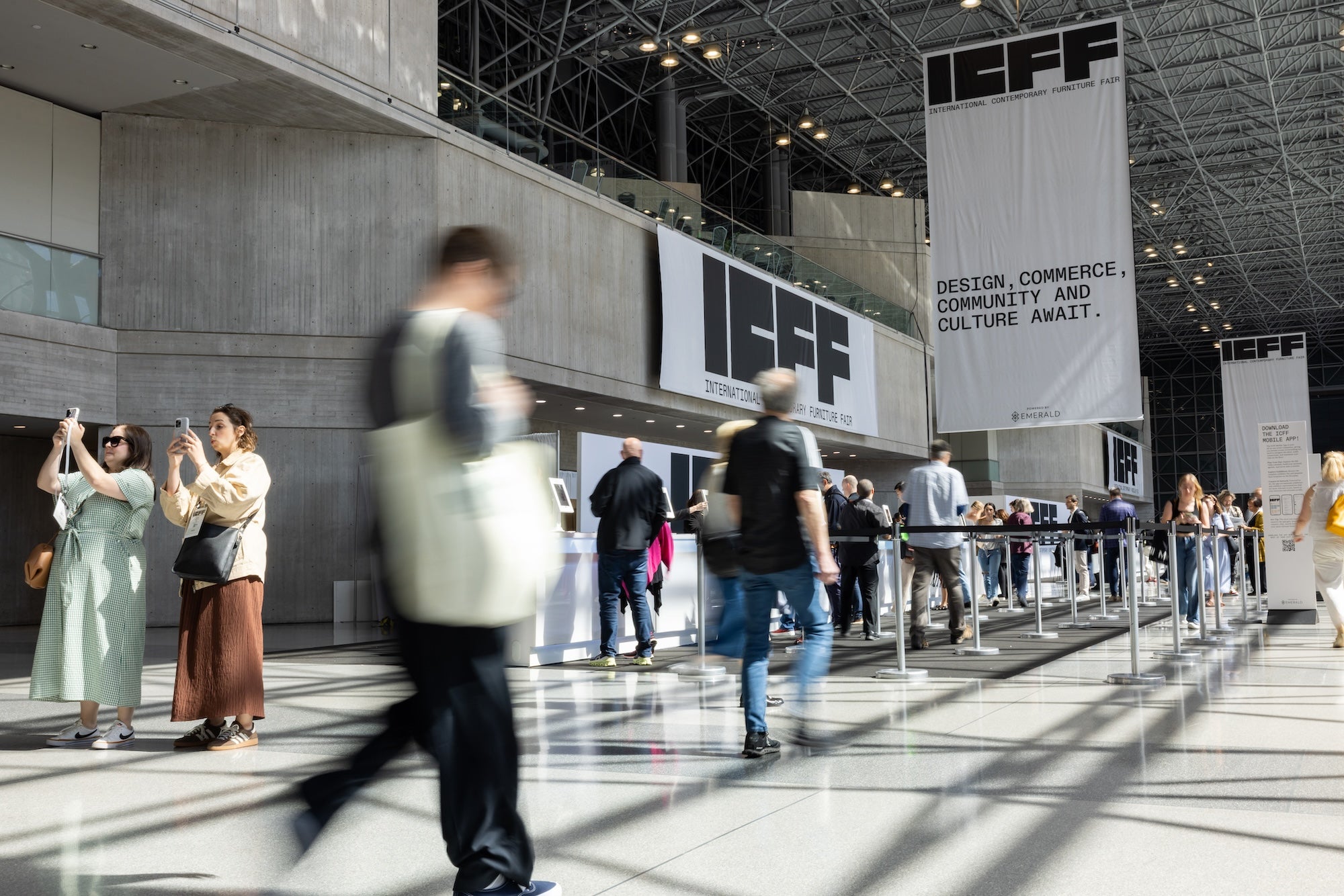

A major shift is coming to New York's trade show landscape. In 2027, the International Contemporary Furniture Fair—better known as ICFF—will move from its longtime May slot to November, sharing the Javits Center with Boutique Design New York (BDNY), the hospitality-focused show also owned by Emerald.
According to the fair’s directors, Odile Hainaut and Claire Pijoulat, the move is a response to long-held concerns from exhibitors and attendees about the design industry’s overcrowded spring calendar. ICFF has always come at the end of a taxing sprint, which for some can include stops at both Milan Design Week and High Point Market. That challenge is particularly relevant for the international vendors who make up roughly 50 percent of ICFF’s exhibitor base.
“We’ve had so many questions from our exhibitors about: ‘Is there a chance you could change those dates?’” says Hainaut. “We felt this was the time to respond to what the industry needs, and bring ICFF to the fall. After 37 years, we understand it’s a big move, but we feel like this is the right time.”
The crowded calendar has always been an issue. What forced the change, say Hainaut and Pijoulat, is Covid and its aftermath. Many predicted that the pandemic would wipe out trade shows—and while that didn’t happen, the disruption did inspire brands to scrutinize their marketing budgets and design firms to pull back on travel.
“The firms are sending people to shows in smaller groups, and they’re not spending as much money sending people to shows,” says Pijoulat. “All the firms we talked to [said] it’s an opportunity to see more coming just one time to New York. It felt like a good opportunity for both sides, exhibitors and vendors.”
By moving the show to November, Hainaut and Pijoulat hope to fix a problem. By colocating with BDNY, they look to unlock an opportunity. Though the two shows share obvious similarities, the audience overlap between them is surprisingly small—only 9 percent (the exhibitor overlap is also in the single-digit percentages). The duo’s hope is that putting the two side by side will create a design event with serious draw, and lead to cross-pollination.
“We’re not merging the shows, but there is an amazing opportunity for each audience to discover the other,” says Hainaut. “It’s an opportunity to create a big moment in November.”
The move will have ripple effects throughout New York’s design ecosystem. The most obvious will be on NYCxDesign, the official weeklong spring celebration comprising parties, panels and exhibitions throughout the city (not to mention the constellation of unofficial events that spring up around it). ICFF has long been a key event of the Big Apple’s design week; without it, the festival will face a new landscape.
NYCxDesign will continue to take place in spring. According to the festival’s leadership, “163,000 unique attendees participated in in 2025, engaging over 2,100 local businesses,” and the fair “expect[s] similar momentum in 2026 and in the years ahead.”
“ICFF holds a very special place in my heart, having been instrumental in its founding and formative first decade,” says Ilene Shaw, executive director of NYCxDesign. “Of course, I will miss having the fair in the spring. But I do not see this as losing ICFF. NYCxDesign is a year-round community and industry organization. As both the festival and the industry continue to evolve, we too will continue expanding our activities throughout the year, including in the fall. We will absolutely continue to support ICFF’s efforts, and they remain an important and valued part of our larger design community.”
As for ICFF itself, the shift will likely change it in ways that are difficult to predict. Since combining their independent design show, Wanted, with ICFF in 2021 and taking the reins of the overall fair in 2023, Hainaut and Pijoulat have managed to grow attendance—no small feat in a tumultuous era. However, the show is not at the scale it occupied in the pre-pandemic days, and there’s plenty of nostalgia in New York’s design world about the ICFF of yesteryear.
At the same time, the design trade show model itself seems to be in a period of transition. One of the biggest—IMM Cologne—was canceled in 2025. Salone del Mobile continues to be a huge draw, though the balance of focus between the show and the unaffiliated events around town is clearly shifting. Meanwhile, newer fairs like Copenhagen’s 3daysofdesign are growing fast, without a tentpole trade show in a convention center. Put simply: It’s a disorienting time for trade shows in general, and ICFF in particular.
“Part of this shift is also to get rid of the ICFF ghosts that we’ve inherited,” says Pijoulat. “It’s not the same as it was in 2017; but it can’t be the same. … It felt like we were trying to continue to force something that has been hard for a long time. And it felt like, Let’s be brave and jump.”