






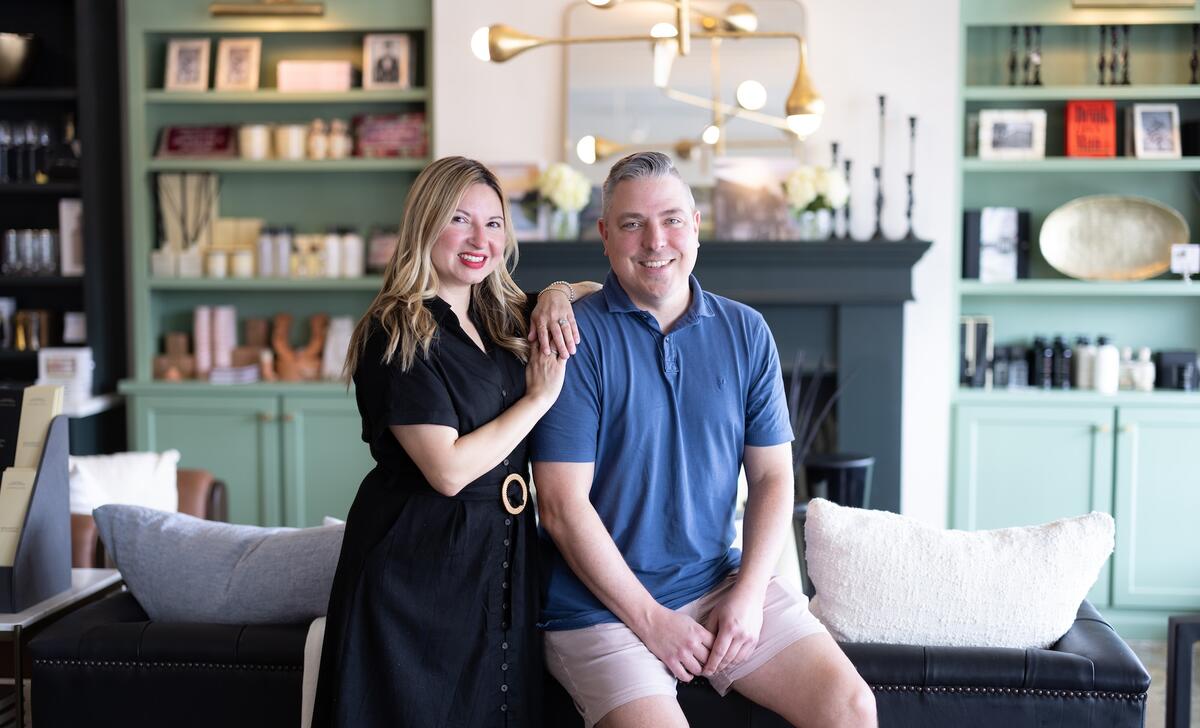
In Business of Home’s series Shop Talk, we chat with owners of home furnishings stores across the country to hear about their hard-won lessons and challenges, big and small. This week, we spoke with Phoenix, Arizona–based retailers Ana and Brian Wells, co-owners of the UrbAna chain of home stores.
Entertaining season feels like the perfect time to chat with the couple, who, after parallel careers in retail, launched their own store filled with beautiful objects made for hosting. They started with one “celebration store” in 2014 and now have two others in the Phoenix area and one in Kansas City, Kansas—expansion that came much more recently, in the years since the start of the pandemic. The pair share the charming genesis of their brand, the nitty-gritty of opening new locations, and why they think retail is just a vehicle for something bigger.
What were your professional backgrounds before the shop?
Ana Wells: I have been in retail since college. I was with Anthropologie for 10 years, and worked my way up [until] I was a shop manager.
Brian Wells: I worked for Tommy Bahama for about 10 years. They went from their first retail outlet to about 40 locations or so when I was with them, and I got to open stores for them. That was a really good experience.
And how did you meet?
Ana: We met in college and just had our 18th wedding anniversary. There was a big group of friends that would get together for—this was college, so bear with us—like $2 Long Island [iced teas] and really inexpensive wings. We were friends for a long time before we decided we were more than that.
Will you tell me about the lovely lightbulb moment with Brian’s grandmother that led to you opening UrbAna?
Ana: It started with a photo. We were going through some albums with her around her 90th birthday, and we came across this photo that really drew us in. I was just stunned by it. Here she is, completely put together from head to toe, painting shutters. They were building their home in Waco, Texas, at the time. I felt like, “Wow, that’s just something you would never see today, in the day of Lululemon.” I’m sitting here on this call in jeans and a T-shirt!
After she passed, we came across this entertaining diary she had kept from her heyday in Texas and in Kansas City. It [detailed] everything from tailgating to the boss coming over—there were photos, recipes, who attended, what she wore, what she served. We were like, “How do we bring this back today, in a way that’s approachable?” You can get pizzas delivered but display them in a great way, put a table runner down, pull out the nice plates. Brian and I had always daydreamed, and we knew my dream was to have our own store. I knew I didn’t want it to be apparel. When we came across this diary, we were like, “This is it. This is how we do the store. This is how we draw in a community around us.”
Brian: We opened November of 2014.
What is the aesthetic of the space? I’ve seen it described as a “celebration store.”
Brian: Tommy Bahama was based on this fictional character. Back in the day, people thought he was real! We would joke, “Yeah, you just missed him.” But it was a good North Star to anchor your brand, and that went back to my grandmother. She was an icon, but all grandmothers are icons. She provided this stake in the ground, and kept our brand focused against that.
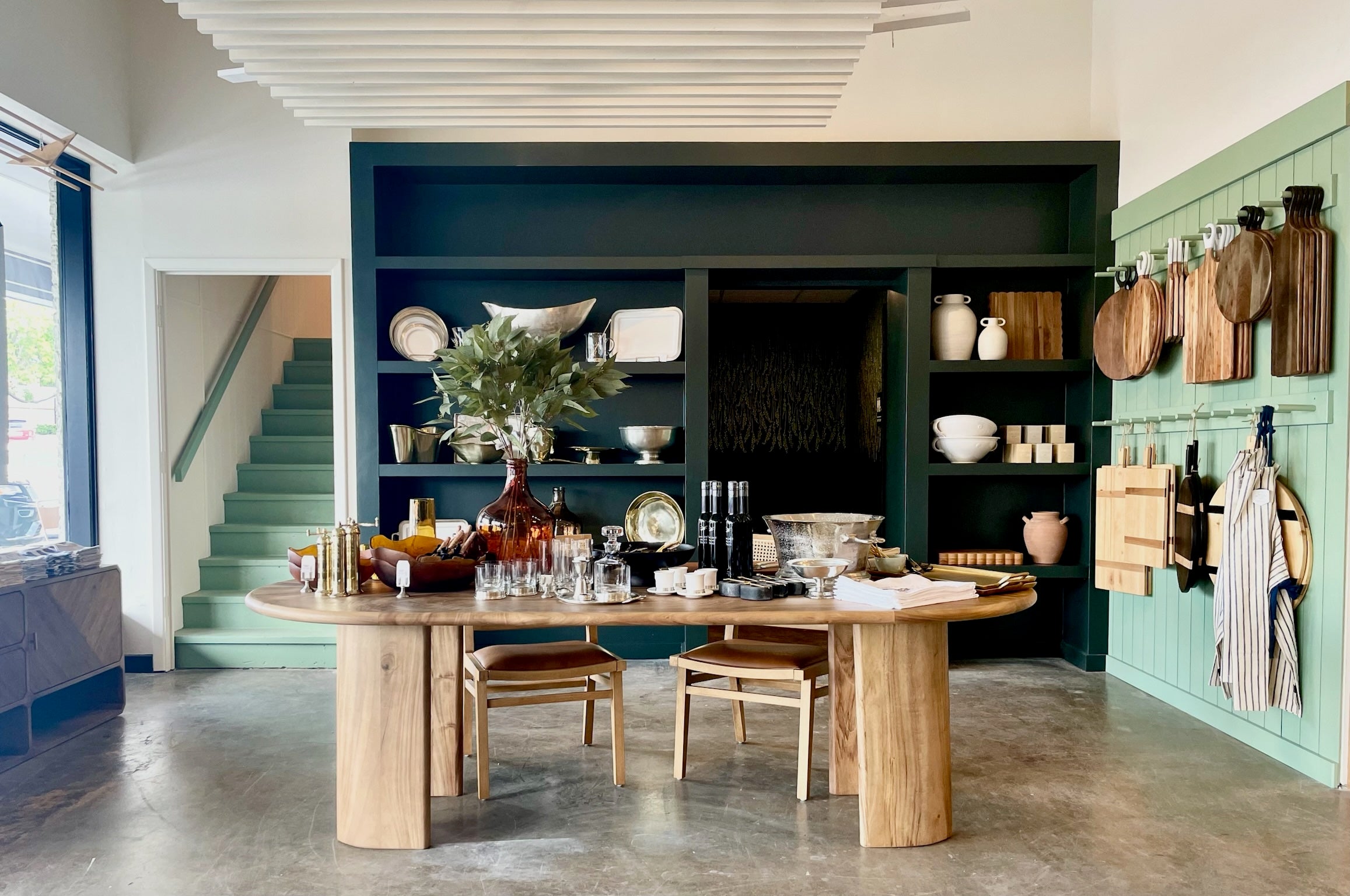
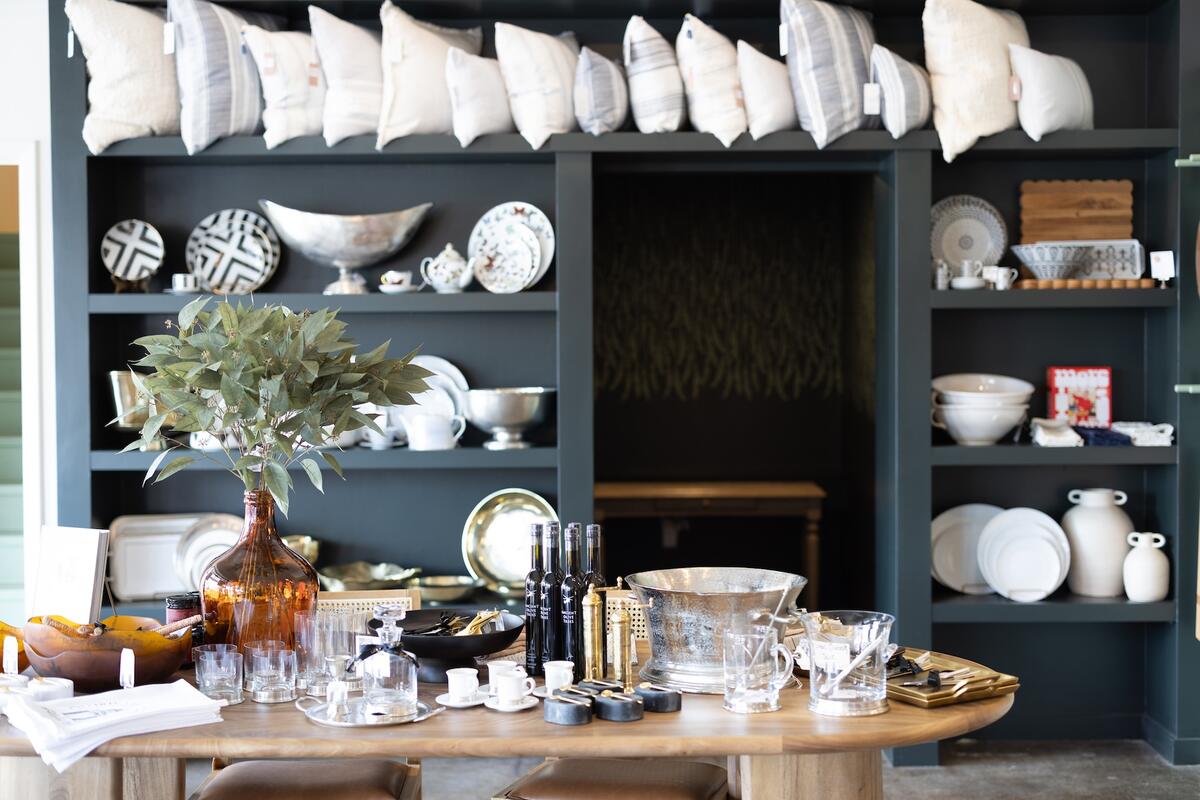
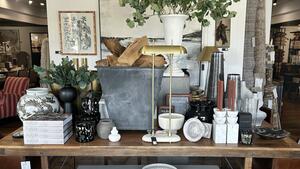
We expanded on the idea as a modern woman, and we conceptualized that she would be in her thirties. She had two young children, but she was independently wealthy. She had a trust. She was a blogger—that’s when blogging was still cool—and she had these great parties in her house. We wanted it to feel like you were walking into her basement in an old beautiful home, where she had laid out stacks of her dinner plates, her multiple sets of flatware, all her linen napkins. To [make it] feel like somebody’s home, we did residential-style millwork and cabinetry in the store.
Ana: That was the approach for the original store, and the ones that have followed all have a little fireplace mantle and a kitchenette.
Who would you say is your customer base? Is there any trade?
Ana: Trade is a really small percentage of our business. Our core customer is someone who’s just looking for something special, typically women between the ages of 40 and 60.
Brian: We definitely cater to an affluent customer, and that’s not necessarily by design—it’s kind of a necessity. You can’t be in retail small volume, which we are by default. We’re a small chain of stores, and low margin, so you do have to cater to a customer base that can spend. Our job is then to deliver on quality and experience. Like Ana said, we are tried-and-true retailers. We don’t really consider ourselves designers. We work with designers and we’re here to help designers, but we are focused, almost singularly, on providing a customer experience that is becoming more and more rare—and more and more difficult to do. That’s our guiding light. It’s a challenge, but also an opportunity, as others are opting not to do that, from a labor standpoint, from a payroll standpoint, from an experience standpoint.
What was the timeline of expansion? And how did you first know you were ready to expand?
Brian: To be honest, you’re never ready. For us, the intention was set early on. We were doing this together, which meant there wasn’t another income supporting the business. We had to prove the concept in the first store. Once we proved the concept and had a tiny bit of cash flow, we had to expand. I can tell you we underestimated the challenges of that scale! We operated a single store from 2014 to 2021, and expanding after Covid, it has been a very different environment. The cost of rents have not come down, but the cost of everything else has gone up. And as a premium brand priced above other options in the marketplace, [we’ve noticed that] the consumer has been pulling back. We view ourselves as perhaps in year three of another five-year cycle, at some scale. We can expand again, very slowly.
Ana: Once we started to prove our concept, we started looking: “Where else can we go in the market?” The original location was in more of a neighborhood center. We’re in Phoenix, and there’s just not a lot of small retail, but that really helped us when we started 11 years ago. We didn’t have a lot of competition, but we also didn’t have a main street where people could park and walk and shop and eat. We ended up going to a large shopping center in town [in 2021], and got the deal because they knew customers were looking for small businesses to support. They didn’t want to see the same big-box retailers.
Brian: They wanted that as part of their asset mix. We were paying a huge rent to be at a big power center, but you do get the traffic. We put our brand among Lululemon, West Elm, Apple. Hopefully we can get to a place where we would be determining markets versus single locations. We’re starting to learn that we’re probably not a suburban concept. We need more density. Our sweet spot is just outside the urban core, in neighborhoods, like Arcadia or Paradise Valley in Phoenix, Mission Hills in Kansas City, or Cherry Creek in Denver.
Ana: We’ve had an extreme amount of growth in the last few years. We’re on a pause now. We need to let all these stores mature.
Tell me about a favorite vendor of yours.
Ana: One of my newest vendors, which we found at market this past season, is Proper Table, started by Dana Lewis. She has all of these vintage fabrics she’s collected over her travels, and basically puts acrylic settings on them, so it’s placemats with that linen [finish]. During Covid, her daughters made [Gigi] Hadid’s spicy vodka pasta, and they set it on Dana’s grandmother’s white linen tablecloth and napkins. She was like, “I ruined the moment because I freaked out!” That’s how the idea was born, and I thought it was so innovative. It’s beautiful. You can totally understand it’s something you’ll have forever, but it’s made for actual everyday use.
Brian: They’re stunning, and it’s great when we find those things that match so well with our brand and what we’re trying to do. I appreciate any vendor that understands what a retailer needs.
What is a product that seems to fly out the door for you?
Ana: We have a couple of these. One is a locally made candle, Koko’s Candles. We burn them in the store, and people will come from outside because the aroma actually draws them in. It smells amazing, but what really sells it is the story behind it: A portion of the proceeds goes to [the Children’s Heart Foundation], because [founder Janeen Kokodynski] lost her son to a congenital heart defect. The stories are what our customers connect to, and what I’m drawn to.
What is your favorite day as a shop owner? When do you feel really in the groove?
Brian: The best days in retail have nothing to do with retail, and that’s the magic. We're not saving lives here. It’s a vehicle for getting to know the community. You have this wonderful little purpose in your life: an opportunity to meet somebody, and to make [their] day better than when it started. You have the opportunity to have a regular come in, and you’re not trying to sell them something—you’re just asking how their day is, [because] it is genuinely nice to see them. We give away things to people on their birthdays all of the time, or if they’re having a bad day. We’re a meeting place in a time when people getting together face-to-face is dwindling. We love when people see each other in our store, because we realize we’ve established ourselves as something that adds value. We are positioned in a really beneficial way if we take advantage of it.

 Withdraw Consent / Manage Privacy Preferences