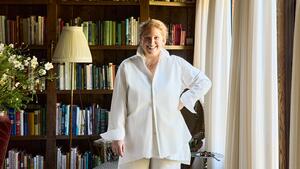




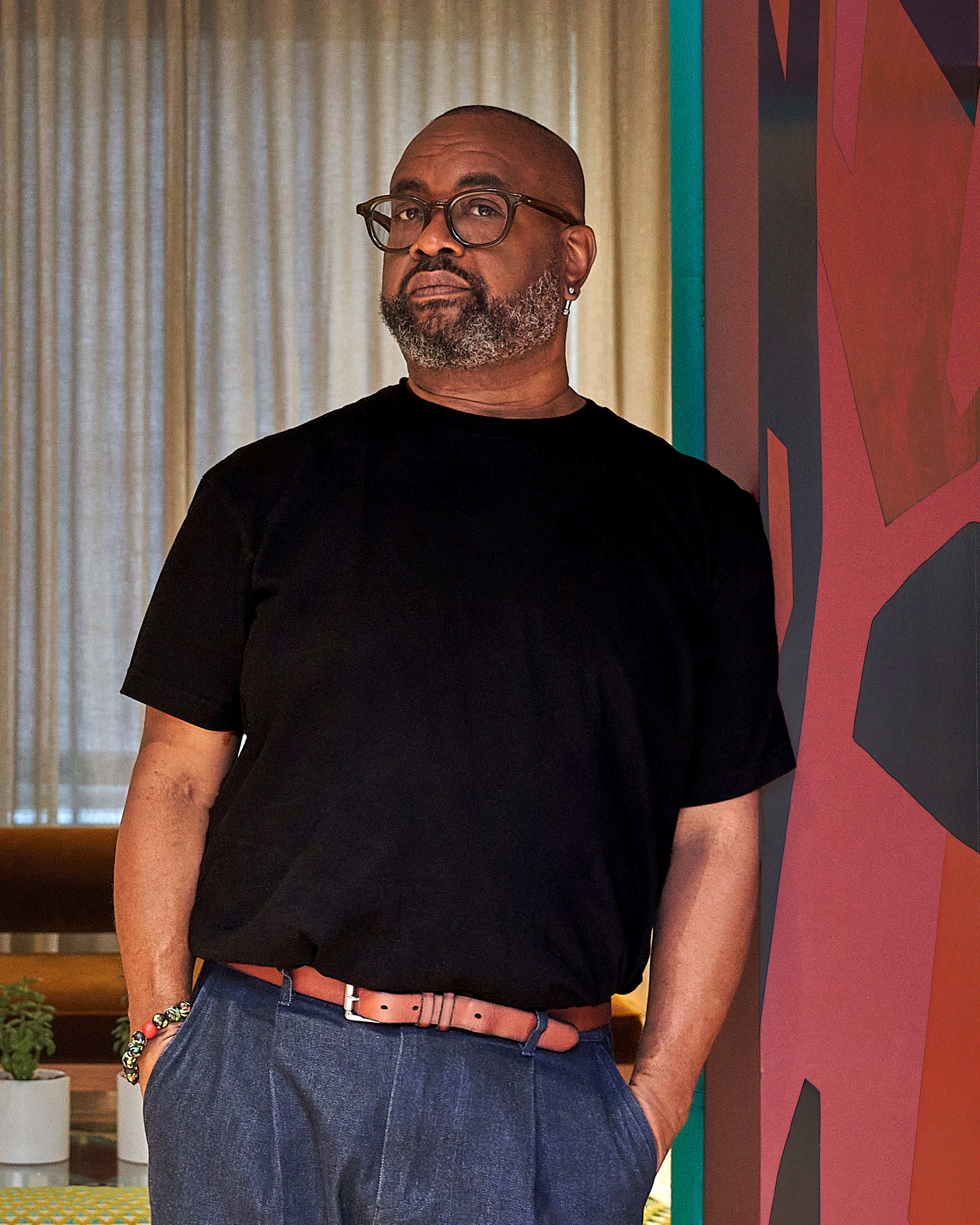

Leyden Lewis learned everything about creating a home from his mother, who emigrated from Trinidad and Tobago before settling in Brooklyn, making him the first person in his family born in the U.S. “I grew up in a faux Louis XIV, three-bedroom apartment. My mother was a domestic worker and worked for families on the Upper East Side, and I’m very proud to say that. She came back with information and a memory of what wealth might look like, and then she interpreted it,” Lewis tells host Dennis Scully on the latest episode of The Business of Home Podcast. “I grew up with that pride, the pride of creating what appeared to be a solid home, sumptuous and—I wouldn’t even call it wealthy; it’s an abundant home. That’s what my mother wanted to create for us.”
A creative at heart, Lewis attended The High School of Art and Design in Manhattan, then studied architecture at Parsons. He quickly started his own firm and, at 29, landed a room in the Kips Bay Decorator Show House in 1999. That was followed by a boost in media coverage, and then five years later he was featured in “Metropolis as Metaphor,” the Studio Museum’s seminal exhibit featuring the work of emerging Black architects. “It’s a series of huge-visibility moments and hustling, and then I’m starting to understand, ‘Oh, I need a network,’” he says of the growing realization that he should harness those connections to create demand for his work. “There are agents who put you in contact, there are design referral services—there are all of these different ways that actually get you in front of people. Thousands of people read The New York Times—who’s going to hire you?”
Over his decadeslong career, Lewis has landed a spot on the AD100 and Elle Decor’s A-List, yet despite his success, he doesn’t believe in project minimums. “Certain designers have exposure to certain clientele,” he says. “My clientele is within a certain financial bracket, and one of the principles that I have really learned is that we don’t say no to money, right? Someone comes to me and they say, ‘Oh, I got $50,000.’ Of course, I want you to have $5 million, but that’s not always the case. I think that we have to continuously be open to conversations around our value, because it might be an opportunity where this person is just doing a bathroom on their Tribeca home, but they have other properties, or they could be a referral-based [client]. I’ve got to be smart and know that what I would love to be paid for on every job is maybe not the real strategy. The strategy is to make contact and build my network.”
Elsewhere in the episode, Lewis discusses the importance of mentorship in the industry, what he would do differently if he could start his career over, and why you have to meet social media where it’s at.
Crucial insight: Lewis is not worried about AI, as he recognizes the human aspect of the job that technology can never replace. “AI cannot take a trip to Ghana and go to a market and eat the local food, and then go to a precolonial ceramicist space and witness women making pottery. AI cannot do that,” he says. “So it is up to us to integrate that into our DNA, pull that into our experiences, and somehow come up with a thought about how that can be fused with something, some action that we would take around our creativity, to show that we understood an experience that we had within design. I’m not afraid of AI at all, because I know that I have experiences as a very sensitive human being, and I’m very mindful about capturing memory and thought and putting it into action through design.”
Key quote: “What [is] published and what is the industry are two different things. Hopefully editorial is producing a series of images, vignettes and directives that show where the industry is and where it’s going, versus the meat of this industry, which is, I think, traditional design.”
This episode is sponsored by Ernesta and Kohler. Listen to the show below. If you like what you hear, subscribe on Apple Podcasts or Spotify.
The Thursday Show
Host Dennis Scully and BOH executive editor Fred Nicolaus discuss the biggest news in the design world, including a check-in on the housing market, RH’s debut in Milan, and whether contemporary kitchens have gotten too slick. Later, designer Sarah Sherman Samuel joins the show to talk about her debut book, The Intersection of Art and Design.
This episode is sponsored by Loloi and Resource Furniture. Listen to the show below. If you like what you hear, subscribe on Apple Podcasts or Spotify.