















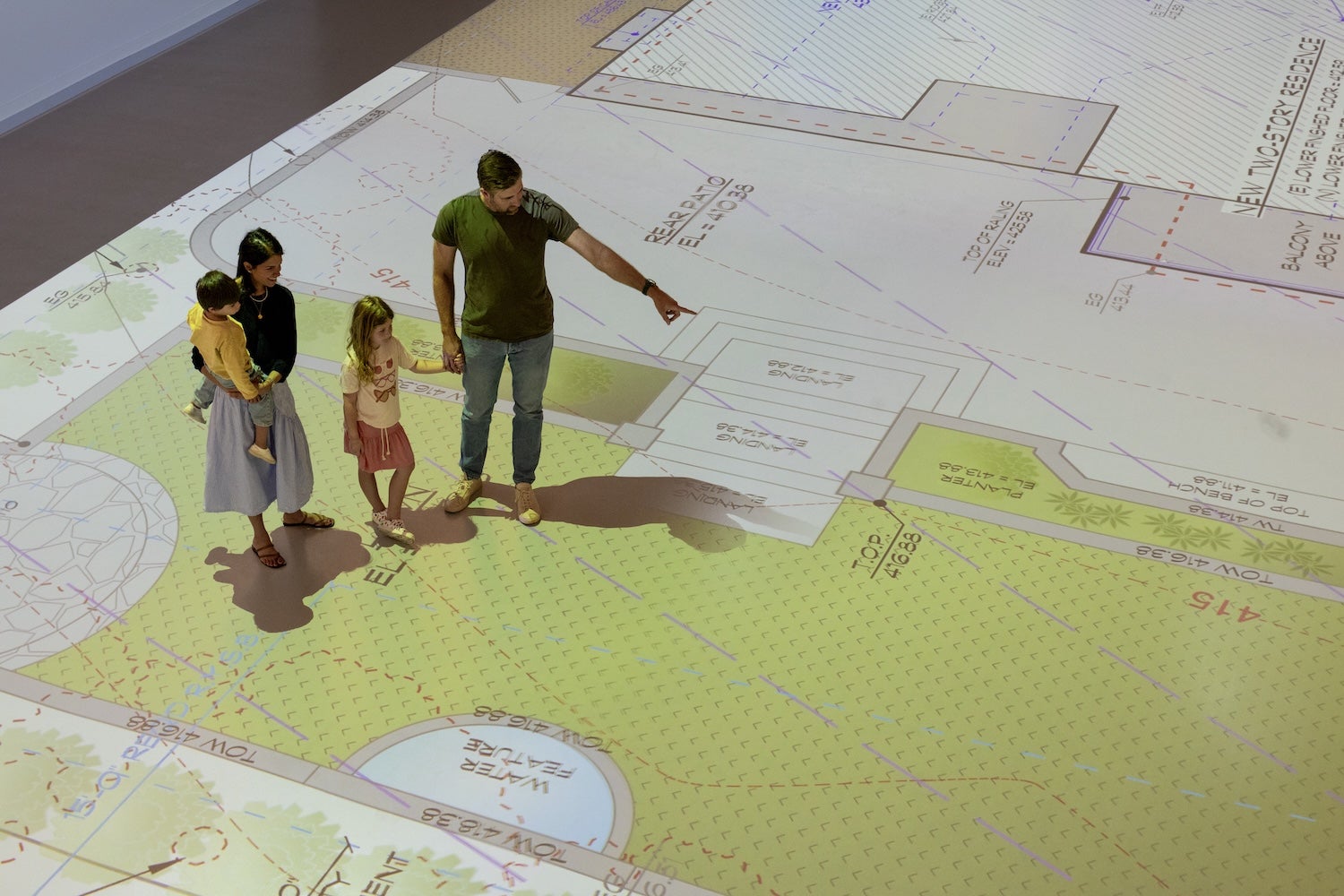

Renderings have their limitations. No matter how realistically crafted the digital boucle, or how dappled the digital light upon the virtual wood floors, they will always come up short in one crucial respect: the feeling of space. Enter Walk Your Plans, a company that looks to bring serious scale to the delicate art of project visualization.
The concept is simple, slightly wacky—and smack-your-forehead, why-didn’t-I-think-of-that logical. Walk Your Plans licenses its tech to local operators, who set up in enormous empty spaces like warehouses, abandoned factories and unused school gyms. Using specialized equipment, those operators then project the blueprints for a home onto the floor and the elevations onto the walls—in life size. Homeowners then “walk their plans” and assess the project with a true sense of scale.
“It’s really hard for the layperson to look at a piece of paper or a computer screen and envision the scale, the volume, what it’s going to feel like in the space,” says interior designer Kim Lapin, who opened a Walk Your Plans location in Los Angeles earlier this year alongside her husband, real estate investor Chay Lapin. “But when it’s to scale, there’s something about it that just clicks in your brain. Even a person that’s not very visual, they go, ‘OK, now I get it.’”
For designers, architects and contractors, the value proposition is obvious: How many problems with a new home have become clear only when the frame is up and the drywall is in? Walk Your Plans aims to give homeowners a chance to make changes on paper—a less expensive medium than wood and steel.
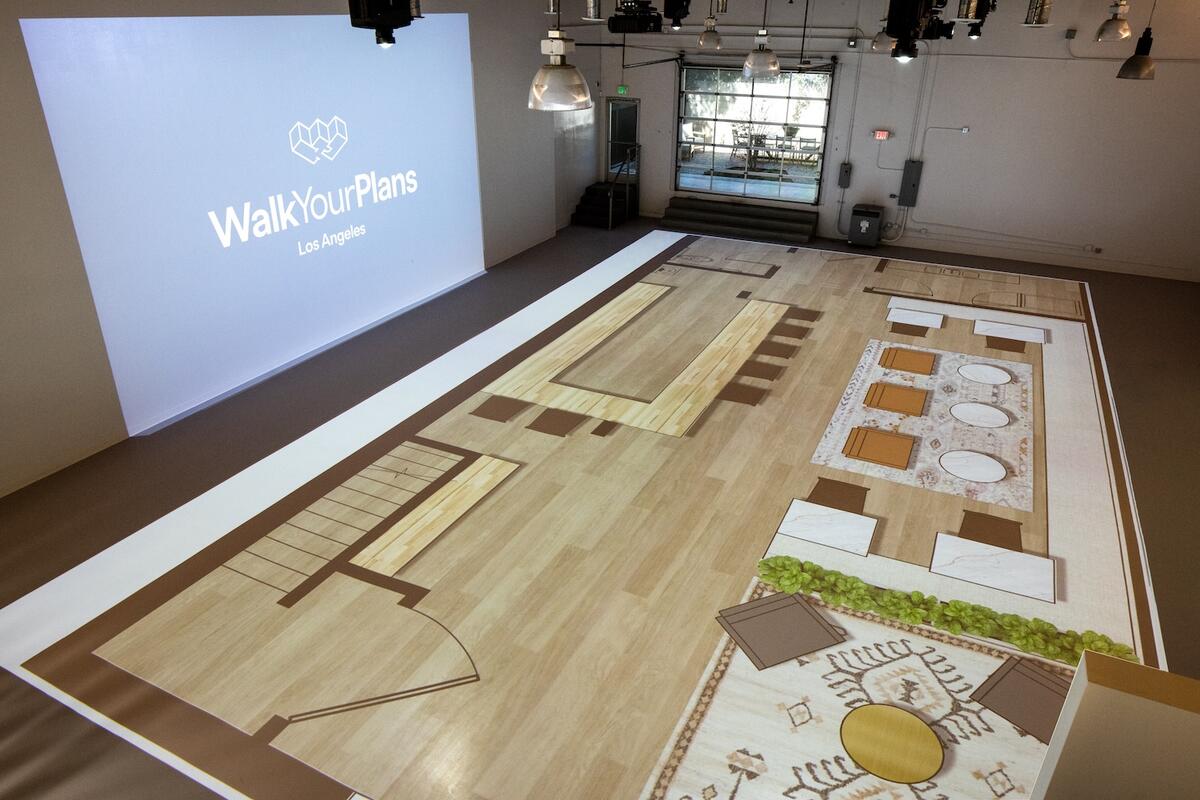
“My GC has [used Walk Your Plans] twice, and she was saying, ‘I’m going to tell every client and every architect we need to do this before every build, because we found 10 mistakes that would be a lot more expensive to fix in three months,’” says Kim. The experience offers a fresh way of spotting issues with clearances for kitchen islands, and the scale of primary closets and bedrooms. “[Clients] want a really grand space. They walk in, and they’re like, ‘This feels like a guest bedroom,’” she adds.
The technology also helps design teams and clients communicate more effectively. “When [clients] are just talking on the phone, their defense is up—they feel like they’re getting sold on something,” says Chay. “When they come in with their architect or designer, they realize, ‘This is a give-and-take: I can’t do everything, because sometimes it’s not possible within the square footage.’”
The Lapins’ L.A. outpost is only months old. The Walk Your Plans business itself is not much older. A few years ago, Ohio-based entrepreneur Joe Matejka put money into an Idaho investment property, but ran into a sizable gap in satisfaction between the blueprints and the finished article. (His joke: “The great room was more of a good room.”)
That was the problem. The solution came in 2020, when Matejka and a few partners had purchased a former Catholic girls’ school and renovated it for commercial use. The classrooms were rented out to local businesses, but the gym remained empty—until the experience with the Idaho project sparked the idea for Walk Your Plans. Early experiments proved the concept: Customers came in for the novelty and walked out thinking, “I need to make some changes.”
“People spent 90 percent of the time in the closets, bathrooms and laundry rooms, where an extra 6 inches to a foot can make a world of difference,” says one of Matejka’s partners, Jackson Heller. “The scale on a blueprint is a quarter-inch to a foot, and it’s very difficult to wrap your head around that. There was a gentleman who was wheelchair-bound [whose] master closet was 12-by-16, which seemed big. But when [we projected the plans], he realized he couldn’t get in and out of it easily. You never would have caught that on a blueprint.”
The business officially launched in 2022 and the early days were spent refining the technology and the experience. Viral social media posts helped bring the concept to a wider audience, and he has recently been in expansion mode. There are currently 16 open locations in the U.S., and 48 licensors have signed up; his goal is to open 120 outposts in the States, with international expansion on the horizon.
The Walk Your Plans experience will vary by region. In L.A., the Lapins are bringing a designer-friendly approach to the buildout, which includes a sample library, an attached kitchen, and as much personality as the space can handle. “There’s a wet bar, there’s beautiful millwork, there are mirrors to give it more depth,” says Kim. “We wanted people to feel like it was a residential space.” Their price ($1,500 per hour, plus a pro-rated fee for additional time) reflects both the pursuit of high-end clientele and the real estate costs of that market.
For the Lapins, the service has also taken on an unexpected poignancy following the devastation of last year’s wildfires. The couple offers a discount to clients who lost their homes in the disaster. The experience—surprisingly emotional even for the average customer—is particularly meaningful for someone looking to rebuild in the wake of the fires. “A lot of the people who come in are crying at the end of it,” says Chay. “They’re seeing: We’re finally to the next step.”
Looking ahead, Heller is eager to grow both the reach of Walk Your Plans and the technology that supports it. It’s not difficult to imagine a potential next phase of the tech—an AR or VR headset that fleshes out the experience into three dimensions. While he was coy on the details, he hinted at big things to come: “What we’re doing now is phase one of our business.”
Correction: Aug. 15, 2025
An earlier version of this story misstated that Jackson Heller, not Joe Matejka, had the idea for Walk Your Plans after his experience building a home in Idaho. Heller is a partner in the business, while Matejka is the founder.










 Withdraw Consent / Manage Privacy Preferences