











In 2007, Nathan Turner launched his first retail store on a stamp-size parcel of land backed by offices and a parking lot on North Almont Drive in West Hollywood. Glamorous it was not. So he brainstormed on how to turn his shop into a design destination, and hit upon a unique solution: Bring friends. Over the years he invited others from the L.A. design world—including Peter Dunham, Joe Lucas and Kathryn M. Ireland—to join him in the surrounding showrooms. They turned the parking lot into a courtyard garden and threw parties, hosted trunk shows, and unwittingly created an informal coworking space.
Though their physical offices were separate, the designers found themselves sharing contractors and bouncing ideas off one another, creating a cocoon of camaraderie and buzz in the larger community. “I feel very fortunate to have started in a place and around people that were so supportive,” says Turner, who dubbed the area Almont Yard. “We were all doing the same thing, and we understood that there is power in numbers.”
Coworking is no longer a novel idea, but communities like Almont Yard remain the exception in the design industry. While most don’t have a built-in physical community, some are looking to change that, creating spaces that encourage designers to share resources, trade experiences, and create a sense of connection that isn’t always easy to come by in their traditionally cloistered confines.
Next month in North Carolina, owner Hilaire Pickett Martin will open the doors to the new and expanded site for Raleigh Workup, an 8,700-square-foot coworking space catered specifically to the local design-build community, particularly designers who are either just starting out, looking to downsize, or searching for the middle step between working from home and committing to a full-time office. With shared sampling library and warehouse and conference spaces, as well as flexible per-diem work desks, the property aims to build community in a town that lacks design-centered gathering places.
“Entrepreneurship has wonderful qualities, but it can also feel really lonely,” says Martin, who grew up in the industry and worked alongside her interior designer mother before starting her own design consultancy business. “I wanted to bridge that gap and say, ‘We all share common workflows, challenges, timeline hiccups, success stories, so why not come in community with other designers in the area and grow alongside your peers?’”
Martin hopes to not only socialize Raleigh-area designers, but also educate them. “My dream is to support entrepreneurs no matter what stage of their career they’re at,” she says. “If you have a client escalation or you need some feedback on how to handle something, or you just won a project, our community at Raleigh Workup is gonna be there to problem-solve with you or give you encouragement or give you a high five.”
The benefits of a hub filled with members who are mutually aligned are obvious in a smaller market like Raleigh, where there is no central design industry hub. The calculus is different in larger cities, where a lot of the community coalesces around design centers. At the Atlanta Decorative Arts Center, the draw for niche coworking space is less about fraternity—though there’s plenty of that—but rather a rarefied level of access to design brands and vendors.
Though ADAC had already offered offices to designers in one of its buildings, ADAC West, in 2015 the company converted vacant space on the fifth floor of its main building into standard-lease studios that range from 300 to 1,000 square feet. The increased proximity to showrooms made the model even more enticing to designers, and in 2025, the center introduced 18 more studios over 18,000 square feet on the second floor. Designers sign on to minimum three-year leases and receive funds to make the studios their own through construction and other cosmetic improvements, as well as benefit from ADAC’s shared amenities: reception and conference rooms, a kitchenette, a mailroom, and access to the center’s marketing, social media and PR teams. The smaller studios are particularly attractive to designers because having a design center just steps outside your door nullifies the need for an expansive library.
“We’re creating this ecosystem, because you have your designers on campus every day, and they’re shopping the showrooms that are here and bringing their clients to the building,” says Katie Miner, the general manager of ADAC, who notes that the arrangement has not only reinvigorated square footage that couldn’t be leased to a showroom because of its more out-of-the-way location, but it also has become a selling tool to attract new vendors.
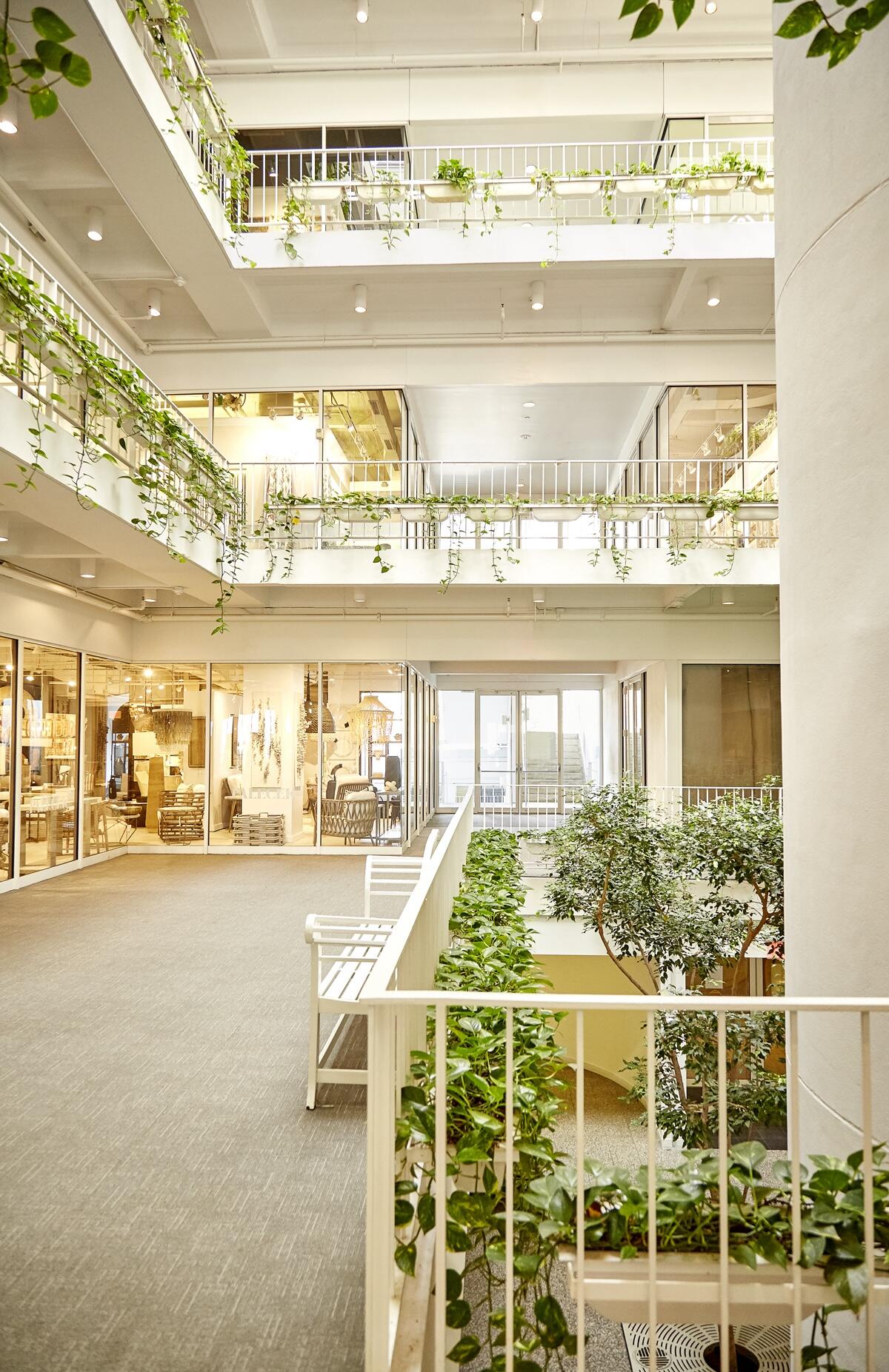
The convenience was a major selling point for Atlanta designer Tish Mills, who had occupied an office at ADAC West for 18 of the 26 years she’s been in business and jumped at the chance to move into the new studios, shifting from a stand-alone office to a shared workspace. “I open my door, and there’s a half-million square feet of library around me,” she says. “Being on campus has honed my productivity and how much I could accomplish in a day. But ADAC is also a family. If you need a special something, you can talk to a neighbor, or you bump into somebody in the kitchen and fall into conversation. It can be social, but it’s also, ‘Have you seen the latest James Dunlop fabric?’”
While you can find informal pockets of collaboration and networking in more competitive markets like New York—for a while in the mid-2010s, designers were flocking to lease spaces in buildings like SoHo’s 270 Lafayette—the concept hasn’t quite taken off on a larger scale, though not for a lack of trying. Aesthetically driven coworking spaces may appeal to creative industries, but selling the concept to designers themselves has been difficult.
In 2016, Maury and Mickey Riad, the brothers behind Italian heritage fabric brand Fortuny, opened Fuigo, a coworking space specifically geared toward interior designers in Manhattan’s Flatiron neighborhood that offered a shared memo library, business concierges and custom project-management software. But the Riads were forced to close its doors in 2019, having never achieved their dream of what Maury referred to as “a designer’s utopia.” On top of the daunting economics involved in renting out 18,000 square feet of commercial space in one of the city’s most desirable neighborhoods, the demand just wasn’t there.
Michael Diaz-Griffith, the CEO of the Design Leadership Network, has a few ideas why. “What’s interesting is that when I’m asked about this coworking dynamic, it’s usually by people who aren’t designers—businesspeople, people who own real estate, investors,” he says. “But when I’m discussing the idea with designers, they don’t like it.” The DLN invites visiting members to hot-desk at its New York offices, but hasn’t yet identified coworking interest among the local design community on a larger scale. “On the surface it sounds so great, but what I’ve found is that if you are a really sophisticated designer with a point of view, your library is very specific to your sensibility, your vendors that you have a deep relationship with, your expressions of custom work,” he explains. “At the luxury end of the residential design market, there can be some tension with the convenience of having shared resources and the reality that the most sophisticated firms pride themselves on having a strongly differentiated culture, library—and the list goes on. I almost see this as a physical analog for the algorithmic world we live in.”
That’s not to say coworking spaces can’t thrive in major cities, or that the concept can’t evolve with the times and shifting sentiments, but community comes in many different packages. “Our relationship to the concept of the office is changing,” says Diaz-Griffith. “For me, the question is how does any given practice find the community that energizes it, creates efficiencies and helps it to keep going. And some of those expressions could be physical and some might not be. We need to talk more about community needs in general. People need more community however they can get it.”








 Withdraw Consent / Manage Privacy Preferences