











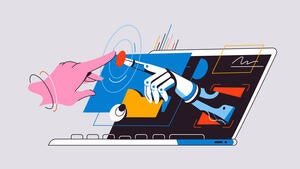
If you follow the AI chatter, you have likely heard the terms AI agent or agentic AI. These terms were likely accompanied by rhapsodic language describing a future in which everyone carries a high-powered personal assistant around in their pocket. You may have justifiably written them off as Silicon Valley fantasy. But last month, with the release of Meta’s Muse and OpenAI’s Dots, that vision got a lot more real.
In simple terms, chatbots talk, while agents do. If you’re asking AI for help buying wineglasses and you get a list of links, that’s a chatbot. If the tool navigates to a website, uses your credit card to buy the wineglasses, then sends an email checking in on the order a week later—that’s an agent.
Agents are not new. Tools like Codex or Claude Code (AI engines that write code) are agentic, as are Claude Cowork and ChatGPT Work. Design software platforms have been introducing agentic functionality—for example, Studio Designer has a tool that will log in to a handful of vendor websites and check trade pricing on your behalf. Some more tech-forward designers have even made their own agents for small tasks—like navigating the web for sourcing, or responding to new leads.
Nonetheless, the release of Muse and Dots represents a watershed moment: This is the first time that general-purpose AI agents have been released as mass consumer software. Muse was downloaded more than 5 million times in three weeks—one of only a handful of apps to reach that milestone so quickly. Once only used by early adopters and tinkerers, agents have now gone mainstream.
Early reviews, especially of Muse, have been generally positive. Muse can read your email and remind you about your daughter’s dentist appointment (or send an email canceling it). It can browse Facebook Marketplace for sconces you might like, and haggle with sellers on your behalf. The AI agent even has a voice functionality—users have successfully dispatched it to call and negotiate a lower energy bill.
Muse and Dots are far from perfect. For one, in order to make the most out of these tools, you have to allow them widespread access to your digital life, including your email and financial accounts, opening yourself up to potential privacy and security risks. For another, like all AI, they make mistakes—a series of embarrassing Muse gaffes are already making headlines. But still, consumers are clearly finding real use from these tools right now.
The longer-term, society-wide impacts can be somewhat mind-bending. Some have speculated that AI agents could crash banks by canceling accounts and moving customers en masse to higher-yield checking accounts in the name of optimization. Another odd but very likely possibility is that in the future, your agent will call your utility company to negotiate a lower bill, only to end up haggling with the company’s agent. Agents all the way down—these are strange times.
As with many AI advancements, it’s possible to see both the promise and the risks for designers in a single glance. Meta has already announced Muse for small business, and other companies will likely follow suit. The thought of having an automated tool that nags vendors, orders samples and negotiates lower bills will likely entice many a designer to give them a shot.
These tools have not been built with the design industry in mind. Muse may be particularly good at navigating Facebook Marketplace, but that’s because it was built by Facebook. Agents may struggle with the complexity of commerce in the trade, and it will be a while before designers trust their agents to handle custom upholstery orders. But even if agents can only do the grunt work—the follow-up emails and text reminders—they will likely be embraced as a godsend by firms large and small.
Then there’s the other side of the coin. When AI image tools got good enough to generate sophisticated and—let’s admit it—fairly tasteful interiors, many designers rightly pointed out that the creative concept was really only a small fraction of the work. Until the robots could make sure the painter showed up before the upholstery arrived, the thinking went, designers were safe. Now that agents are tiptoeing ever closer to facilitating the execution of a design job, the proficiency of tools like Muse at coordinating plans and communicating via email, text and even phone may lead to some existential panic.
In truth, it seems unlikely that even the most advanced AI agent could manage the complexity of a design project. These tools excel at relatively simple, short-term tasks, not the vast amount of detail that goes into a two-year renovation project. More pressingly, they don’t exist in the real world—they can email the painter, but can’t supervise his work. There’s also the emotional component: Most clients need a side of therapy along with their design work. Agents can’t do that.
But it seems equally unlikely that AI agents won’t change the design business. As designers fold the tools into their workflow, it won’t be lost on clients that less time is being spent on administrative tedium. This may in turn lead to new pricing debates—how to charge an hourly fee during procurement, for instance, if agents are doing a lot of the work.
The dynamic will also create new HR complexities, especially at the junior level. If a lightly supervised agent can perform many of the same duties as a recent grad, how will firms choose to hire, and how will the next generation of designers learn their chops?
The cultural angle will also be a curious one. You can have an agent send follow-up emails to your favorite vendors, but how will they feel about it? And how will you feel if, instead of your client texting you about an order gone wrong, you get a pointed note from the client’s agent? Relieved to not have to deal with their anger, or insulted that they couldn’t bother to take the time?
Not sure? Ask your agent.












 Withdraw Consent / Manage Privacy Preferences