










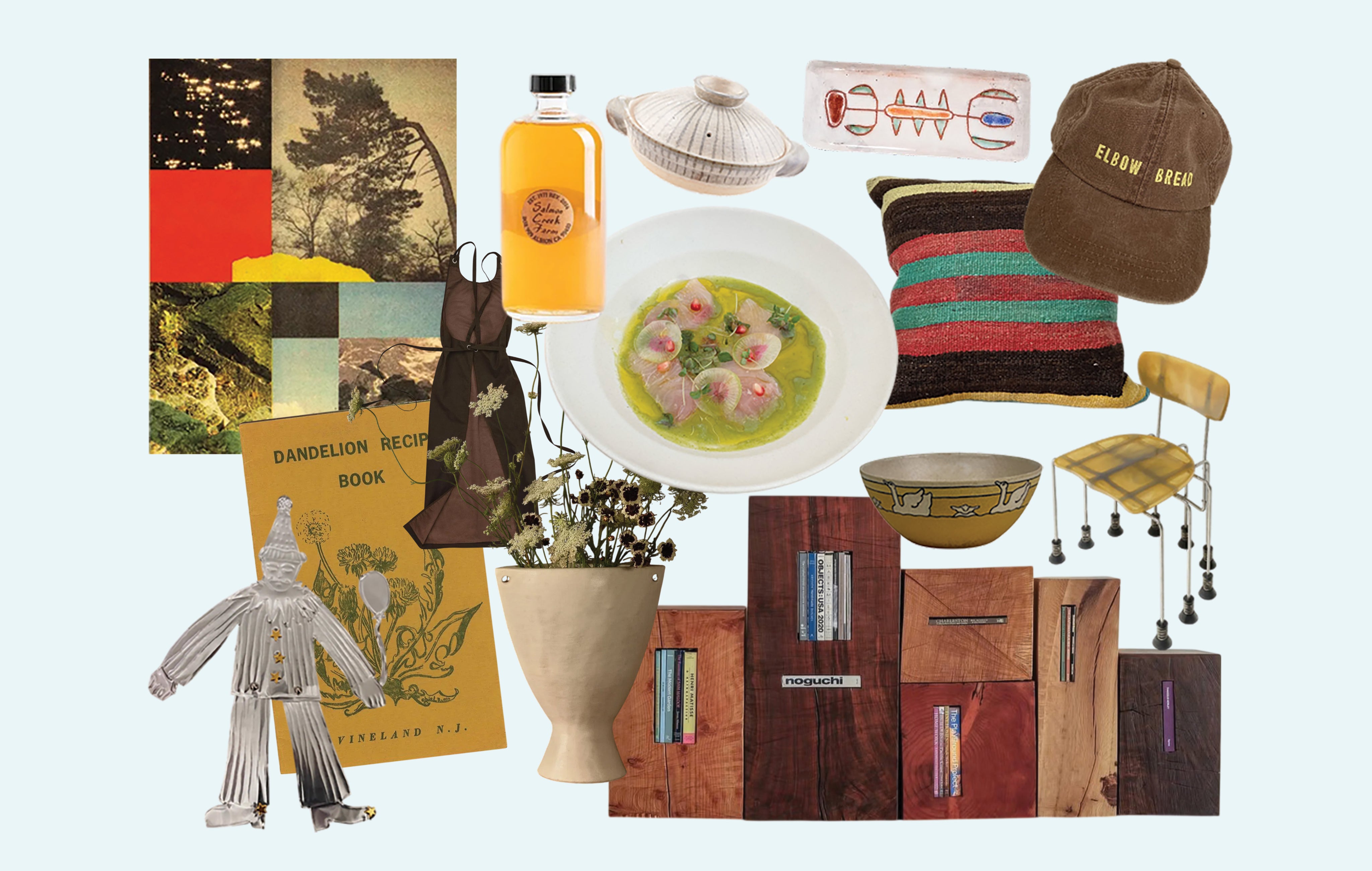

Tired of AI slop taking over your social media feed? Rec League may be the solution. Founded last year by James Kylstra, Chris Mueller and Grier Stockman, the social media platform is a way for users to make recommendations across categories like food, clothing, music, furniture and art—and engage with other users’ suggestions. “We want Rec League to be the place where people go to find great things,” Kylstra, the company’s chief technology officer, tells Business of Home. “There’s a role for Google. There’s a role for AI and a more generic kind of search. But if you’re looking for something really special, something unique that comes [from] a human, Rec League is going to be the place where you go.”
Kylstra and Mueller, Rec League’s CEO, were software engineering leaders at Substack until 2024, and after they left the company they stumbled onto the idea while designing a craft marketplace. “Sellers could recommend other sellers, and that recommendation system was really interesting, and there was a thought that maybe the recommendation could be the whole thing,” says Kylstra. Stockman—who was previously the chief marketing officer for her sisters’ textile brand, Block Shop—started as an advisor for Rec League, and then became co-founder and CMO. The trio raised a small funding round from friends and investors, began coding last summer, and launched in January.
“Our overarching thesis was that it was too hard to find quality information online,” says Stockman. “There’s too much noise on Instagram. Where is the really excellent edit? In our very early days, we were building off of some of my network in the design world and elsewhere. We went after people who have incredible catalogs of information and exquisite taste.”
One of those people was Amanda Hesser, co-founder of Food52 and writer of the Substack newsletter Homeward. “I often have product recommendations, and I can put them into my Substack or I can post them on my social channels, but there was no place for me to gather and categorize them and create a place that people could revisit,” she says. “While I was renovating a house [in Ojai, California,] I created a spreadsheet of small goods that I was looking for, whether it was jars for my pantry, a stove or a set of bowls. I was thinking all along, ‘Oh, this would be so great to share with my community, but there’s no easy way to do it.’ The stars aligned.” That list now lives on Rec League.
Hesser also appreciates that the platform isn’t limited to products—some users recommend places as well, like the best spots in New York to see the sunset. “These little glimpses of life that they highlight on Rec League: an insight that they had, or a quote that they read, or even just a little portion of a song that they thought was really great,” she says. “I feel a joyfulness about Rec League. It’s not just about, ‘Here’s a cool product,’ but ‘Here’s something additive to your life.’”
Traci Fleming, president of the Los Angeles–based design firm House of Honey, was another early adopter, and has used Rec League as an extension of her Substack, The Wonderlyst. She developed “Lust Lysts,” a collection of things she’s inspired by, divided into categories for home and design, jewelry, art, and travel. “It’s the perfect mix between Pinterest and Instagram,” she says. “The interface is so easy to use, and the real beauty of it is the community.”
The platform is simple and free, built on an algorithm designed to tailor recommendations without overmanaging user feeds. “There’s a very lightweight algorithm, but for the most part, the algorithm is just, ‘Who have you chosen to trust?’” says Kylstra. “It’s the algorithm of allowing other people to curate your feed for you.”
That approach is a huge plus for Fleming. “Instagram used to be a cool community for me. It still has a place, but the rabbit holes that I used to find that I could go down on Instagram no longer really exist because it’s so algorithmed up, and it keeps feeding me what it believes my taste is back to me over and over again. I’m not able to discover in a way that I used to back in the day,” she says. “But on Rec League, the rabbit hole factor is there for me, and while everything may not tickle my fancy, it does remind everyone that taste is really personal. I love seeing what other people get inspired by, and I’m not able to do that anymore on those [other] platforms. They’ve taken away the joy of discovery, and Rec League has brought it back.”
Seven months in, Rec League has already gotten the attention of design-world heavyweights, among them David Michon, editor of the popular Substack For Scale; Sight Unseen founder Jill Singer; MillerKnoll creative director Kelsey Keith; and Joanna Goddard, the lifestyle blogger behind Cup of Jo. Furniture brands have also crept onto the platform, not just to sell product, but to interact with the community. Russell Hill, a co-owner of the Los Angeles–based furniture brand Rad Furniture (and Stockman’s brother-in-law), joined the platform in its early days as an individual, but quickly realized the benefits of an account for his company.
“I thought that it was an interesting place for a brand to be, and to think about that approach to merchandising and offerings outside of our catalog as a different way to interact with our audience and potential customer,” says Hill. “[It] doesn’t have to be something where you’re just constantly selling your own product; it can just be a way of engaging in conversation with the people that follow you. We can do a little bit of storytelling that breaks through the Rad brand and says, ‘Here are things that we love in our neighborhood,’ or ‘Here’s what we’re reading to get inspired for new designs.’ It brings a casual, fun conversational element.”
That’s something everyone agrees on about the platform—it’s just fun. “You’ll start noticing pretty quickly that Rec League is uniquely positive, and we talk about it as kind of the last great corner of the internet, because ultimately the building block of the platform is a recommendation, and recommendations are inherently positive because this is something I recommend, something I love and something I value,” says Stockman.
Rec League does include simple ways for users to make money. Account holders can opt to put some of their recommendations behind a paywall. The fee structures are flexible: Users can choose to have followers subscribe for access to everything they post, just specific edits, or even individual recommendations within those collections, and then Rec League takes a small cut of the subscription revenue. Users can also post recommendations using affiliate links and generate income that way.
Hesser has a mix of free and paywalled collections (for example, $20 for Kitchen Tools), and charges $125 for an all-inclusive annual subscription. “Everything I bought for my Ojai house, I put behind a paywall, because it’s a very extensive list, and I put a lot of research into the things,” she explains. “I’ve been trying to be thoughtful about where I put paywalls. For instance, while I did a lot of research for clothing, accessories and skin care, I just felt like that was something that should be a free collection in my case. If somebody is an annual subscriber for my Rec League, they’ll get every collection that will continually update. So it’s not static—you’re buying into a dynamic, ongoing feed of that particular person’s recommendations.”
For Fleming, she’s able to engage with a truly supportive online community, something that is hard to come by these days. “Some of my lusts are true lusts. There are things that are beyond anyone’s price point, and nobody has ever said, ‘How dare you recommend something that nobody could buy.’ Nobody’s ever talked down to anybody for what may be a mundane kind of recommendation,” she says. “There’s just a lovely sense that everybody’s voice is welcome here, and we’re all learning from one another. The simpler recommendations are often really wonderful reminders about how to be a beautiful human. It’s been really nice to see people supporting one another and seeing good humanity play out on this platform, especially in light of what’s happening in our world.”