













In our new series Ask an Expert, we’re speaking to the specialists who help design firms thrive. This week, we spoke with New York decorative artist Anne Harris, whose eponymous studio has flourished for over three decades thanks to large-scale collaborations with designers.
Here, Harris shares how a stint selling advertising at Town & Country contributed to her early success, the key differences between her custom murals and hand-painted wallpapers, and the freedom that comes with attaining enough success to feel comfortable saying no.
What drew you to interior murals?
I’ve painted since I was a child. My mother realized that there was one side of my brain where there were dust bunnies and on the other side, I could paint. So I’ve taken art lessons since I was little. But the first time that I went to Italy and saw frescoes and what they could do for a room just absolutely changed me. It’s the importance of being somewhere and seeing something. I had certainly seen pictures [of frescoes] in books, but until you get into that room and the ceiling explodes and the walls recede—I was really taken with it.
And how did you start painting professionally?
I was fired from a job. In the 1980s, I was working at Town & Country selling advertising, and fortuitously was let go when a number of other people were as well. There was a change in the publisher, but I should have been fired anyway. I was terrible at it. I knew that I could paint, but I could never figure out how to make a living painting because I didn’t know how, as an artist, you make any money.
My husband was a freelance photographer, and he said, “You can do this.” In the ’80s, decorative painting was everywhere. And I kept seeing [decorative elements] that I wanted in our home but I couldn’t afford. So I thought, “I could paint that.” I took a couple of classes [on] marbleizing and glazing and that sort of thing, and it came easy. And every time I would be out somewhere, I would just try to talk someone into letting me do a mural, because that’s really what I wanted to do. Sometimes you just need to be careful what you wish for, because it happened. My whole business now is just big murals.
Tell me more about how you started getting clients—and especially how you started working with interior designers.
I knew Charlotte Moss. She had a [design] shop on Lexington Avenue and 74th Street, and my apartment is on that same block. I started by doing painting jobs for her shop. I also did a lot with Juan Pablo Molyneux. I did some marbleizing projects for him at first, but I let him know that murals were something I did as well, and we worked together for 15 years. It was slow, but between decorators and meeting people, I kept getting work. And I’d just call people. Because I had been in sales—even though I was bad at it—I wasn’t afraid to pick up the phone. I think that was important. If my photographer husband didn’t have work, he would lie on the sofa and read. He didn’t have a background in sales. So, actually, the time working in sales was one of the best things I’ve ever done, even though it was hard and it was not fun. Once I started pursuing painting as a career, it only took me about three months to have clients, and I’ve been working full-time for the past 35 years now.
What’s your intake process like? How do you decide to take on a job?
Someone will get in touch—I would say it’s usually about 65 percent decorators and 35 percent individuals. I’m still always surprised where someone’s found me on the internet, because I just would never dream that would work. But someone will call and tell me what they’re thinking. For example, someone with a new home got in touch recently, and they want a mural in their dining room. They sent me the dimensions of the room, the wall elevations, and then sent some pictures of what they had in mind. I saw the pictures they sent and I was like, “I really don’t want to do this job.” I’m finally at a point in my life where I can say no. It just wasn’t a style I was interested in.
But, more typically, if it is a job I’m interested in, we send inspiration images back and forth until we’ve come up with a direction we agree on. From there, I’ll do a mock-up of the colors and the designs. I don’t use the computer very well, so it’s usually hand-painted—a really rough sketch. Once they sign off on that, I request a deposit. It depends on the client and depends on how much it is, but sometimes it’s half, and then another 25 percent halfway through, and then the final 25 percent at the end.
I’m sure there can be a ton of variation, but typically how long does a project take you?
Nothing takes less than three months, and my most recent mural took a year and a half. It depends completely on what I’m painting, and everything takes longer than I think it should. In the past five years, I’ve been doing some really massive pieces—I did the ballroom for the Houston Junior League, which was 12 feet high by 150 feet long. I don’t usually work with other artists, but sometimes I have to, and that was an example of that. As you can imagine, every artist paints a little differently, so it’s not an easy thing to do as a team.
There are certain details that can make the project take less time, like it’s only above the chair rail, or it’s a foggy landscape that doesn’t have as much detail, but honestly, I’m known for my details, so I don’t do those very often.
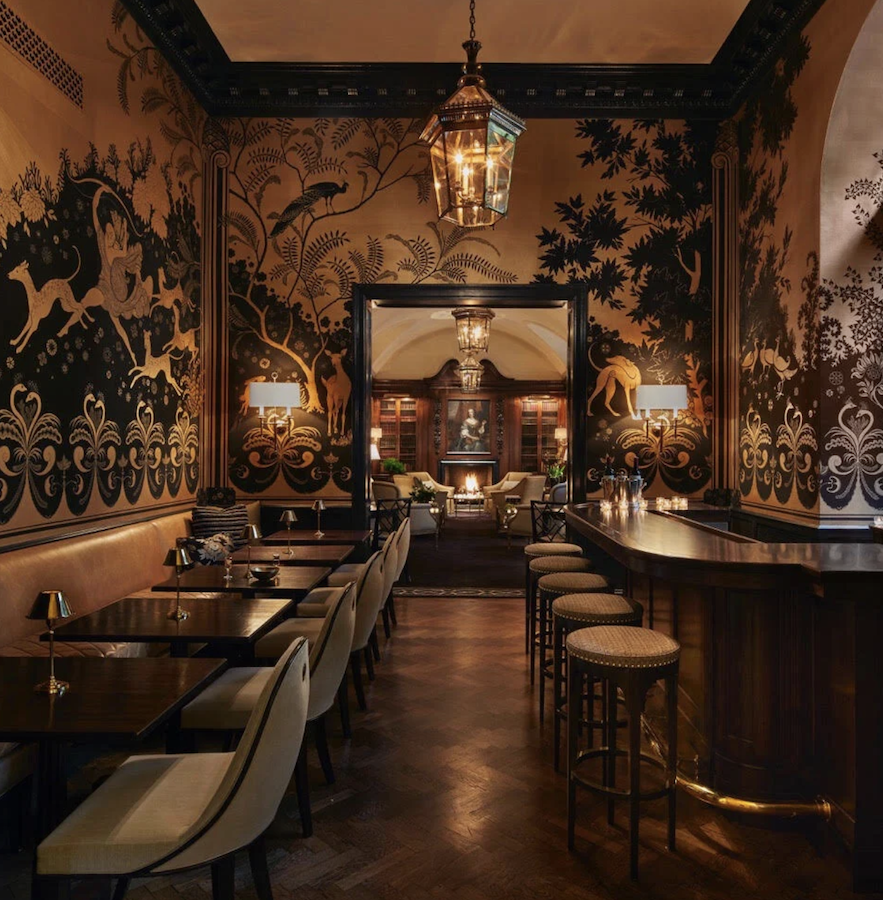
I did the Women’s Athletic Club in Chicago and it ended up really, really nice. It looks simple because it was just two colors: black and gold. But each leaf took at least three coats just to cover—just to get it the dark, black color. Even simple things take up more time than you ever think they will, or certainly more than anybody who isn’t a painter thinks it will take.
Where do you work?
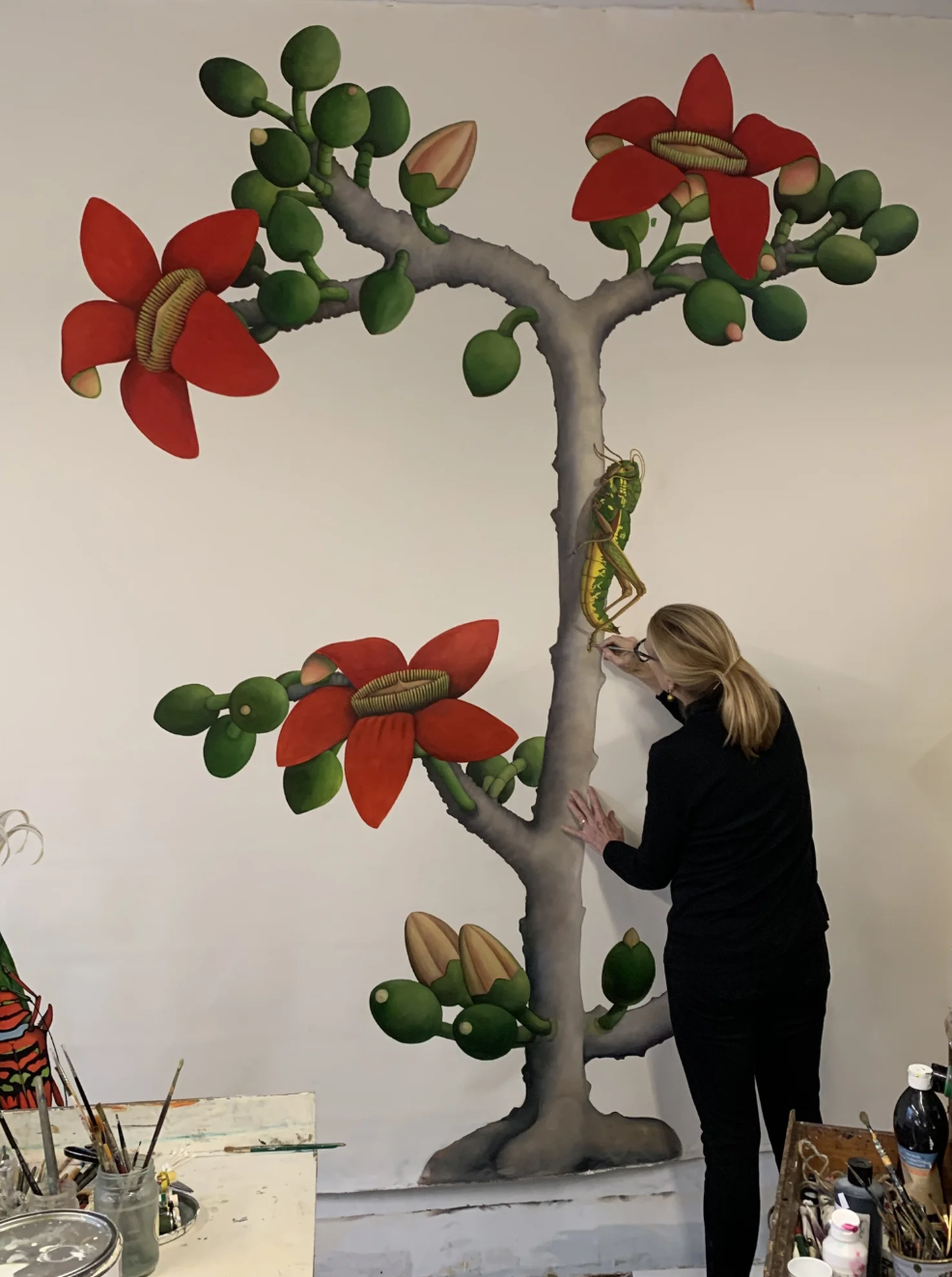
I work on canvas in my studio. I’ll go [to the site] to measure it all out and do a sketch around the room. I’m looking at details like: What’s your dominant wall? What are the quirks in the room that might be hard to read on an elevation? Then I do the mock-up in my studio for the client to approve, and then I go to work. Right now, I’ve got a 22-foot-by-12-foot mural up for a Miami client, and I just staple it up here. When it’s done, I’ll ship it down, and then I’ll go down to oversee the installation and touch up as needed.
Is that installation aspect nerve-wracking?
It didn’t used to be. I used to say that any good wallpaper hanger would do. Wallpaper hangers usually take themselves quite seriously, and I would never give them a suggestion for how to hang a wallpaper paper—but canvas shrinks. If you start angling it wrong by a quarter of an inch in the beginning, by the end of the wall, that becomes a foot and a half off. I know the pitfalls. And while I can always correct things, sometimes the touch-ups are just killer due to a paper hanger who wasn’t listening. But usually, it’s fine because I’m there. I don’t ever have an installation where I’m not there.
How would you explain to designers the difference between your work and hand-painted wallpaper murals?
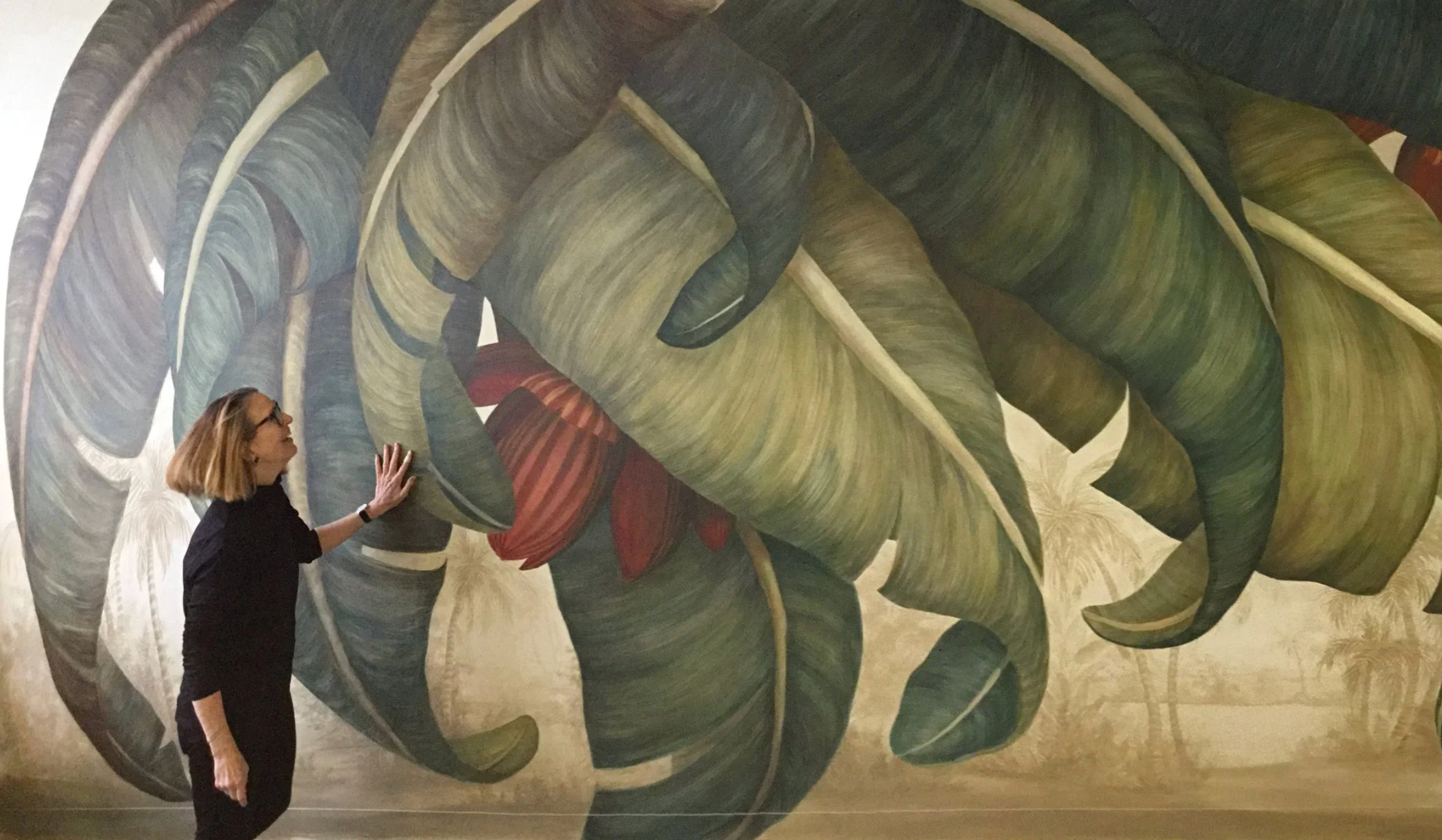
I often do oversized, overscaled details. So for example, in a wallpaper from someone like Gracie, their trees go up to the top of the ceiling, and it sort of stops and they peter out. Whereas, if it’s my trees, they go up and out and back over and come back in these huge branches. I go for a more monumental feel. My work is more for the unique space and the person.
I just finished a double-height mural around a staircase in Southold, on Long Island’s North Fork. It’s very agricultural out there. They have these beautiful sunflower fields. I painted an 18-foot-tall sunflower—it goes up the stairs and it’s fabulous. It’s very bold. It’s got a great depth of color, and they wanted it sort of dark, which very few people do. But it reflects the place, which I think wallpaper companies have a harder time doing. And I do maps a lot, which are in the style of the Gallery of Maps in the Vatican. I do maps of the places that people live or their favorite places. It’s personal to the [client], and usually taps into an awareness of the place. My particular style is bigger and bolder. I think wallpaper murals are more decorative and pretty. Mine are less pretty and more commanding.
Looking for an expert? From accountants and attorneys to fabricators, installers and artisans, the Business of Home Find an Expert directory connects you with industry professionals and skilled trades with the knowledge to bring your vision to life and move your business forward.