

















It was bound to happen: Havenly has rolled out an AI design engine. The free tool, launched in beta this week through the online design platform’s iOS app, allows users to upload an image of their room and get an algorithmic glow-up.
“Either someone is going to do this and disrupt us, or, hey, we’re actually pretty well positioned to do it ourselves,” says Havenly Brands founder and CEO Lee Mayer, who is quick to note that the tool is an experimental work in progress, not the finished article. “We’ve got the data, we’ve got the designer perspective, we’ve got humans in the loop—there’s a lot of good reasons for us to try it.”
In many respects, Havenly’s new feature is of a piece with the rush of AI-powered design tools that have sprung up since the release of ChatGPT in 2022. Users submit their space, go back and forth with a chatbot, and receive a rendering, which they can then tweak. The tool has the typical flaws as well. For example, when given a photo of a space, it will sometimes add or subtract windows and doors, or otherwise warp the architectural envelope of the room. (Mayer says the company is working to fix this problem.)
However, in subtle-but-meaningful ways, the brand’s AI tool has some interesting distinctions. Many competing products struggle with fine-tuned adjustments—requests like “make the sofa brown instead of blue,” or “replace the side table with a lamp.” Havenly’s has an interface that allows users to press and hold a finger on specific elements in a room to make small changes.
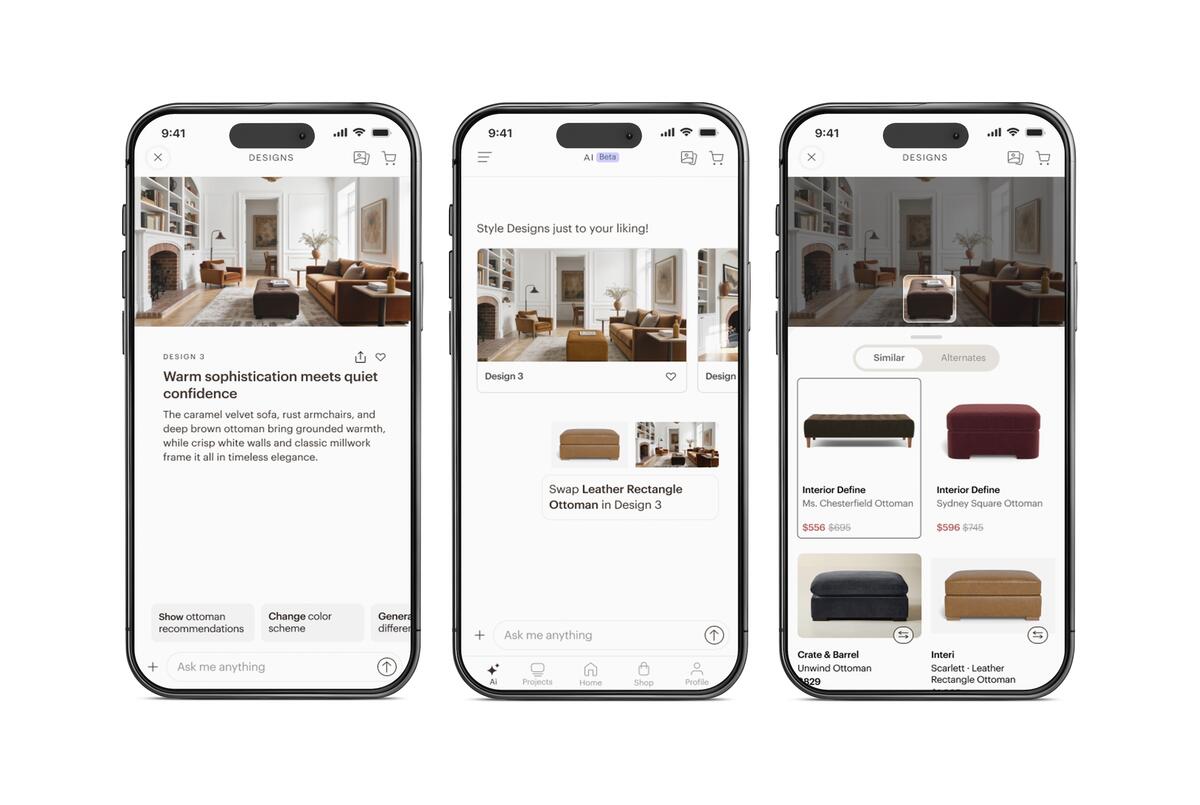
The engine is also distinct in that it will provide links to shoppable products within its AI creations; many similar tools don’t. The method used to get there is backward—it creates furniture algorithmically, then attempts to match “invented” pieces with actual items in Havenly’s catalog. The match is rarely exact, but if the AI generates a gray sofa, you’ll get links to real gray sofas. That’s an improvement upon early versions of this technique, like Wayfair’s now-defunct Decorify, which would make bizarre mistakes like confusing an AI-generated chandelier for a decorative birdcage.
Havenly’s tool also tends to produce results that seem a little more interior designy than those of many other platforms. The proportions, the layouts, the baseline taste all feel competent in a way that can’t be said of all AI design. No surprise there, as Havenly’s tool was trained on the vast body of work—some 2.4 million proprietary renderings—executed by its own (human) designers over the course of a decade-plus in business.
Artificial intelligence is not a new technology for Havenly. The company had long relied on AI-powered backend tools for product selection and rendering that Mayer says have allowed its designers to work more efficiently. Making a consumer-facing tool was a matter of merging those systems with new features, and putting it all together in a user-friendly package.
“It’s all the designs we’ve ever done, and it’s also fed with an understanding of whether or not the customer liked the design,” says Mayer. “We have a lot of indications around that, as well as the products associated with the design, and things like how old the design is. There’s a trend-based thought process there.”
Intriguingly, this is the rare AI engine that’s quick to hand users off to a human. While it will generate a rough layout swiftly, the chatbot will strongly suggest working with a Havenly designer when users ask for too many complex changes.
“We’ve had this in test mode over the last five to seven days for a small group of people. And what we found is a lot of people are using it [for free], and then are [upgrading to paying] for a designer,” says Mayer. “There’s just so much more that a human can do right now. My guess is that [AI] expands the scope of people that will use some sort of design tool. But I don't know that it will replace the human designer. Maybe that’s naive.”











 Withdraw Consent / Manage Privacy Preferences