







Dear Sean,
I’ve noticed a worrying pattern with my employees. It seems that once people have worked for me for a few years, there’s often a backslide: They feel like they can coast, or that they’re entitled to come in late, and there has to be a corrective conversation. I don’t like this dynamic. How can I maintain motivation without needing to have awkward conversations?
Sincerely,
Being Proactive
Dear Being Proactive,
I love this question because it says so much more about you than it does about your employees. Of course we all want those who work for us to be productive and engaged in their work. If you have to have the tough conversation you speak about to wake up those who are too comfortable in their work (and presumably not rising above the competence bar), then maybe that is just what you have to do.
If you are invested in a factory-type model where everyone is tasked with, well, tasks, then it will be inevitable that those doing them will see enthusiasm wane given their repetitive nature. There are many firms that run this way—if this is how you wish to continue, I am not sure that you will be able to prevent the need for (not so) gentle reminders of what is expected of your employees.
However, if you are willing to rethink what you expect and how you might foster growth in your employees so that they are constantly engaged in their work for you, then keep reading.
I am guessing that you are the primary designer and salesperson for your firm. You are the one landing the clients and are principally responsible for the design of their project. Your employees are there to support the design effort, and then likely manage the production, procurement and installation work to be done.
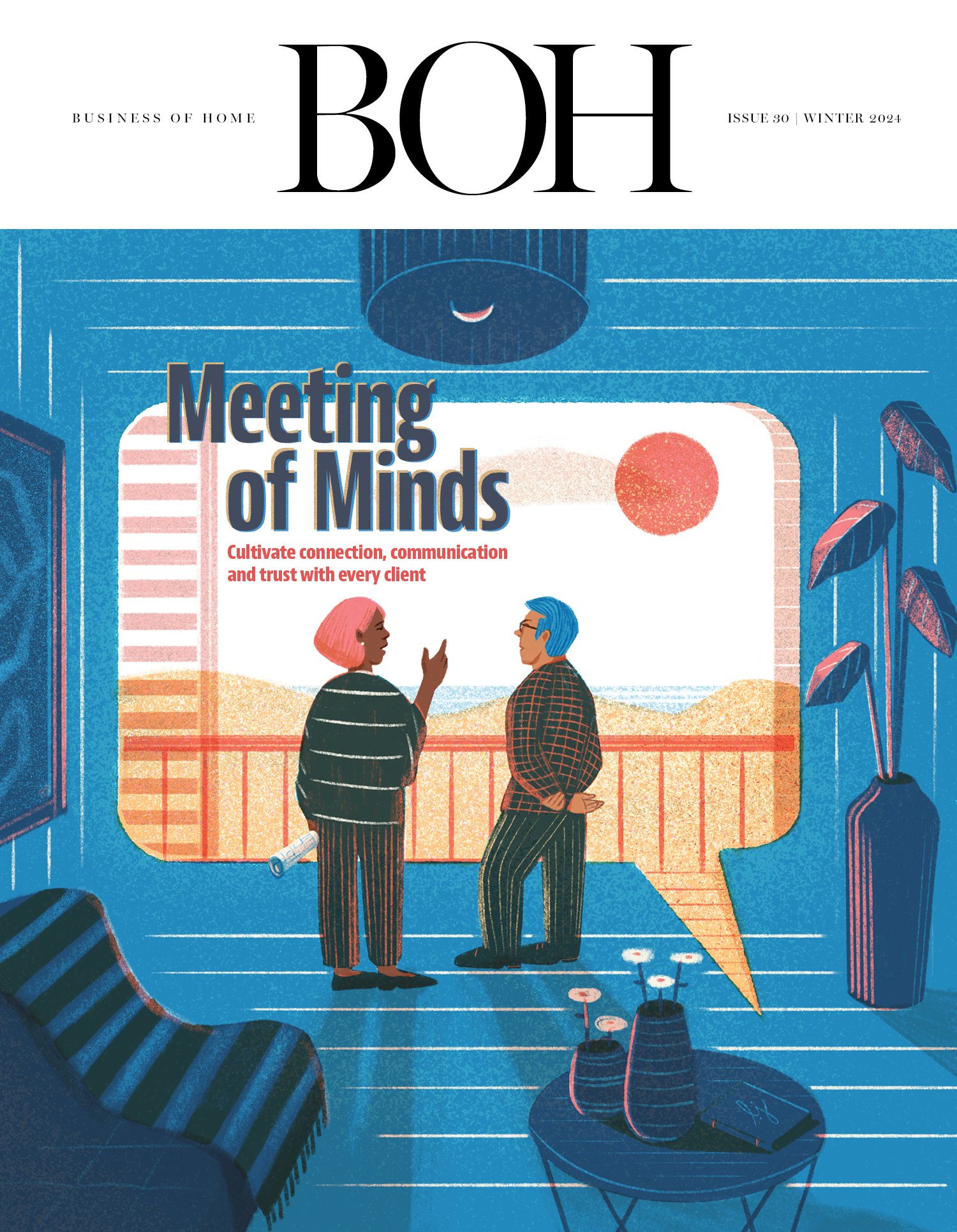
I will challenge you with this thought: The single biggest opportunity to improve your firm is with client management. So the question is, How do you intend to entertain your clients throughout the process?
By entertainment I don’t mean a cocktail party—instead, it is providing information consistently and effectively such that your clients would miss it if it were gone. In today’s world, using your software system or spreadsheets alone results in opportunities lost. If you think about it, the dissemination of information to clients—and to vendors and partners—has never been more exciting. Video, audio, even rendered updates are incredibly possible, especially with AI, and virtually without cost.
But getting it right means turning your employees into entrepreneurs. Entrepreneurship means something very specific to me, far beyond starting a business. It means having the conviction (delusion?) that how you see the world is how the person across from you should see the world, and acting accordingly.
While your employees will likely never be tasked with generating business, or even the level of creative direction that you do (and will always do), that does not mean they cannot be responsible for the client experience and improving it such that they own it.
Once and for all, abandon the idea that the sole goal of your design business is to execute amazing design for your clients. Of course it is a necessity, but it is not the goal. The experience of how you manifest that necessity is what matters today. All designers at a level I am sure you are most certainly at are going to do amazing work. How that work gets done—with engagement, empathy and conviction—is how you will stand apart.
Your employees certainly know you and your firm inside and out. Challenge them (at the interval of your choosing) to offer their thoughts, which you will support both financially and organizationally to make the production experience better for all involved. Let them own it—test it, work with it, and be committed to discovering what might happen if there is success.
And if the experience is improved, what else might come from it? While they may never bring in the client, they can certainly make sure that there is no other place your clients would rather be. That is on your employees to undertake if you dare to change from the “Just do your job” mentality you now have to the “How can you make us better?” mindset I am suggesting. Again, there is nothing wrong with “Do your job,” and clearly what you are doing is not broken, just frustrating.
What I am saying here is that if you really want to fix it, you are going to have to break it. We all want to make a difference and to be the catalyst for change. Your employees included. Make that the fabric of your business, what informs your expectations of your team, far beyond the necessary tasks to be completed. The rest will take care of itself.
____________
Sean Low is the go-to business coach for interior designers. His clients have included Nate Berkus, Sawyer Berson, Vicente Wolf, Barry Dixon, Kevin Isbell and McGrath II. Low earned his law degree from the University of Pennsylvania, and as founder-president of The Business of Being Creative, he has long consulted for design businesses. In his Business Advice column for BOH, he answers designers’ most pressing questions. Have a dilemma? Send us an email—and don’t worry, we can keep your details anonymous.