





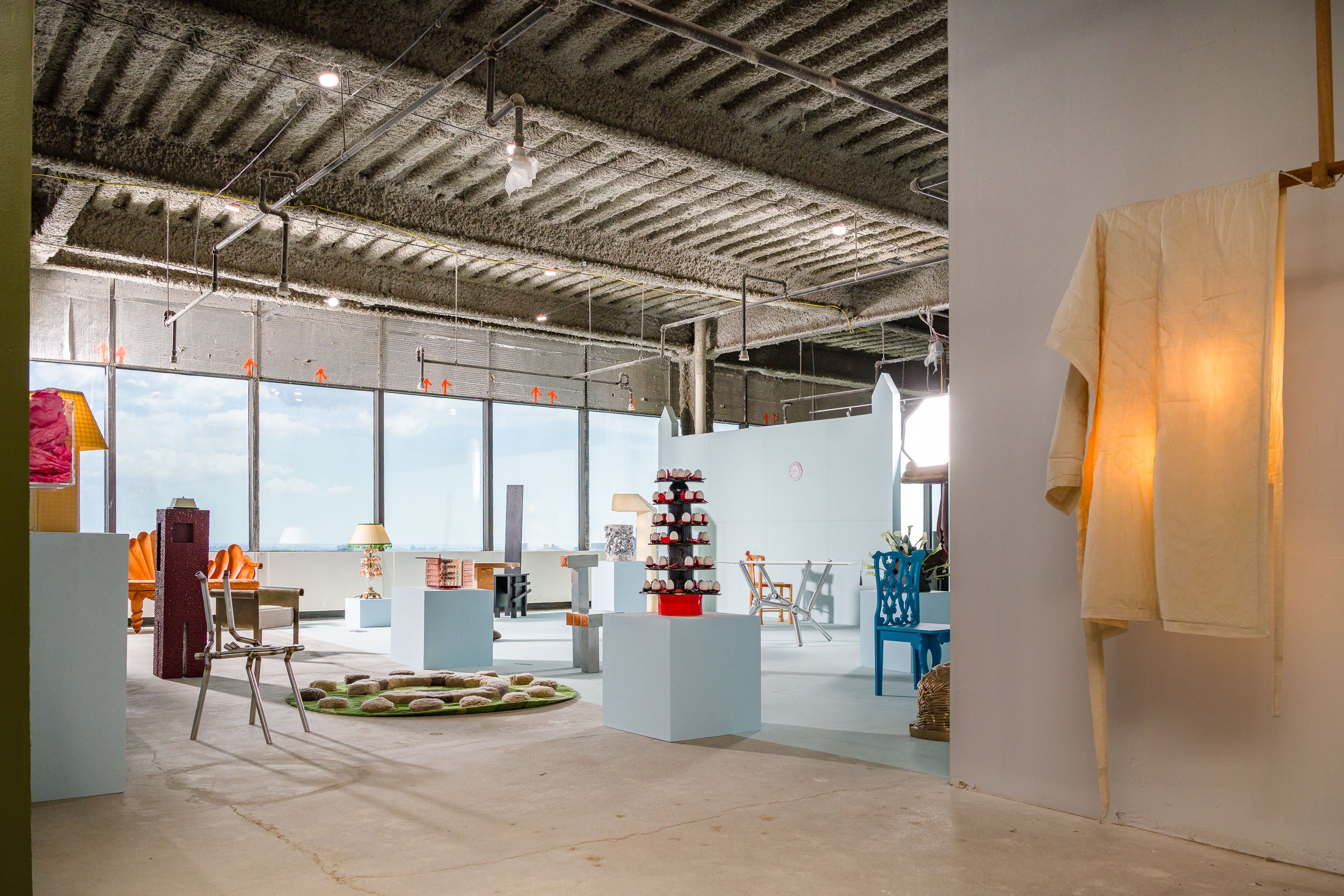

Set against sweeping views of the Manhattan skyline, the contemporary design fair Collectible returned for its second annual New York edition last week on the 39th floor of the buzzy WSA building in the Financial District.

The fair was founded in Brussels in 2018 by Clélie Debehault and Liv Vaisberg, two art-world insiders who saw how contemporary makers in the design space were often excluded from shows dedicated to furniture, antiques or art. Collectible NYC debuted in 2024 to rave reviews, and returned last week with an expanded roster of 128 galleries, artists and designers showing everything from Marcela Cure’s geology-inspired pieces in amber-hued resin and Rosie Li’s pressed-glass lighting installation to an evocative collaboration between multidisciplinary studio Tang Thousand and speaker design studio Silence Please.
BOH sat down with Vaisberg to discuss why 21st century makers needed an event like Collectible, how bringing the event to New York brought buyers with a fresh outlook, and why she’s always looking to create new conversations about investing in contemporary design.
After six years in Brussels, you launched the New York edition of Collectible last year. What happened here that made you want to come back?
Magic happened. What I really appreciated last year, and again this year, is how grateful people were—the visitors who say, “Oh, my God, New York needed that.” That was what I heard: “There’s nothing else like this.” It was a warm welcome.
How had you identified New York as the right next step?
Coming to New York was a gut feeling, not a strategic development. In 2016, before the Collectible fair existed, my business partner Clélie Debehault and I went to New York. I remember going to Patrick Parrish and all of the galleries, very naive and happy, because we had this idea. We were going to do contemporary collectible designs—no brands, no vintage. Most of the fairs have either only brands or mainly vintage, and contemporary is an anecdote. It’s like the side dish, and we wanted to be the main dish. So we came to New York, and people were like, “Yeah, whatever. Who are you?” We were both in the art world: At the time, I was the director of the Independent art fair, but in Brussels. Clélie and I made names for ourselves in the art world, not the design world, but we fell in love with this [category], collectible design, and wanted to support it. No one else is doing this. I thought, “Let’s do a fair.”
As opposed to what?
A gallery or an exhibition. I’ve done other things too: I’ve done a biennale where I live [Design Biennale Rotterdam, which launched this year in the Netherlands], and I’ve created a permanent space there [Huidenclub, which opened in 2020]. There are different ways you can do it, but a fair—a fair is big. What I like about fairs is that you can bring a lot of people together. It’s also commercial; it’s clear that you’re here to sell. And these contemporary designers need to sell. They need to stop having side jobs; they need to be able to live from their work. That’s very important to us.
Has that been one of the primary challenges for designers in this category?
We wanted to stimulate that market. You know, the art market is one thing, and the vintage or historical market is another, but contemporary is really in between.
Before Collectible was born, I was meeting with collectors to tell them about our plan. There was one collector in Brussels who was collecting chairs—she owns like 700—and she said, “Sorry, I’m not interested in design. I only do art.” For her, a design fair was brands. It was products. It was commercial, and it was not interesting. And I said, “Just come to the fair.” So she came—I think just to be polite—and bought five chairs. Now, she’s addicted to Collectible—she loves it, and she’ll never miss one.
I have friends who are art collectors—they’ll buy works for $100,000 like you would buy a shirt at H&M. But when they came to Collectible in the first years and said, “Beautiful chair. How much?” Maybe it was $10,000, but they’d go, “That’s really expensive for a chair.” Because a chair has a function, it’s like, “Why would I spend money?”
Function makes them assess the value differently.
It does. Part of it is that we don’t have as many interior designers in Europe who are making homes—they are mainly working on hotels, restaurants and retail. That means the collectors are buying for themselves directly. I wanted to convince those art collectors that you can buy design pieces the same way you buy art—just because it’s functional doesn’t mean that it has less value.

One thing that has helped us a lot is the design magazines. When the editor of Elle Decor France was coming to New York, I sent him to Studio S II. Apparently, they just got published in the magazine this month—so now French people in the countryside are going to see this crazy house in New York, and maybe subconsciously they’ll be like, “I can do that too.” And for me, the fact that you can find the crazy shit from Collectible Design in the magazine that everybody buys at the petrol station or your local supermarket—that’s what you need.
Our work as Collectible is very broad, because we need to find different ways to make people understand that [collecting this way] is not that crazy. And in the end, you need to support the living artists. Dead people are dead. They don’t need your money.
Did you always have plans to expand?
From the beginning, we had invested in a London PR agency with a staff member who specialized in continental America. We didn’t know much about the U.S., but we had that gut feeling. So we’ve partnered with Sight Unseen since the first year, and we got a few articles [in the American press] as well. We launched Collectible in Brussels in 2018, did another fair in 2019, and then went back to New York that fall. When we visited this time, people were so welcoming and encouraging. I remember having a meeting with a bunch of designers and galleries, and they were all like, “You should bring Collectible to New York.” Then Covid happened, and we just had to make sure Collectible survived after the 2020 edition was canceled, because we still had to pay everybody. It’s a miracle we held strong.
Then I saw the WSA space on Instagram last year. It has the vibe of Brussels, with a similar style of building, but so much sexier. A friend of a friend walked into the building for me one day and asked, “Who’s in charge?” She got the phone number of Matthew Khalil, the owner, and I called him five days before Collectible Brussels opened last year and said, “I have a fair in Brussels and I’d like to bring it to New York”—and he said, “Why not?” So we made a press release, told the journalists at the fair in Brussels, and it got blasted everywhere. Then Collectible Brussels happened. And then I flew myself to New York to see the building. We only had a couple months to put it up, but it happened, and it was great.
There was immediately a sense that the fair was filling a need.
I grew up in France, and we have a saying about making mayonnaise—you put in all of the ingredients, you beat the egg, and sometimes it just doesn’t take. It stays flat. And that can happen: You’ve done everything, but it could have stayed flat. That first evening in New York, I was still scared that no one would come. And at some point, I looked out and there was a queue all the way to the street. There were people everywhere.
You were onto something, that’s for sure—and it’s clearly growing. You’ve moved across the street to a new WSA building, and you’ve got a lot of exhibitors this year.
Last year, we were on the second and third floor; this year, we’re on the 39th floor, so the views are insane. And every centimeter is full.
How is the Collectible visitor different in New York?
I was just talking about that with Johan Viladrich, who has participated in both fairs. He said that in Belgium, people would come and have discussions about materiality, or about the designer’s practice. Here, it’s speedy. If they want to know, they go straight to the point: “How much is it?”
For some French and Belgian gallerists, [that dynamic is] really weird for them, but it’s also nice. They were explaining that, at the fair in Brussels, people will be polite and listen, but maybe they actually don’t give a damn. Here, if they listen, that means they care and they’re interested—if not, they just don’t stop. You know where you stand.
Since the fair’s inception, you’ve had to do a lot of educating to get collectors ready to invest in this category. Do you have the same work ahead of you here in New York?
They’re quite good, the Americans, I have to say. You know, we have a lot of clichés about America, coming from the other side. We grew up with American TV, so we tend to think that America is very commercial—McDonald’s country, where everybody is the same. But I have noticed since the beginning of Collectible that the craziest designers—the ones making statement pieces, very weird stuff—only sell their work in the U.S. I think Americans know how to take risks.
Yesterday, I met some older collectors from Aspen and they were in love with these completely crazy chairs and wanted to buy them. In Belgium, I see people coming to look: They love the vibe, but they’re not buying yet. It’s been eight years, and some of them still aren’t buying. I think you’re a bit more ready for that here in the U.S.

Does having more interior designers working in the residential space change the energy at the fair as well?
When an interior designer falls in love with a piece, they’re going to push their clients. That’s going to change things more rapidly than in Belgium, for example, where people don’t typically work with a designer. That’s when they’re insecure, like, “Am I going to buy this crazy chair, or is that too weird?” They hesitate more.
Does the show keep growing from here?
We have been invited to Hong Kong, [where] Maison&Objet gave us a 3,000-square-foot space to curate at its Design Factory event in December. And I’ve fallen in love with Mexico City, where there’s a hotel that wants to do something in February for Zona Maco. It’d be a hard-hat situation—the hotel will still be under construction. I said, “I don’t like stupid parties; let’s do something meaningful.” But come on, two fairs a year is already tough!
As you’re looking at new opportunities, are you looking at locations where there is already an audience of collectors?
I like challenges. I like when the crowd is not ready. Maybe it’s a little easier here in New York because the crowd is ready. But even so, people didn’t understand it at the beginning—a design fair that looks like an art fair. This is not a trade show. I forbid [exhibitors] to put stickers [on their pieces]; there are no business cards or brochures. You have to show your own world, and then the sale is in the conversation.
It’s funny, because I was speaking to some interior designers and fashion industry people in the last two days, and [they said the show felt very international]. They seemed very excited because it was very new to them. But half, or even two-thirds, of the exhibitors are American. It’s actually designers from your own country! We just put it in one place together.





 Withdraw Consent / Manage Privacy Preferences