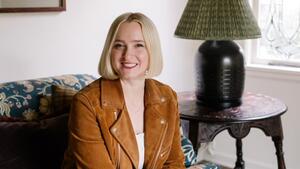





For Angela Harris, it never felt quite right to narrow down her passion for design to a sole industry focus—instead, she was drawn to the bigger picture. The discovery unfolded naturally as she waded through her early career years: first earning a business degree, then taking a job with a Chicago designer on a whim, before going back to school to study design.
After that, it didn’t take long for Harris to strike out and start her own firm, a process that had a snowball effect on her network and professional focus: Working with residential clients led to working with Realtors, which led to relationships with builders, which soon spun into something even bigger. “Once I got in the realm of the builders introducing me to developers, I was like, ‘Oh wait—you mean I can balance my left and right brain? I can use my business marketing and management [skills] with my creativity?’” she tells host Kaitlin Petersen on the latest episode of Trade Tales. “That’s when I knew, ‘I’m an interior designer in the B2B world.’”
In 1999, Harris established her firm, Trio: a now 80-person enterprise that takes on projects of all kinds—hospitality, multifamily, student housing, master-planned communities and more. Though her studio’s scope and team are large, her visionary role has kept her sharply focused on sustainable living and a human-centric approach to design. With those principles in mind, she’s taking a deeply thoughtful approach to developing her practice—both internally, through a careful structuring of the firm’s systems and processes, and externally, through enriching side projects like her own ongoing PhD studies.
Elsewhere in the episode, the designer talks about what it takes to fully inhabit the role of design visionary, how overhauling her firm’s infrastructure helped the team claw back creative time, and why she’s pursuing a visual arts doctorate centered on the concept of design as an ethical imperative.
Crucial insight: When it came to managing the growth of Trio, hitting a certain revenue threshold signaled to Harris that it was time to streamline the business’s internal infrastructure. A major component of that process involved transitioning the team from multiple software platforms to one central database that could handle everything from lead generation all the way through project closeout—a time-consuming undertaking, but one she knew her team could handle. “Anytime that you are committed to data migration in every facet of the business, you can just expect that it is a very complex endeavor,” she says. “You have to have a whole lot of patience, and you have to have a very resilient team that is able to operate in a place of chaos with confidence.”
Key quote: “If we believe that design is an ethical imperative, then we need to bring something to market that is authentic, and in order for us to do that, we need to learn as much as humanly possible in every facet of wellness. What we found is there’s a spiritual side, and there’s an artistic side, and there’s a cultural side, and there’s neuroaesthetics, and there’s ontological aesthetics. We’re all creators, and this constellation of things leads to our perceived perception of beauty, so how do we thread our design strategies into accomplishing that outcome?”
This episode was sponsored by Vanguard Furniture and Kohler. Listen to the show below. If you like what you hear, subscribe on Apple Podcasts or Spotify.