












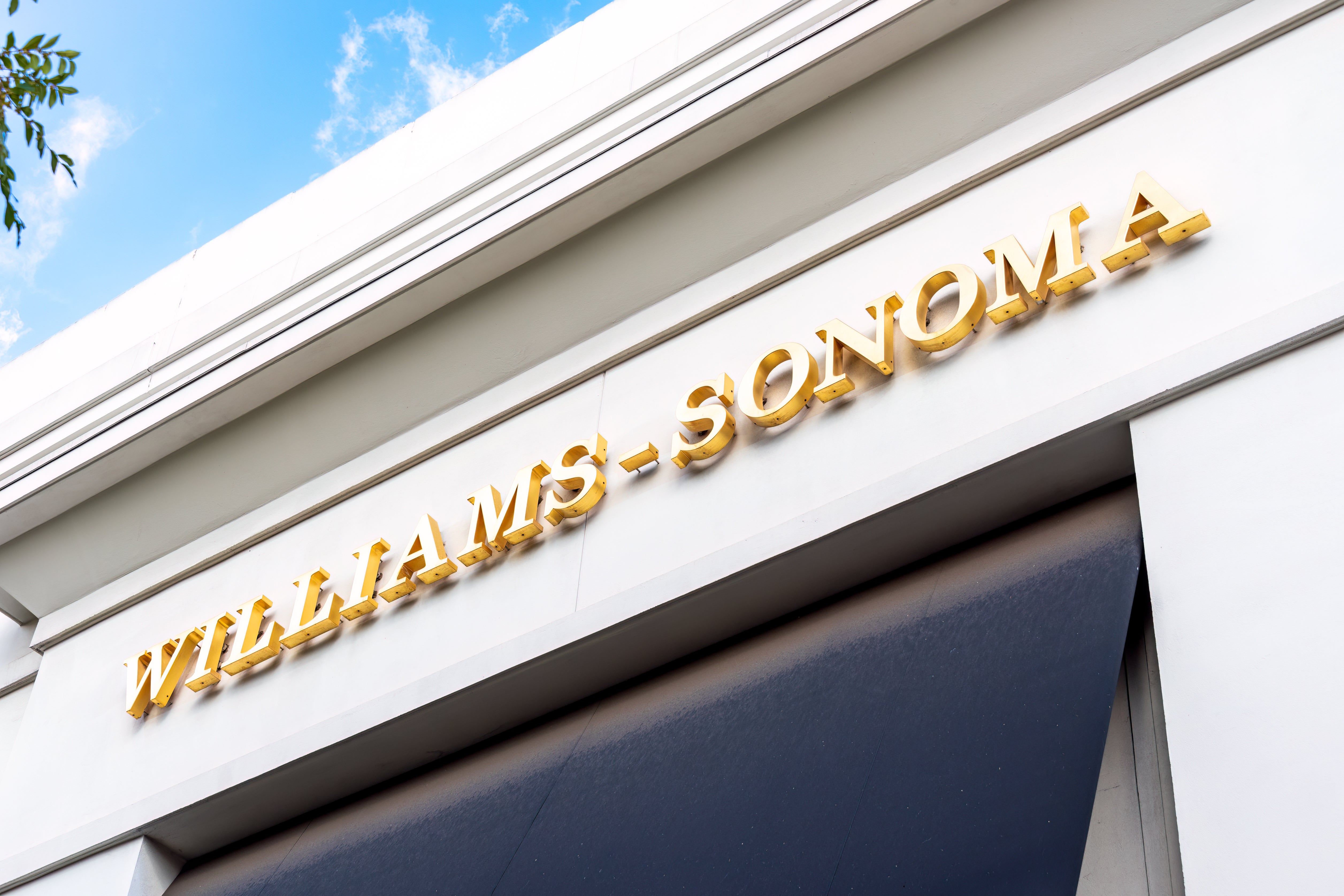

As self-professed foodie Chuck Williams shopped around for restaurant-quality kitchenware in Sonoma County, California, in the mid-1950s, he couldn’t have imagined it would lead to today’s Williams-Sonoma Inc., a $7.8 billion retail giant in the lifestyle and home furnishings space.
Nor could he have guessed that 70 years later the company would continue to outperform just about all of its competition, as it just did once again this week with the release of its fourth-quarter and full-year results. Its well-balanced mix of online and in-store sales, and its equitable distribution of brands across the decor and functionality sides of the home business, has given it an advantage that none of the other players in the lifestyle channel—RH, Crate & Barrel and the like—can claim.
“In 2025, we delivered sustainable, profitable growth in a dynamic environment,” said Laura Alber, president and CEO since 2010 and a 30-year veteran of the company, when announcing the results on Wednesday. “Our powerful portfolio of brands, strong channel execution and growth strategies drove our results.”
Net revenues for the year were up 3.5 percent to $7.8 billion, while net earnings showed a slight decline versus a year ago, even as earnings per share ticked up. Most of these results topped analyst forecasts, with the exception of the fourth-quarter revenue of $2.36 billion, which came in just shy of estimates. The company also lifted its quarterly dividend by 15 percent.
Wall Street liked what it saw, driving up the share price by almost 5 percent earlier in the day before a downturn in the market resulted in a modest 1 percent gain at the end of trading hours.
For the full year, the Williams-Sonoma kitchenware brand had the best performance, with revenues up 6.9 percent versus a year ago. And while all its major nameplates showed gains for the year, the smallest was registered by Pottery Barn (its biggest brand) at 0.4 percent. Still, that was better than the division’s 6.2 percent drop-off the year prior, especially given that the furniture and decor sectors continue to be impacted by the softness in the housing market.
As it has done for the past several years, Williams-Sonoma closed some of its physical stores in 2025, bringing its total fleet to 506—down from 512 the year before. Before the pandemic, the company had an almost perfect balance of in-store versus online revenue, but since then, more business has transitioned to e-commerce, which now accounts for about two-thirds of its total revenue.
Going forward, Alber said she expects Sonoma to show net revenue gains in the 2.7 to 6.7 percent range, with comps in the range of 2 to 6 percent. She added that the company is not figuring in any tariff refunds: “Our guidance assumes that these will be replaced with tariffs at a similar rate.”
For this year, she said, “As we look forward to 2026 and beyond, we are confident in our competitive advantages that have allowed us to take market share, and our focus is on widening that advantage.”
____________
Warren Shoulberg is the former editor in chief for several leading B2B publications. He has been a guest lecturer at the Columbia University Graduate School of Business; received honors from the International Furnishings and Design Association and the Fashion Institute of Technology; and been cited by The Wall Street Journal, The New York Times, The Washington Post, CNN and other media as a leading industry expert. His Retail Watch columns offer deep industry insights on major markets and product categories.








 Withdraw Consent / Manage Privacy Preferences