







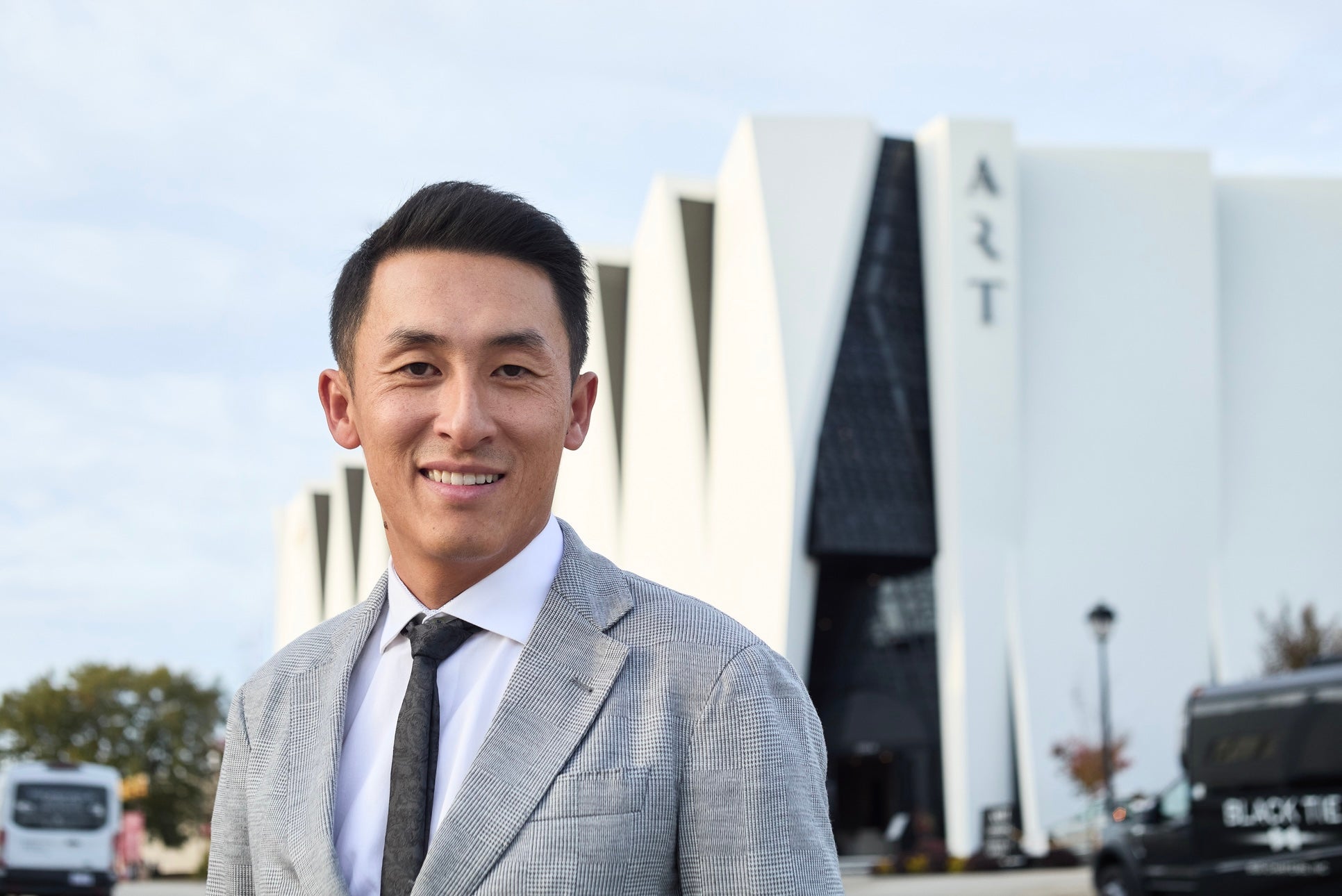

Furniture conglomerate Markor grew out of an interior design business. Its founder, Richard Feng, did a brisk business creating nightclubs and hotels in China, until the late 1980s, when he decided to pivot to a larger industry: furniture. “The first person in our family who went to High Point was my mother,” Mark Feng, Richard’s son and the company’s current chairman and CEO, tells Dennis Scully on the latest episode of The Business of Home Podcast. As an outsider, she wasn’t allowed into showrooms, but she took photos and sent them back home to China. “[She wrote on the back], ‘Hey, these people look professional. We should probably get into this.’”
In 1990, the family set up a furniture manufacturing factory in China, first doing business for other brands before starting their own in-house lines, ultimately taking the company public in 2000. Since then, Markor has gone into the international wholesale business, distributing its four U.S.-based brands—Caracole, A.R.T. Furniture, Jonathan Charles and Rowe—across 100 countries.
Now, Mark Feng, who has been with the company since 2016 and became chairman in 2022, is pivoting to a technology on everyone’s minds: AI. In 2023, he founded DecorX, a software that helps visualize Markor furniture products in different spaces. After the platform garnered the attention of the industry, Feng wasted no time expanding it to include visualization and product organization products for other retail brands, and early next year, he will release a designer-focused AI software.
Feng envisions the new tool as a time-saver that could level the industry playing field by expediting and eliminating administrative tasks—allowing junior staff members to jump into creative work faster, and helping firms operate more efficiently as a whole. “[Think about] the 80-20 rule: [the idea that] 80 percent of the work that we all do, whether you’re a designer or just any job, is annoying, time-consuming and manual,” he says. “So we’re not going to try to replace your 20 percent [of creative, original, human-driven work]—because I know people enjoy that—but that 80 percent can be gone, especially with the help of AI. What we’ve also found is that if you truly have a great interior design visualization tool, it’s not going to help your best interior designers. The best ones don’t even need help. It’s really your average ones, or your young ones: You’re able to lift them up and get them 80 percent or 70 percent there.”
Crucial insight: Feng doesn’t see the rise of AI as a threat to human creativity, but rather as a support system that can enhance creativity. “For young people nowadays, Google isn’t the first thing that they go to anymore. AI is able to cut through algorithms and find these things [they’re interested in faster]. So I actually think this is a great hope for our industry that through AI, we will become more creative,” he says. “AI will never experience in real time or replicate the human experience. And how we get creative, at the end of the day, is as we go through life, the curves we see, the magazines we read, the places [we go] … AI will get us to do it faster, to do it more, [but] it’s always going to be a human that starts with the idea.”
Key quote: “I think AI is on most people’s minds that we talk to. I think it’s a good thing that we’re democratizing creativity, but I do think the people who do not embrace this tool are going to be left behind. Now, these tools are not perfect, right? If we think about the last industrial revolution, when the internal combustion engine was first invented, these engines were not that great, and these cars—the tools that connected the technology and the users—were also not that great. So people still rode horses for decades, and they were able to perform the same job better on horses. But as these cars got better, horses had no chance, at the end of the day. So we do not know how fast this process will take. I’m sure your best horse riders, in that way, will still outperform your AI workflows in the short term. But just [because of] the ease, the expense and the speed, I predict it will happen much faster than the last industrial revolution.”
This episode is sponsored by Loloi. Listen to the show below. If you like what you hear, subscribe on Apple Podcasts or Spotify.
The Thursday Show
Host Dennis Scully and Business of Home executive editor Fred Nicolaus discuss the biggest news in the design world, including Wayfair’s breakout quarter, the rise of AI-generated video, and a drama-filled celebrity home tour. Later, BOH editor in chief Kaitlin Petersen joins the show to recap High Point Market.
This episode is sponsored by Chelsea House and Newport Brass. Listen to the show below. If you like what you hear, subscribe on Apple Podcasts or Spotify.











 Withdraw Consent / Manage Privacy Preferences