













Love it, hate it or fear it, there’s very little disagreement in the industry anymore that AI matters. This is no flash-in-the-pan Silicon Valley fad (ahem, the metaverse), but a truly impactful technology that will change the way designers work. Still, there’s a sizable gap between a sense of its importance and a clear understanding of how exactly that transformation will take shape. It’s precisely that gulf that last week’s inaugural Design Intelligence summit was aiming to bridge.
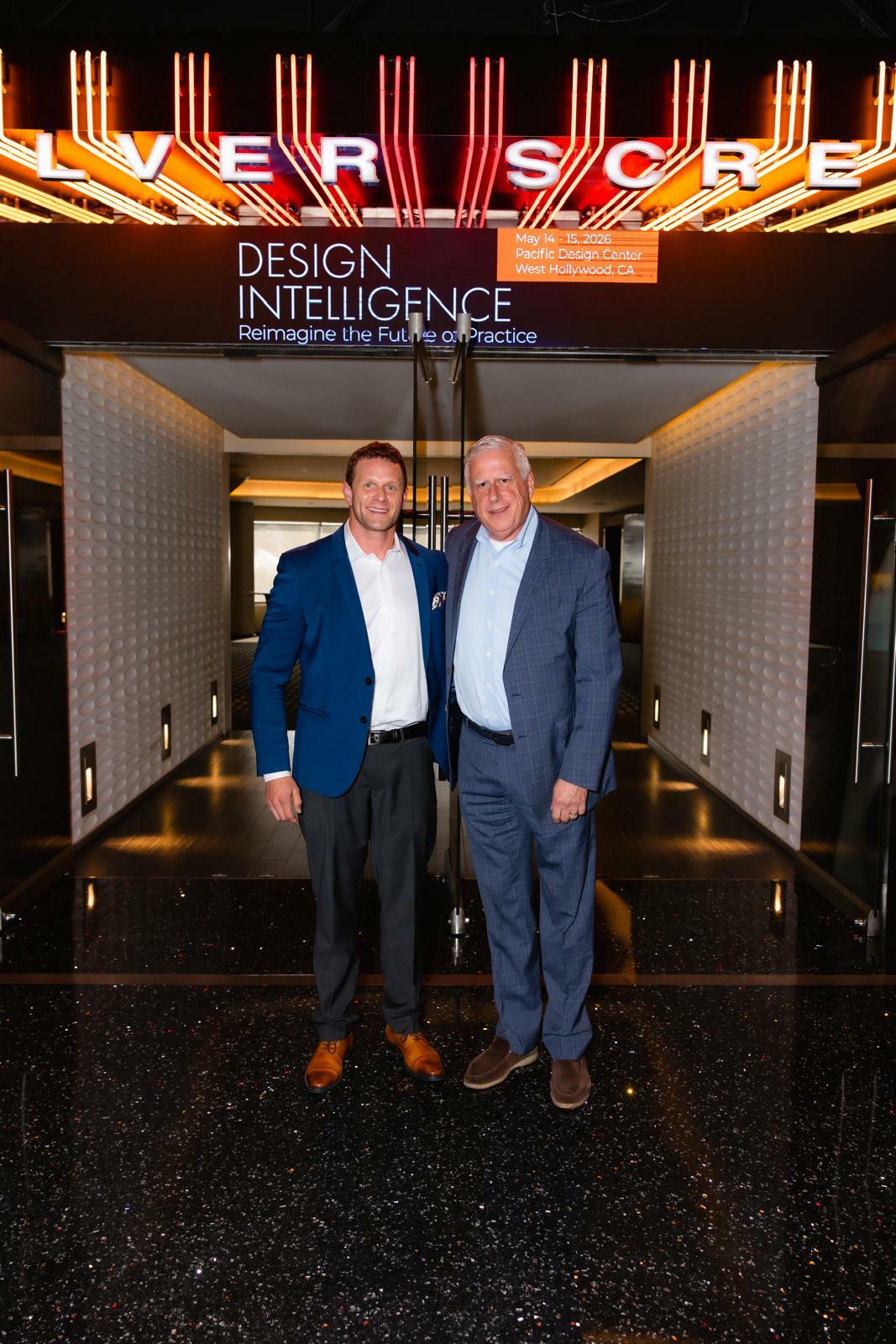
Held at the Pacific Design Center in West Hollywood, the event was organized by veteran industry consultant Keith Granet alongside business partner Blair Carlton. The pair welcomed 85 attendees—largely principals from architecture and design firms—for two days of programming dedicated entirely to exploring how artificial intelligence is intersecting with the design industry.
“The buzz on AI is everywhere,” says Granet. “We thought: Our responsibility, whenever anything is significant that could be transformative to our industry, is that we truly need to see how to embrace it.”
Granet and Carlton tapped leaders of big, recognizable companies from the world of industrial design, architecture and tech: The full list of speakers included Gensler’s chief digital officer, a partner from starchitect Bjarke Ingels’s firm, the dean of the USC School of Architecture, and John Maeda, a former president of RISD and current Microsoft executive. “What we wanted to do is take a high-level view of the industry and what’s happening, and try to hone it down to what works for a smaller firm,” says Granet.
One of the complexities of holding an AI conference is that attendees come with a wide range of experience with the technology. Over the course of two days, I spoke with some designers who had already set up complex Claude workflows in their firms, and others whose experience maxed out at light interactions with chatbots. Some were enthusiastic about the technology, others were overwhelmed. The uniting factor was curiosity.
Victoria Sass, the founder and principal of Minneapolis-based firm Prospect Refuge, came to Design Intelligence with a good amount of AI know-how already under her belt: She is already using the technology to generate renderings, help with presentations, write emails and analyze trends in her business. This also wasn’t her first AI-in-design event, having attended workshops through Granet’s membership organization, The Leaders of Design. “I think for the people who worry that [AI] is going to take their job, or people who haven’t dived into it yet, it can sometimes be scary,” she says. “A good reason to go to an AI conference is just to get familiar with it. [It’s about] extinguishing fear and getting you to feel like it’s an accessible tool.”
Another complexity: Even within the niche of “AI in design,” there’s simply so much to explore, from practical how-do-I-use-this questions to avant-garde experiments, philosophical inquiries, legal perils and beyond. The conference’s speakers did an admirable job of covering a lot of that ground in a relatively short time, taking attendees on a whistle-stop tour of the near future.
This being a design conference, there was plenty of AI-powered design. Joseph Joseph, Gensler’s CDO, presented some intriguing experiments from inside the design giant, including an internal chatbot the company had trained on its own data. The firm is also leaning into generative AI video for presentations—Joseph shared a cinematic short film in which two characters meet and connect within a Gensler-designed complex. He said that a similar film had landed the company a major project. The video drew applause.
Early in their presentation, Jenna Fizel of San Francisco industrial design powerhouse Ideo (among many other accomplishments, the company helped craft Apple’s first mouse) acknowledged the “emotional weather” around AI, pointing out that the technology could produce dread and anxiety. However, Fizel encouraged the audience to think of artificial intelligence as simply a way that more people could make more things. They presented a series of left-field projects Ideo had produced with AI, including a desktop toy that helps software engineers debug their code.
Warrington Parker, a managing partner at law firm Crowell & Moring’s San Francisco office who has worked on AI-related litigation, brought a bracing directness to the conference. He opened his presentation by declaring that he was essentially agnostic on AI—neither a big fan nor a detractor—but that he had little doubt the technology would change the world, comparing it to the Basilic cannon, a 15th century invention that helped the Ottomans conquer Constantinople and in turn reorganized the shape of the Western world.
As for how AI would interact with the law—especially when it comes to intellectual property law—Parker was candid that much is still unwritten, calling the situation “entirely unpredictable.” In general, he advised caution, whether it came to using AI for creative work or feeding sensitive data into a chatbot. He also brought the political dimension into play, pointing out that with an administration that has embraced AI companies wholeheartedly, we were unlikely to see significant regulation or legislation until the White House changes hands.
Much of the conference’s first day was dedicated to a 30,000-foot view of AI in design. On the second day, smaller breakout sessions gave attendees the opportunity to get into the weeds a little, where participants were prompted to share what they were currently using AI for, what they’d like to be using it for, and what a blue-sky goal might be.
In my group, the conversation felt like the uncorking of a champagne bottle, as all of our AI tips, tricks, hopes, revelations and anxieties came bubbling out. In that conversation and across the span of two days, I got an intriguing cross-section that ranged from the expected (marketing emails, lots of renderings) to the more in-depth, like feedback on financial decisions or identifying trends within a firm’s purchasing history. Hovering in the future are wild-but-not-that-wild concepts, like training a chatbot on a principal’s knowledge so that he or she could keep advising the firm after retirement.
Across both high-level presentations and breakout sessions, the conference brought into sharp relief one of the paradoxes of the moment. With so much hype and noise around artificial intelligence, designers are understandably looking for simplicity: Do this one thing to make your business more profitable, try this one tool and you’ll net a new client. But the reality is that we’re in the messy figuring-it-out stage of the technology. Leon Rost, the partner from Bjarke Ingels Group, shared a humbling moment in which he had presented on the firm’s usage of AI to a group of students, only to find out that several of them had tips for him. “This stuff is always changing,” he said. “The advantage goes to the most curious.”
Granet and Carlton are looking at ways to keep the conversation going—including a potential East Coast edition and bringing the conference back to L.A. next year. By then, AI will no doubt have made new leaps and bounds, both dazzling and dizzying. “We’re going to be in a completely different place,” says Granet. “Why not keep educating?”