












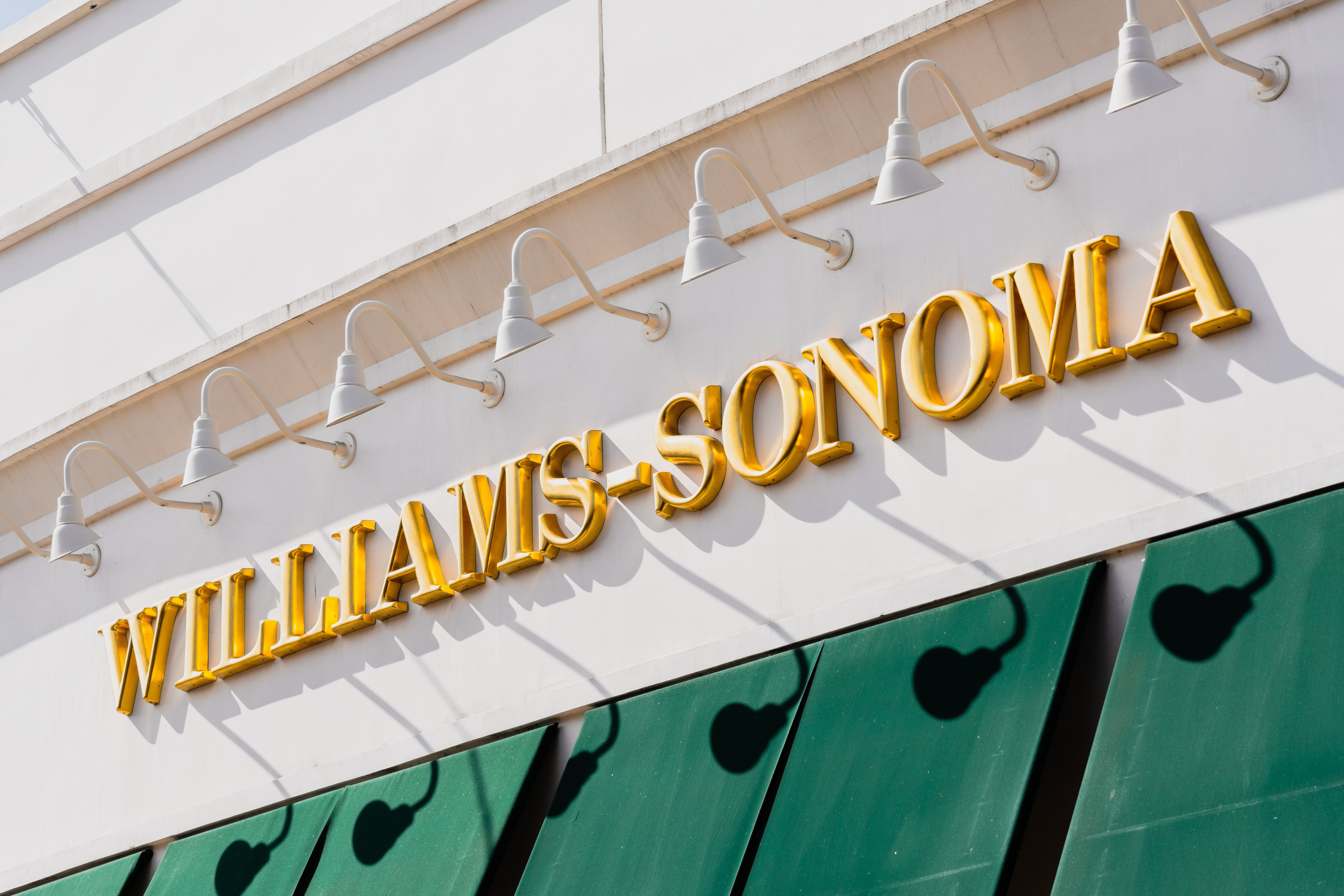

If you want to know which home retailer has doubled its stock price over the past two years, has consistently outperformed the overall sector, and offers one of the most balanced portfolios in the business, you may be surprised to find out it’s Williams-Sonoma.
Competitors like RH and Arhaus may get more headlines, but after this week’s announcement that Williams-Sonoma has another solid quarter under its belt and is upping its forecast for the balance of the year, the retailer is emerging as the leader of the entire sector.
Other players in the space blame the housing market, tariffs, interest rates, and raw material costs caused by the war in the Middle East, but Williams-Sonoma is having none of it. “Our strategies continue to gain momentum, and our results reflect the power of our execution,” said Laura Alber, president and CEO, in announcing the company’s second-quarter results Wednesday. “We gained market share, continued to outperform the industry, and raised our annual outlook on both the top and bottom lines. We are delivering compounding results despite the housing market and other macroeconomic events.”
What’s most impressive in the company’s numbers is the uniformity of positive results across its entire brand portfolio—particularly Pottery Barn, its largest nameplate and the one that has been underperforming versus its stablemates. Its sales for the period were up 5.1 percent to $771 million, compared to just a 1.1 percent increase a year ago.
West Elm, its next-largest brand, saw a 6.4 percent increase in sales to $496 million, while Pottery Barn Kids and Teen was up 3.5 percent to $297 million. Williams-Sonoma’s namesake kitchenware division, which has acted as a balance to its more furniture-centric brands, had the largest percentage gain for the period—7.6 percent to $269 million—showing the continued post-pandemic strength in home cooking and entertaining.
Overall revenues for the company were up 6.7 percent to $1.96 billion. Williams-Sonoma also registered gains in its gross margins and liquidity, the latter helped by about $200 million in tariff refunds and the related accrued interest.
Wall Street was suitably impressed, as it should be. After a dip when the market opened on Wednesday morning, following its earnings release Williams-Sonoma share price has since climbed around 8 percent. Its stock is up more than 30 percent year to date, and about 80 percent over the past two years.
The company is optimistic about what’s to come too. “We are raising our fiscal 2026 guidance to reflect our year-to-date strong performance,” said Alber, adding that Williams-Sonoma is now forecasting net revenue gains in the 4.7 percent to 7.2 percent range, an increase from earlier predictions. She added: “We remain confident in our priorities and plans for the remainder of 2026 and beyond.”
While competitors in the home retailing space have reported uneven numbers and have the stock prices to prove it, Williams-Sonoma just keeps winning.
____________
Warren Shoulberg is the former editor in chief for several leading B2B publications. He has been a guest lecturer at the Columbia University Graduate School of Business; received honors from the International Furnishings and Design Association and the Fashion Institute of Technology; and been cited by The Wall Street Journal, The New York Times, The Washington Post, CNN and other media as a leading industry expert. His Retail Watch columns offer deep industry insights on major markets and product categories.






 Withdraw Consent / Manage Privacy Preferences