







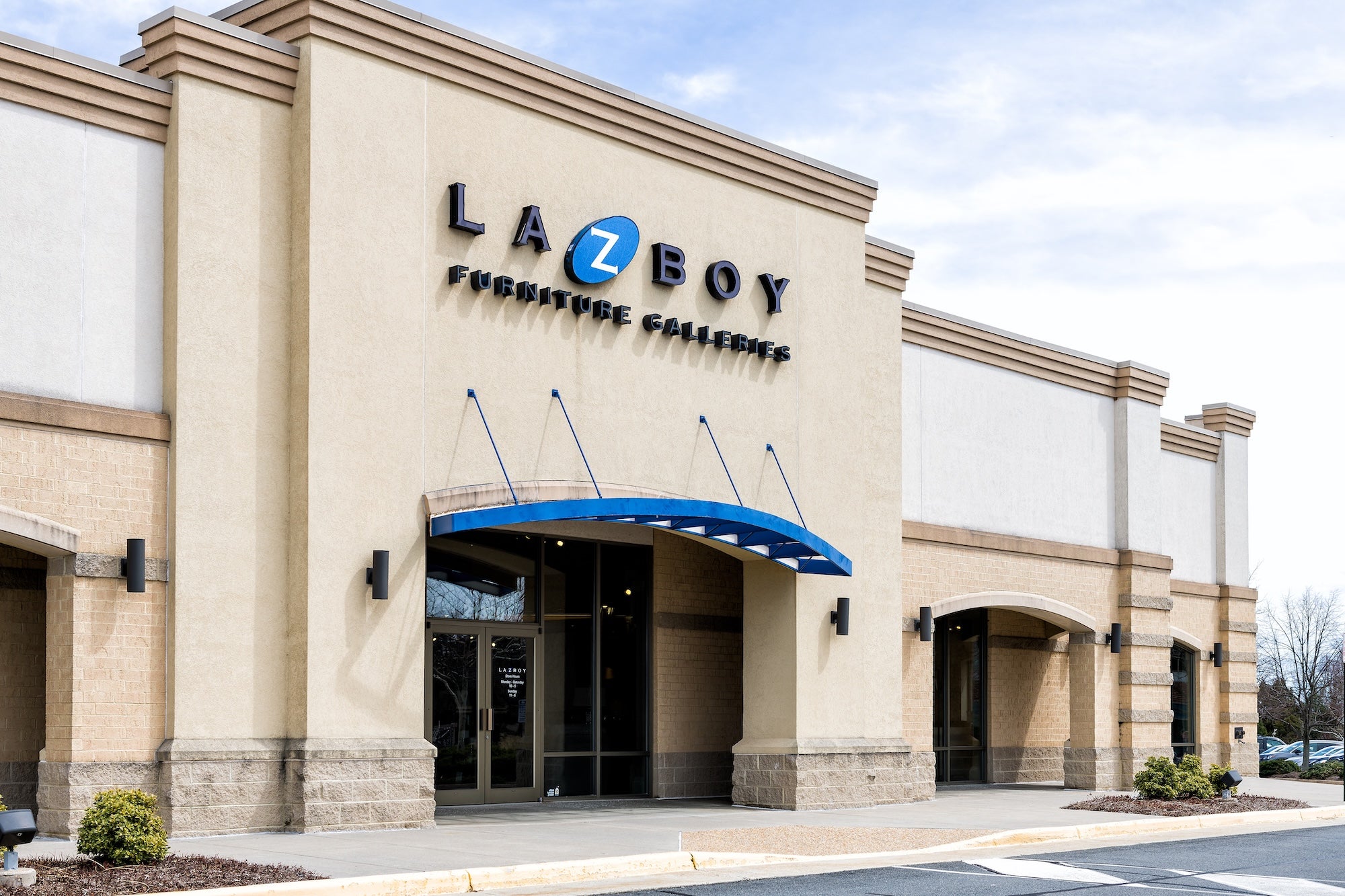

It’s one of the oldest, best-known names in an industry not generally known for longevity or brands. Its signature product is not on the cutting edge of trendiness, nor next-gen acceptance. But in a year when the entire furniture sector has struggled, it may be the best-performing publicly traded retailer out there.
La-Z-Boy, which is one year shy of its 100th anniversary, just released its fourth-quarter and full-year results, boasting numbers most of its competitors will envy. More glamorous brands in the sector, like RH, Williams-Sonoma and Arhaus, may get a lot more attention, but La-Z-Boy has steadily been pursuing a multiprong strategy that paid off this past year—one that is setting the company up to do even better once the American consumer decides it’s time to buy furniture again (whenever that is).
The proof is in its full-year numbers, which beat the analyst consensus forecast. Sales rose 1 percent to $2.1 billion versus the prior year, while net income was up 2.4 percent to $102 million versus a year ago. For its fourth quarter, the company reported adjusted earnings of $1.26 a share on sales of $570 million, versus expected earnings of 82 cents a share on sales of $569 million.
The day after releasing its earnings report, La-Z-Boy’s stock price spiked from about $35 a share to more than $44 a share, although it has since given some of that back. For the trailing 12 months, its stock price is up about 10 percent, beating similar vertical brands like Ethan Allen and Bassett, and performing substantially better than RH or Arhaus.
So, how is La-Z-Boy doing it? Think about it as a game of addition and subtraction.
Accelerating retail footprint: For the full year, the brand added 15 new stores and acquired 15 independent La-Z-Boy locations, the latter representing its ongoing strategy to take more control over its retail distribution from previously franchised players. With 230 company-owned stores—making up nearly 61 percent of its total network—this is the company’s most aggressive expansion in its history. “We continue to drive our own momentum and are playing offense, led by our Retail business expansion through new stores, acquisition of independent stores, and delighting consumers across our network,” Melinda Whittington, La-Z-Boy’s board chair, president and CEO, said in the report.
Reclaiming the recliner: That “delighting” is largely the result of the company’s ongoing advertising and marketing campaign, themed “Long Live the Lazy.” For years, Whittington’s predecessors avoided any reference to the company name, its signature recliners, or anything at all to do with being lazy. Now it has taken that negative and turned it into a positive with equally positive results. A new, softer and rounder logo has accompanied the brand repositioning.
Domestic production edge: La-Z-Boy, like most furniture companies, has been hit by the double whammy of tariffs and higher material costs. Even so, it has fared better than most, primarily because the company continues to manufacture almost 90 percent of its upholstery products in the U.S. (although components like fabrics continue to be imported). Whittington said more efficient manufacturing and distribution systems have helped its bottom line, mentioning the integration of two additional smaller manufacturing plants into the company’s larger U.S. plant network. She said those moves are helping drive sustainable sales gains, “even against the current macroeconomic backdrop.”
Simplifying the business: Smaller plants aren’t the only components being eliminated. In April, the company announced the sale of its American Drew and Kincaid case goods divisions to Banner Home (previously known as Magnusson Home Furnishings)—though it will continue to offer products from both brands in order to maintain its complete assortment of furniture offerings. When the company bought up these brands several decades ago, as well as others that were previously sold off, it was part of a strategy to be a full-service furniture conglomerate, something others in the industry were also pursuing. Over time, that turned out to be a losing plan—only Ashley Furniture has been able to expand along this path, though it has done so through internal expansion, not acquisitions. (Privately owned, Ashley is by far the largest company in the furniture industry, and like La-Z-Boy it has done so as a vertical player with both manufacturing and retailing. La-Z-Boy ranks as the second-largest in the business, but is now editing its focus around its core upholstery offerings.)
At the time of the American Drew and Kincaid sell-off, Whittington was clear about that strategy. “This transaction will enable La-Z-Boy Incorporated to focus on our core, vertically integrated North American upholstery business,” she said in the announcement last month. Looking forward to 2027, she added: “We are excited to move ahead as a more focused enterprise to drive value for all stakeholders.”
The furniture business remains challenging. La-Z-Boy’s strategy has helped it navigate the downturn more effectively than many peers—and its results reflect just that.
____________
Warren Shoulberg is the former editor in chief for several leading B2B publications. He has been a guest lecturer at the Columbia University Graduate School of Business; received honors from the International Furnishings and Design Association and the Fashion Institute of Technology; and been cited by The Wall Street Journal, The New York Times, The Washington Post, CNN and other media as a leading industry expert. His Retail Watch columns offer deep industry insights on major markets and product categories.





 Withdraw Consent / Manage Privacy Preferences