







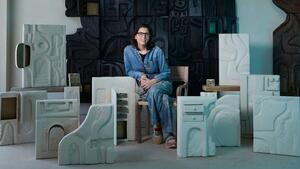
In the early 1990s, a young Mansi Shah moved with her family from India to California, where she was inspired by her newfound landscape. “The first few years we lived in North Palm Springs, so the California high desert was my first experience of America, its stillness and strange magic,” Shah tells Business of Home. She had always been passionate about design, drawn to it because it felt like a language that could hold both logic and emotion, and she was “curious about how things are made, and how color, form and material shape the way we feel in a space.”
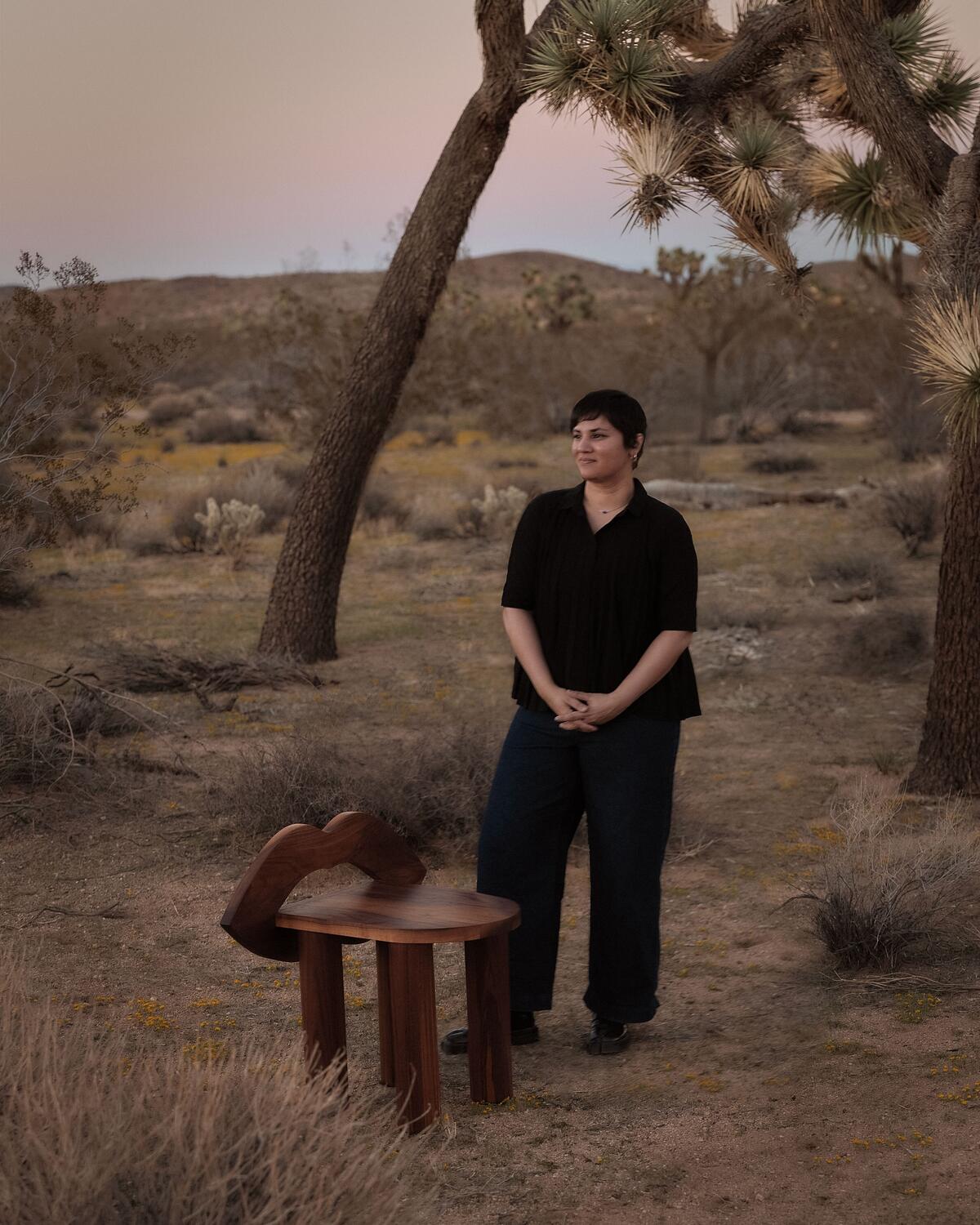
That curiosity took Shah to the California Institute of the Arts, where she graduated with a BFA in 2008. “I learned that design allowed me to experiment, to take risks, to blur the line between image and objects,” she says. “That freedom to let process and intuition lead is what made me fall in love with design and is still what keeps me engaged in my work today.” She went on to spend several years in New York and Los Angeles as an art director, then pivoted to ceramics as a studio assistant for Peter Shire Studio/Echo Park Pottery and Julia Haft-Candell, before ultimately venturing out on her own. Now, she has returned to the desert and runs her studio out of Twentynine Palms, just outside of Joshua Tree National Park. “My practice bridges design and material exploration. I work primarily with cast glass, ceramics, tile, and [am] adding metal and enamel this year—materials that transform through heat and time,” she adds. “I’m interested in how physical materials can carry emotional weight: how form, color and texture can hold tenderness, humor and memory all at once.”
Shah’s design process is led by material exploration. “Sometimes I start with a sketch or a loose idea, but most of the time I just start making and see where it goes. I like when the material pushes back or surprises me—when something imperfect or a little awkward happens and the piece suddenly has a sense of humor or personality,” she says. “I’m drawn to forms that feel slightly off-balance, like they’re leaning or pausing mid-gesture. That space between control and happenstance is where the work starts to feel alive. I pay attention to those little details—the moments where something almost resolves, but doesn’t.” The artist relies on her senses to guide her during the design process. “Everything begins with touch: hammering copper, casting glass or cutting tile,” she explains. “The process is slow and physical, but also quite tender. Each piece carries the traces of being made by hand—fingerprints, textures, and the small irregularities that make the work feel alive.”
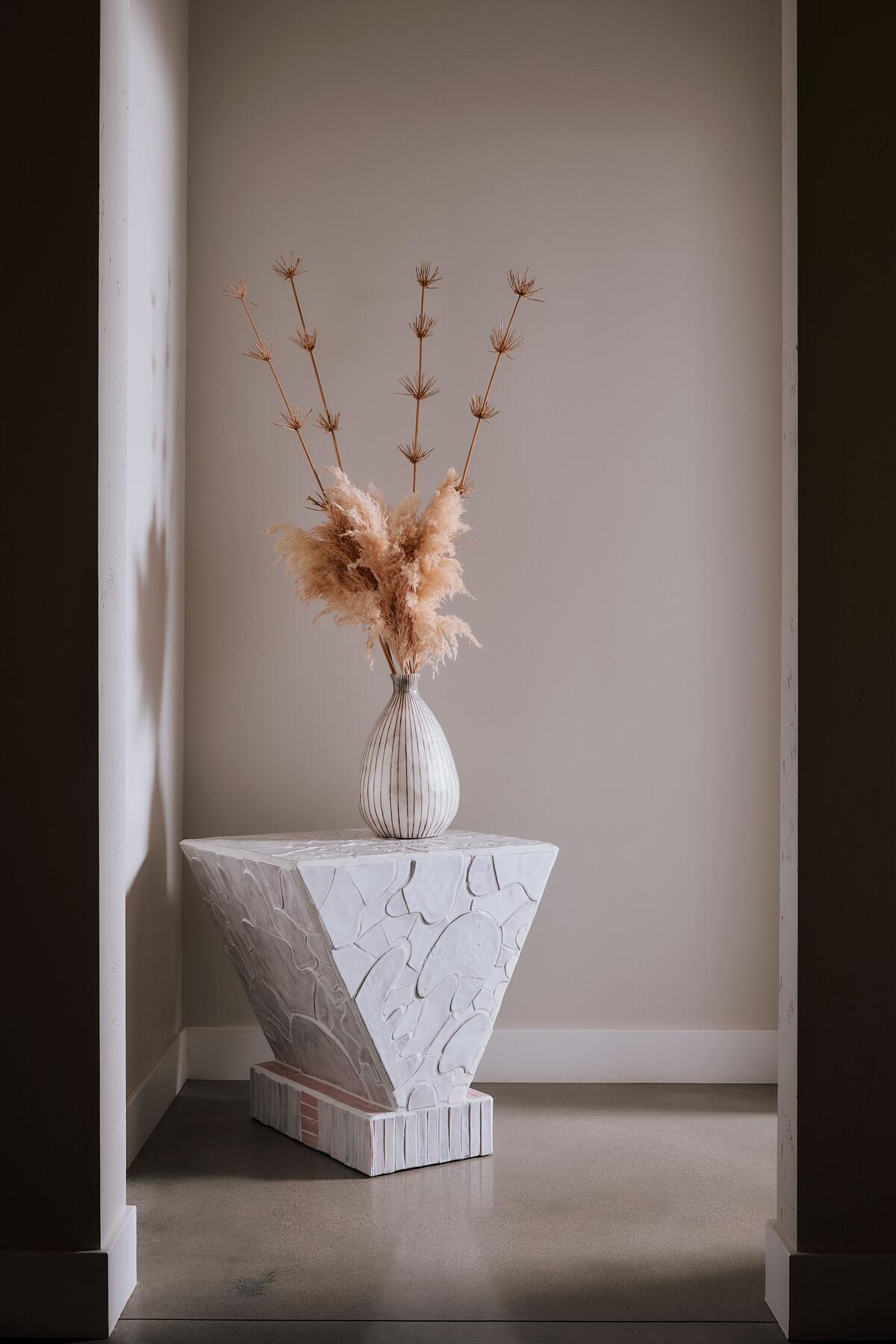
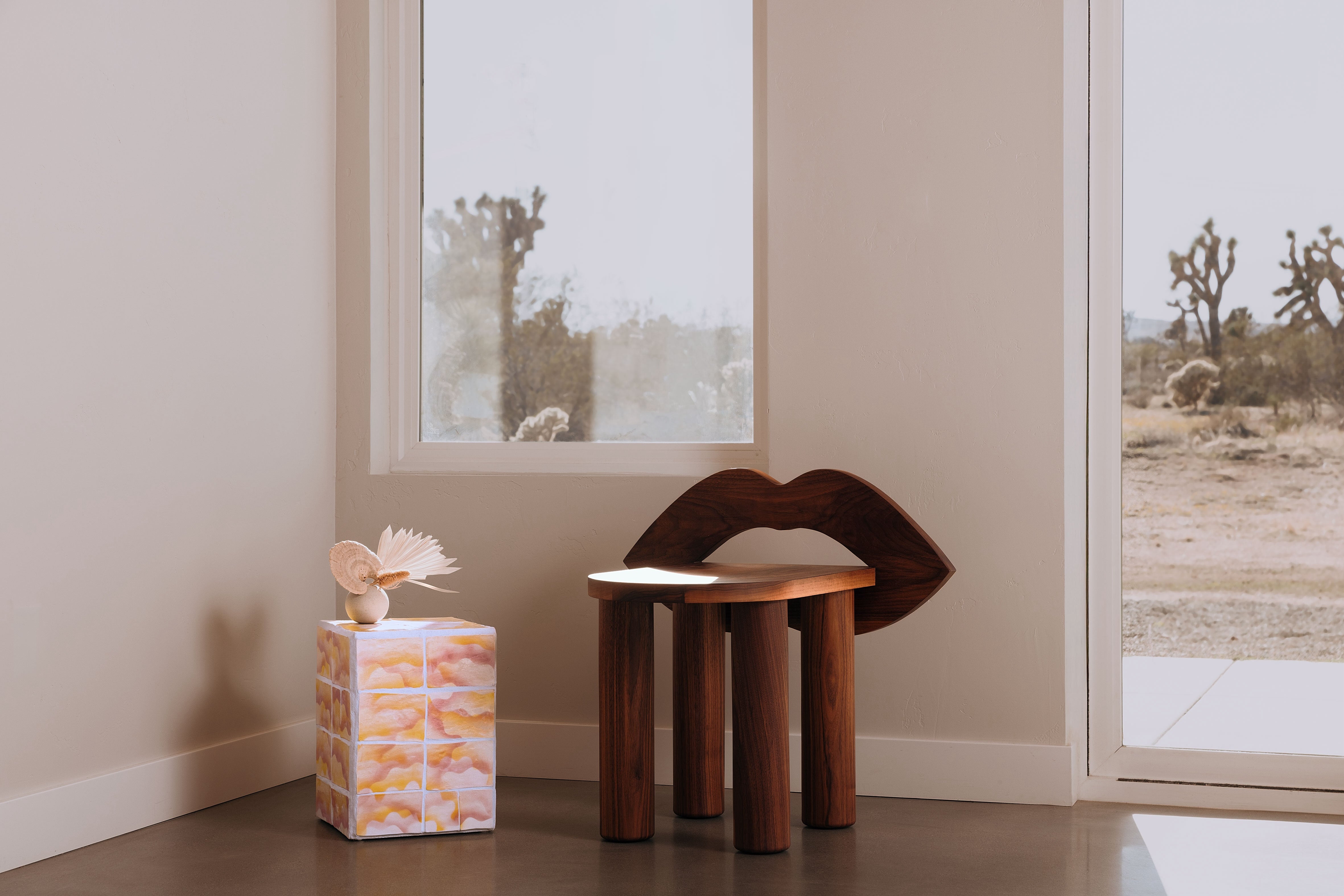
Two of her favorite designs are the Mouth chair and Tiled Triangle console. The anthropomorphic chair, which began as a small side table she designed in 2018, is crafted in solid walnut and resembles a mouth sticking out its tongue (the tongue being the seat). “Honestly, it makes me laugh every time I see it,” says Shah, adding that she hopes to develop the piece into a full-bodied collection. “I try to let warmth and play show up in the work, even in small ways. There’s always room for a bit of humor. I think objects should make you smile as much as they make you think.”
The console is part of a series of ceramic-tiled furniture. “The process is what inspires me most—hundreds of individually cut and glazed tiles, multiple firings, and careful reassembly onto a form,” she explains. “The result feels like a conversation between precision and imperfection, structure and softness. Every tile has its own personality, and together they form something that feels like a living object.” All of the pieces are crafted by Shah except for the Mouth chair, which she outsources to a woodworker.
A new edition to her lineup is a lighting series designed in hammered copper and colorful enamel inspired by her grandmother’s meenakari (painted enamel) jewelry and the traditional handicrafts of Gujarat. “While researching the technique, I learned that meenakari has Persian roots, and that the word itself translates to ‘placing paradise upon an object,’ a phrase that just feels insanely beautiful to me,” she says. In addition to her studio, she designs a whimsical housewares line called Manu Nanu that also showcases her experimentation with shape and form.
Looking ahead, Shah hopes to ramp up her engagement with the design community. “I’d love to collaborate more closely with interior designers and architects, people who are shaping environments where design can actually be lived with and felt every day,” she says. “I also hope to work with design galleries that champion material-driven work, so the pieces can reach collectors and spaces that value both craft and experimentation. Ultimately, success is being able to keep making work with intention—to evolve and build relationships that allow the work to move out into the world in meaningful ways.”

 Withdraw Consent / Manage Privacy Preferences