



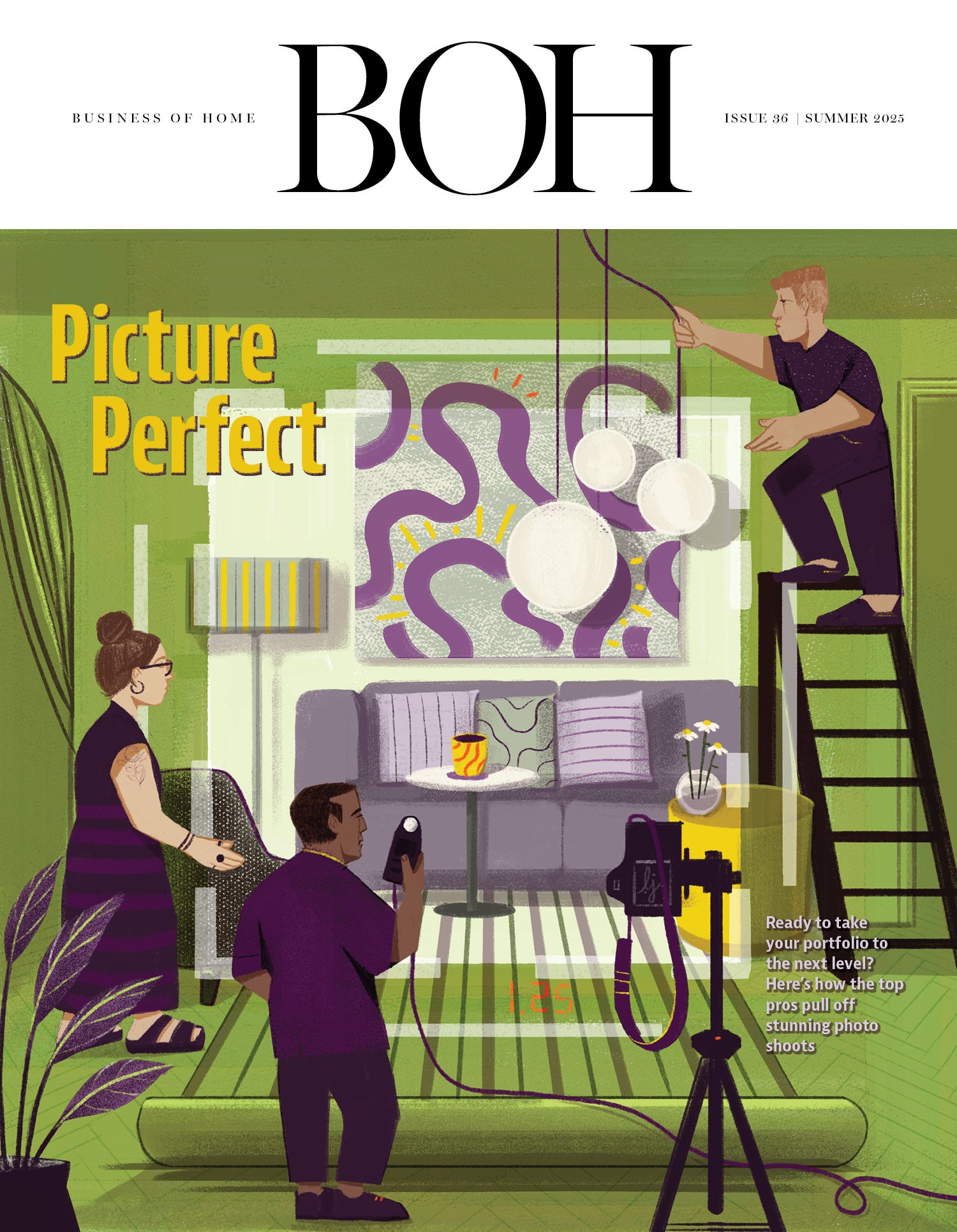

If you want to make a good first impression with a prospective client, your portfolio is the place to start. Whether a potential lead stumbles upon your Instagram or hears about you by word-of-mouth, often their immediate response will be to scroll down your website to see if your projects align with their dreams. “Your portfolio directly influences the type of work you’ll attract next,” says Houston designer Benjamin Johnston. “The goal isn’t to document everything we’ve done—it’s to present the strongest possible expression of who we are as designers.”
Whether you’re an early-stage designer who may not have a wide range of photographed work, or you’ve been in business for decades and need to trim down what you showcase online, finding that sweet spot is imperative to grabbing a potential client’s attention and sealing the deal. BOH spoke with designers, brand experts, and creative business consultants to find out the best ways to organize your digital portfolio at every stage of your career.
STAGE 1: PACKAGING YOUR POTENTIAL
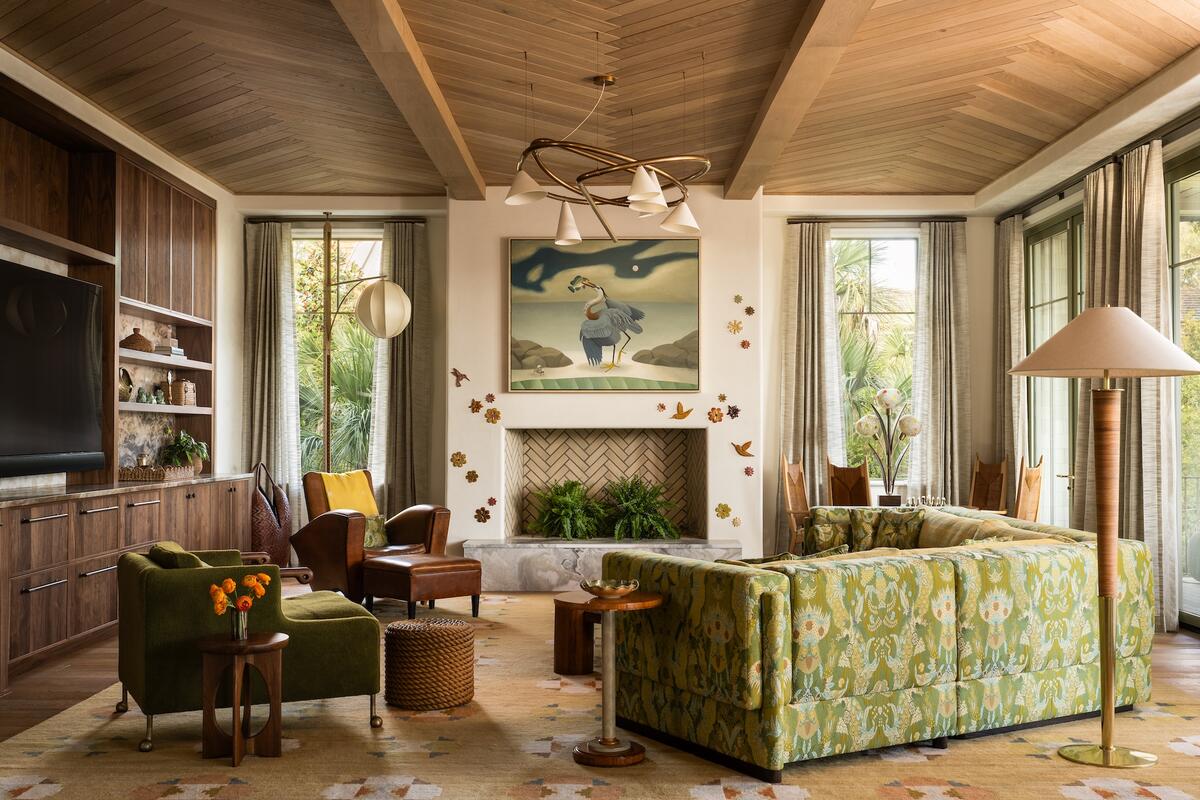
At the outset of your career, marketing your potential is key. “If you do want to show more projects, but you don’t have a ton, I like to try to make sure that we can focus prospective clients on what you can do, rather than having them focus on what you’ve done,” says Renee Bush, the founder of Tandem, an interior design business consultancy. She recommends designers take two or three of their best-shot projects (eliminating those they aren’t as proud of, or where the photography is not up to par) and then have a “Coming Soon” section. “Rather than having a placeholder blank spot, instead create a very detailed flat lay, renderings or a hand sketch on a project page,” she says. “That tells a little bit about the story of what’s coming. That will help build a lot of trust on what you can do and what you’re currently working on, which can really elevate the whole experience for prospective clients.”
Alexandra Abramian—a former design editor and the founder of The PR Collaborative, a digital community for designers—agrees that a captivating “Coming Soon” section can be a nice solution for newer designers. “If you do this too early in your career, before you have the photo assets that you really need to succeed, you run the risk of turning clients away. What I find is that designers start using less-than-fabulous images,” she says. “Maybe they took some iPhone shots, or hired a photographer earlier in their career who was actually a real estate photographer, not an interiors photographer, so they’re putting images on their portfolio page that aren’t their very best work.” For this stage in your career, less is often more.
Experts and designers agree that when you’re starting out, investing in good photography is the way to go. “Even if you’ve only got one project, make sure that the photography you have is the best possible photography you can afford,” says Valerie Helgeson, who founded her Oklahoma City–based design-build firm Design Directions in 2000. “Invest there.” Design business coach Christine Woodward, founder of the consultancy 19th & Co., concurs: “Designers forget that their projects are their product, and if we don’t photograph it, how’s anyone supposed to know how good they are?”
Let’s say you now have a couple photographed projects in your repertoire. To make those projects go further, experts recommend using close-up shots to fill the gallery space and to tell an enticing narrative. “Two or three strong projects can say a lot if presented with intention,” says Charleston-based designer Cortney Bishop. “The key is to be honest about where you are, but very clear about what you stand for. If you only have a few completed projects, make sure they are photographed well, edited thoughtfully, and presented in a way that tells a story. You don’t need to show every angle or every room. Show the moments that feel most aligned with the kind of work you want to do more of. I also think designers should remember that a portfolio is aspirational in some ways. It should reflect not only what you have done, but the direction you’re moving in.”
When Cary, North Carolina–based designer Brittany Cooper founded her firm Rathell seven years ago, she did just that. “I was very strategic about what I was posting, because I was still staying true to myself—[even if it was] just one corner of the space that I was very proud of,” she says. “That is how my portfolio started out when I was first coming along and getting my footing.”
Hiring a lifestyle photographer is another cost-effective way of getting your ethos out there. “Interiors photography is obviously an investment, and you want to do it right,” says Roxanne Hanna, the founder of Providence, Rhode Island–based branding agency Hanna Creative Co. “So, if you don’t have the right project or the right funds at the very beginning, I always recommend working with a lifestyle photographer who can do process shots, or behind the design—photographing plans and materials that you love to use, or different types of architectural styles that you love, to really get your point of view out there.”
If professional photography is too big of an investment at the start, and you still want to show off your style and mission, follow the lead of designer Sarah Storms, the founder of Maplewood, New Jersey–based Styled by Storms. “My firm is five years old, and my very first iteration of my website was really [focused on] philosophy and talking about what I believed in, like how my previous career in luxury apparel informed my mindset and decisions,” she says. “I wrote a short-lived blog, like a newsletter, where I talked about how fashion translates into my home sensibility, and then it was connected to my Instagram.”
When in doubt, using your own abode is always an option to show off your design chops. “Your own home can be one of the most valuable portfolio pieces you’ll ever create,” says Johnston. “Early in my career, I transformed a modest townhouse into the strongest expression of my design point of view that my budget would allow. It gave us beautiful imagery, but just as importantly, it allowed us to refine our styling, photography and visual storytelling. Clients hire designers for their vision, not necessarily the size of the project. Even if you can only complete one room at a time, execute it exceptionally well and document it thoughtfully. A compelling point of view is far more important than a large volume of work.”
STAGE 2: CURATING A GROWING BODY OF WORK
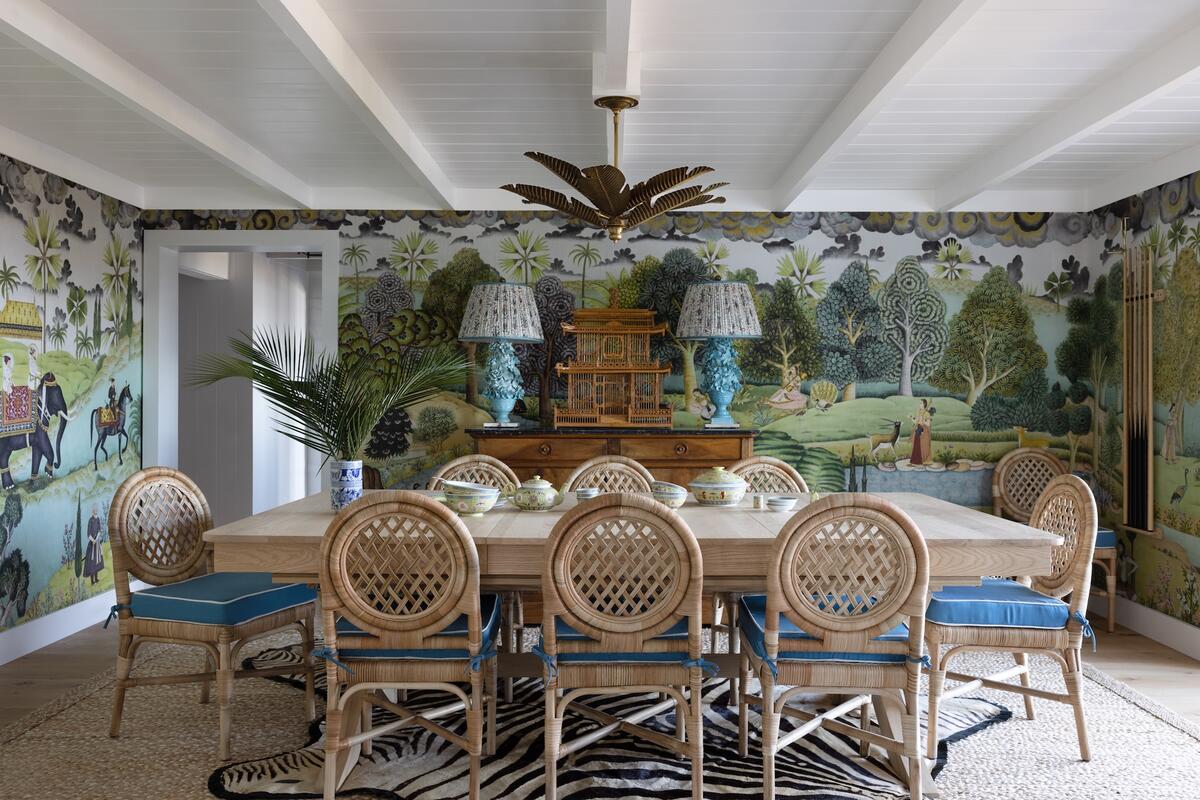
As your career progresses—and once you’ve established a healthy amount of professionally photographed work—there are a number of ways to showcase those images. The first thing to keep in mind, though, is making sure your portfolio is not a complete historical archive. “You don’t just put it all out there,” says Ericka Saurit, founder of the branding agency Saurit Creative. “Think about it as part of a positioning strategy for how you want people to see you as different [from others]. I have to tell [my clients], ‘You have to kill your darlings.’ Designers are really attached to their projects, especially if they pay for the photography. But only show the work that you want to be known for, not past work that you don’t want to do anymore. If it’s too small or a decorating project, and you only want to do new builds, don’t put that kind of project on there.”
No matter how beautiful the work is or proud of it you are, if it’s a type of project you would say no to today, axe it. “[Let’s say] this designer used to do apartments and now they’re doing $10 million homes,” says Woodward. “I don’t care if it’s the most beautiful, coolest Kelly Wearstler [style] apartment, if it shows a kitchenette without a kitchen island, we don’t want anyone coming to your website thinking that’s what you do.”
One of the more popular ways of organizing is the classic “by project” system, where each project is separated and named. Katelyn De Spain, the founder of San Diego Makehouse Design Studio, employs this strategy; in addition to images, she writes up an overview on the project that includes how the job arose, what the clients were asking for and how the firm delivered on those asks.
For this type of portfolio structure, naming the projects is crucial. Oftentimes designers will use the street name alongside an adjective or noun that describes the vibe of the project. While that may look and sound nice, it lacks pertinent information on where the project is. “Serene cottage tells me nothing,” says Woodward. “We need to convey the kind of caliber of clients we have, which means [the description] absolutely needs to have the locale [or neighborhood]. Even if I don’t know it, because I’m here in California, and you’re in Ohio, that’s fine. If it’s an affluent neighborhood in your area, hands down, you need to write that.” De Spain previously used only the street name, but now uses the part of San Diego where the project is located, along with a catchy adjective—think “Del Mar Tierra” and “Carlsbad Coastal.”
Within the by-project blueprint, there are other ways to make your work stand out. Bishop organizes her projects with a flat lay as a teaser to each home. “We still identify the individual projects, but the entry point is emotional and atmospheric,” she says. “The mood boards give people a way to enter the work through feeling first. A home might be layered, soulful, coastal, restrained, romantic, relaxed or full of color—and those qualities often speak more directly to a client than a project name or location. It also reflects the fact that our projects are not formulaic. They may share a spirit, but each one is deeply connected to its setting, its architecture and the people who live there. The mood board structure gives us a way to show those relationships more intuitively.”
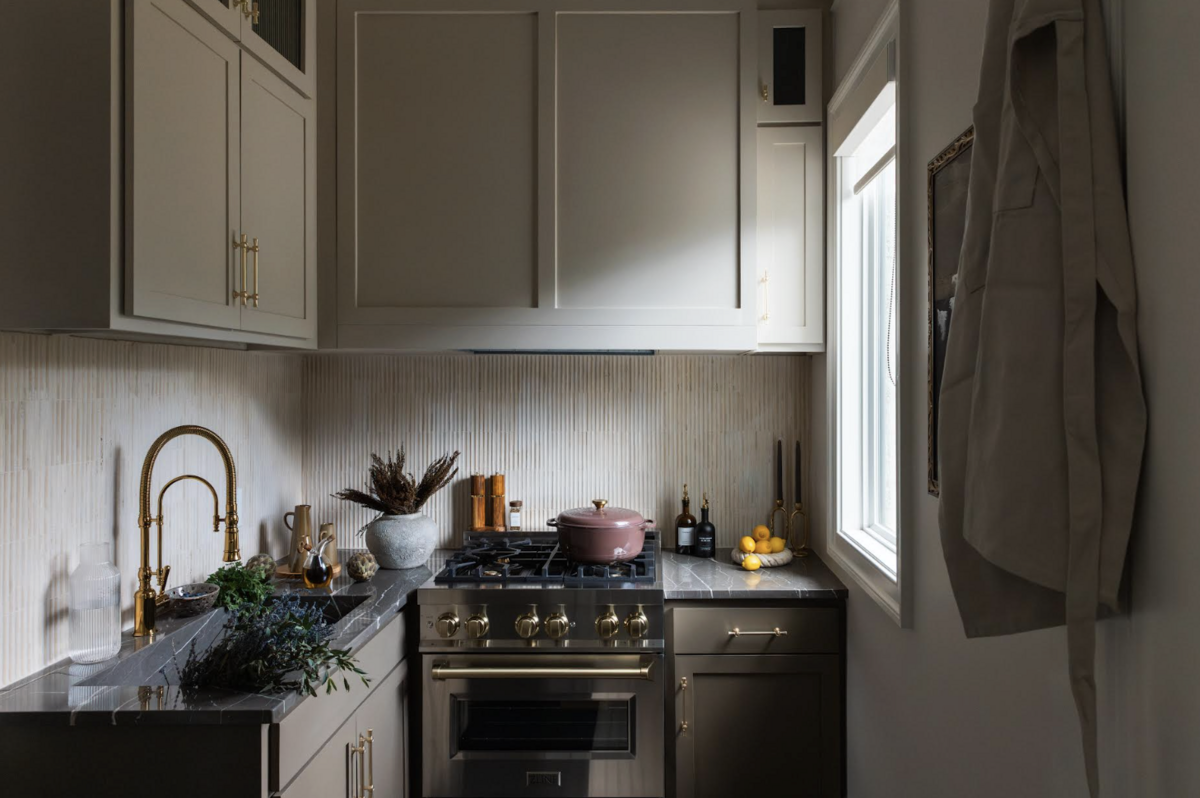
Another way of formatting your portfolio is through waterfall-style images—a page of all of a designer’s work together. This is how Helgeson organizes her portfolio. “I want them to feel something and really understand who we are and what we do based on the photography, and a traditional gallery of [individual] projects could kind of feel more like a case study,” she says. “You have to click [on each individually]—mine used to be that way—and it takes so much time, and I don’t think people have that much time, so mine evolved into this grid, a mix of style and spaces that quickly reflect our capabilities and our aesthetic.”
Johnston also employs this method, so visitors can see the through lines in his designs all at once, which also provides previous clients with more anonymity. “Our website is divided into two broad categories—interior design and architecture—and each page presents a curated collection of our strongest work,” he says. “Many of our clients value their privacy and prefer not to have their homes presented as complete case studies, so we respect those wishes by interweaving images from numerous projects. It also allows prospective clients to focus on the consistency of our design language rather than associating our work with a single home.”
Storms chose the best of both worlds. At the start of her company—with a few professionally shot spaces under her belt—she used the waterfall model. Her early projects included one or two room jobs and didn’t tell a narrative that lends itself well to the by-project model. In the past month, she made a switch. “When I was talking to my website developer, we decided that at this point it was better to break it into projects, especially the ones that told more of the story of our firm,” she says. “We have a little blurb about them, and use things that had been either said in the press or our general philosophy on these projects. I also didn’t want to lose the option of having a waterfall, because I do think that when you are project-based, it sometimes feels daunting to have to go into so many different clicks, and I didn’t want people to get annoyed. We broke it up into projects with lead images, but then at the top you can see all images.” And for those projects that may just be one or two rooms, they still have a home in the waterfall section.
Another popular way to organize a portfolio is by category, a solid option if you prefer to take on room-by-room projects rather than a whole home. “If you organize by kitchens, bathrooms, bedrooms, you are showcasing that you think room by room,” says Bush. “If you show rooms, you’re going to get people more interested in rooms. If you show houses, you’re going to get people more interested in houses. If you show renovations, you’re gonna get people more interested in renovations.”
When Nureed Saeed founded Nu Interiors in Berkeley, California, 12 years ago, she decided to organize her portfolio by project. She quickly discovered that didn’t work for her in landing the projects she was most passionate about. “As I evolved, I really realized that I love kitchens and baths and whole-home construction more than I love the decorating part of my business, and while I do all of it because it all connects, I really love the hard surfaces and the hard construction more,” she says. “It made me realize [I needed to set] up my portfolio in a way that kind of spoke to how I wanted people to see me, and the kinds of projects I wanted them to reach out to me for.”
She now splits her portfolio up into kitchens, baths and interiors. “A lot of times you’re doing homes over time,” Saeed says. “It takes many years to get to a point where you’ve done the whole home, so to give projects a name doesn’t necessarily speak to the reality of how I think business runs for a majority of designers. I think the majority of us come into a space and do someone’s kitchen, and then they call us back a year later and say, ‘Can you do our bathroom and our bedroom now?’ At least, that’s been my experience, so a category-based portfolio lends itself to [that kind of workflow].”
Grouping by themes like wellness, entertainment, beachfront, new build or historic renovation may work better for designers who thrive in thematic rather than room-based categories. “This way of organizing is a way of repositioning how clients think about you first, so it’s more of a sales tool, because you can reorganize things based on how you want people to find them,” says Saurit. “You can do it by experience or by transformation. Treat it like a chance to do some storytelling on the portfolio page, because most of the time, again, the website is part of your sales tool.”
Courtney B. Smith, whose design firm is based in Marin County, California, and Marblehead, Massachusetts, launched her business 17 years ago, and currently organizes her portfolio by project and category. “Putting myself in a client’s shoes, if I was hiring a designer, I wouldn’t necessarily need to see every project,” she says. “Maybe I’m really focused on my living room, and I’m really curious about seeing all of the living spaces that that designer has done.”
This method comes in handy during her discovery calls, when she asks which space is the highest priority for them. If they say bedrooms or the kitchen, for example, she’s able to go right to that category on her website to peruse some of her past work with that new client. “It helps me hone a conversation,” she says. “I think it’s helped us be smarter marketers and have more targeted conversations with potential clients.”
STAGE 3: MAINTAINING, UPDATING AND ELEVATING
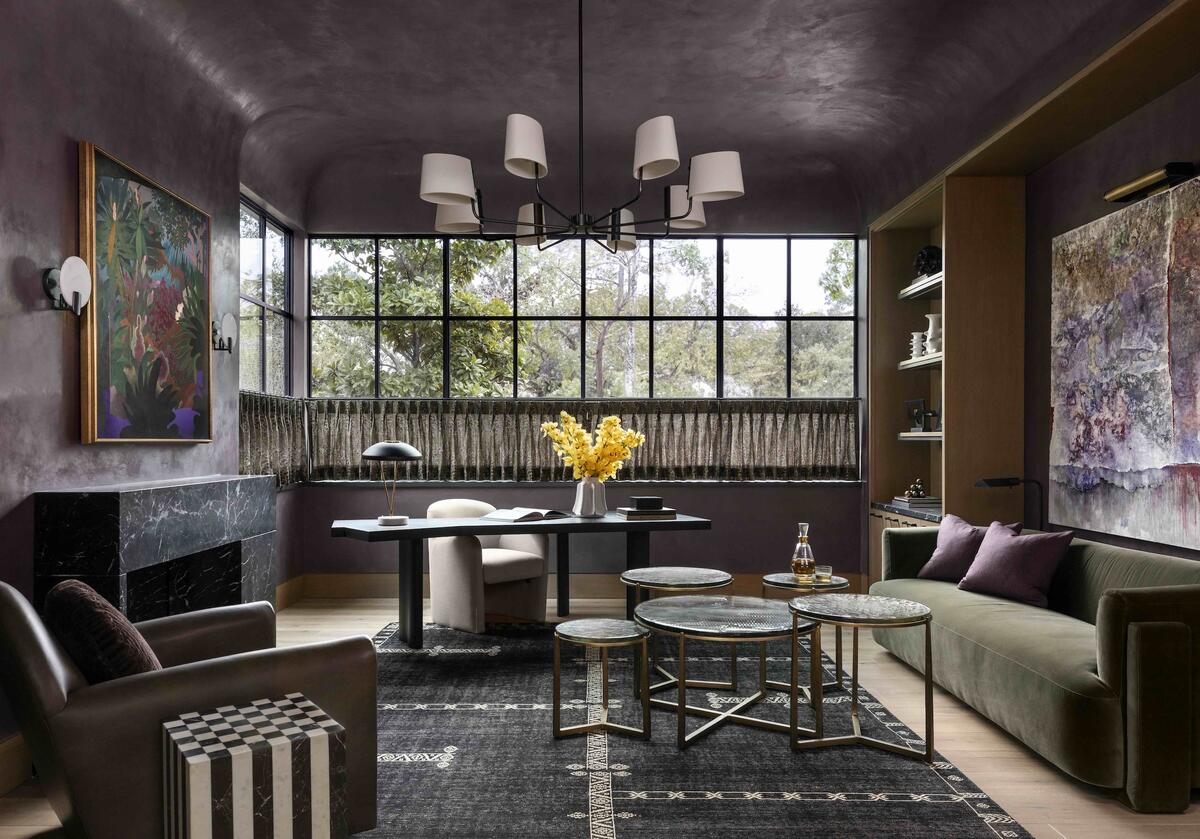
After working out which format works best for you to attract the clients you want, how often should you edit the projects you feature? “If you have a project that elevates your portfolio, [upload it] as soon as they get that photography,” says Woodward. “Use it as an opportunity to reach out to former clients, active clients and referral partners to say, ‘Hey, look at this great project we’re so excited about having launched.’ [The new photography] becomes a business development tool as well.”
The ideal number of projects to display at any given time varies from person to person. Some experts recommend a portfolio of six to 12, while others say no more than 20, and still others specify 12 to 25 images per project, or one to two images of each room. “It’s about curation and not being so attached to putting every single project on your site, because you think volume means more to a client, but luxury brands don’t do that,” says Saurit. “They organize by story. They organize by how they want you to enter the brand, so think about yours in the same way.”
The important thing to keep in mind when deciding which images to post is whether you would say yes to a project like that today. “Not, ‘Was this project impressive when I did it?’ I don’t care about that,” says Bush. “It’s more about, ‘Would I be happy if a client came to me and asked me for this exact style and this exact scope today?’”
She recommends designers audit their portfolio every six to 12 months, or whenever they have a new batch of photography (Johnston evaluates his entire portfolio after every complete professional shoot). If two new ones come in, Bush recommends looking for two weak links that you can then pull out. Saurit advocates for a quarterly review. “It’s hard, but it’s not an art exhibition where everything goes up there; it’s a positioning tool, so think about it like that,” she says. “How are you curating this conversation with your clients, and then when does it become overwhelming? Look at your metrics, look at the backend of your website, or ask your marketing team or whoever administers your website, ‘How long are people staying on the page?’”
Bishop doesn’t add every recent project; it has to bring something different to the conversation she is curating in her portfolio. “That may be a new type of project, a different setting, a stronger expression of our point of view, or a home that captures a feeling we want future clients to understand,” she says. “I try not to add work just because it’s new. New does not automatically mean it belongs on the website—it has to add something.”
Smith recently wrapped and shot a project in South Carolina, but she can’t upload it to her website, as she is waiting to hear back from magazines about publishing—another factor to think about. “As soon as something hits and gets published, we are very eager to add those projects to our website as soon as possible, and I’ll probably drop our oldest project at that point from our website,” she says. “I [may] still like that project, but it’s not reflective of the work that we're doing now.”
It’s about quality versus quantity, and not overwhelming the viewer with every single thing you’ve ever done. “The projects that I’m most proud of where I’ve spent a lot of money on photography are the ones that I just want to keep highlighting,” says Cooper. “Whether I’m just moving them around on the website or I’m deleting some, those are things that I am very, very proud of.”
There’s no right way to organize your portfolio. It’s about figuring out what methods work best for you and how you can best market yourself to secure the client that you actually want. “The more aligned your portfolio is, the more likely you are to be able to do work you love,” says Bush. “I think [designers] are often afraid that if all their work looks too similar, that’s all clients are going to want, but if you pull the work that you’re proudest of to the forefront, then your clients will be attracted to that.”






 Withdraw Consent / Manage Privacy Preferences