






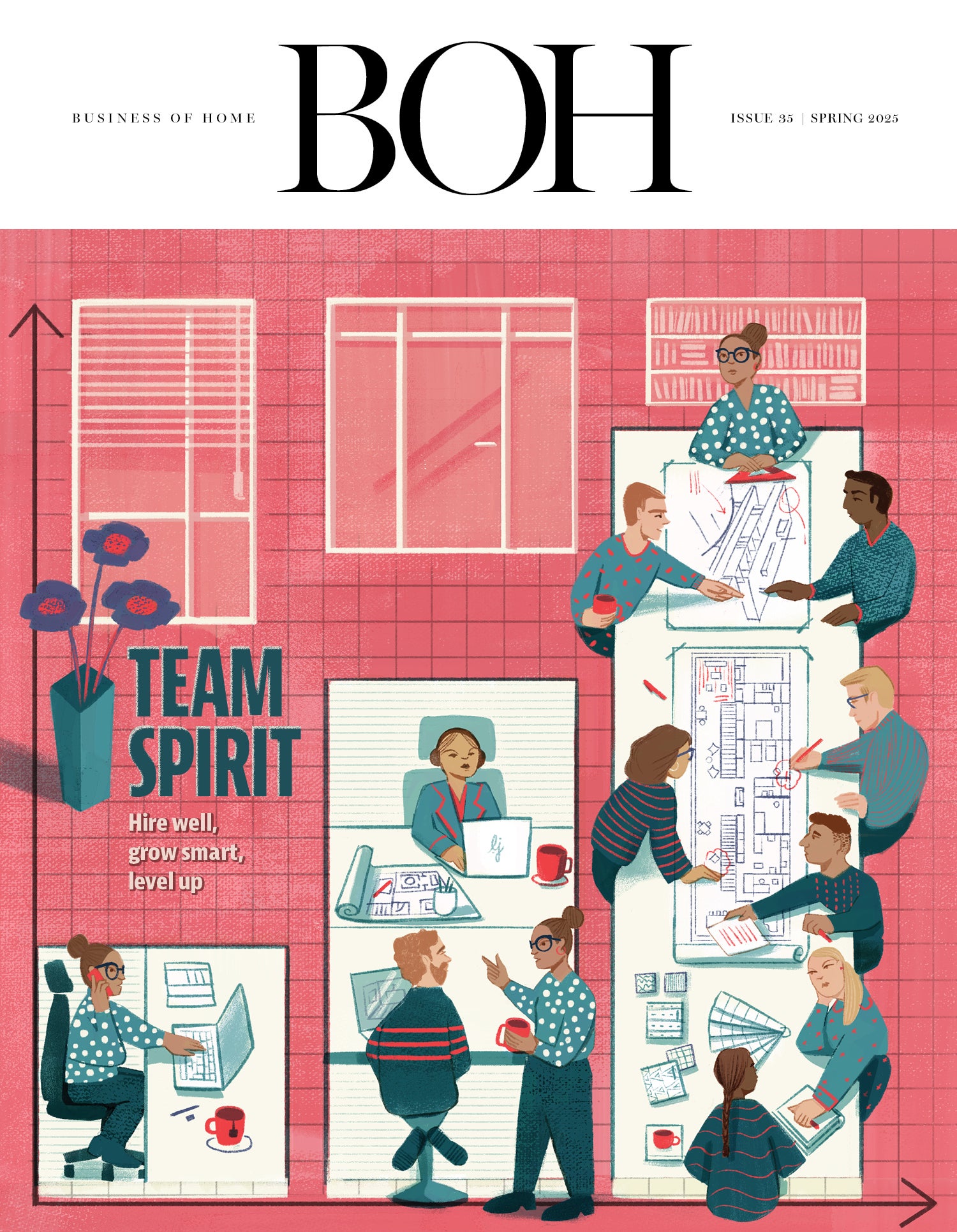





When my design firm was only five people, I knew everything. I knew which client was nervous about their budget, which fabric order was running late, and what everyone was working on. I didn’t even have to ask. We were scrappy in the best sense of the word—fast, intuitive and a little chaotic. That intimacy was the culture. Then we grew, and I learned the hard way that the very things that made us special at five would quietly start to break us as a team of 15.
If you’re scaling a design business, the most useful lesson to remember is that team growth isn’t linear—and neither is the strain it puts on your culture. It arrives in jolts. There are specific team sizes where what worked yesterday simply stops being effective, and if you don’t change your approach to match, you don’t just plateau—you actively erode what attracted your team members to your firm in the first place.
You may also dilute what attracted you to your craft. As you grow, you have less time to design. You’re now an HR manager (and sometimes babysitter). But every milestone in head count is really a milestone in who you and your team members must become. Here are three common tipping points where the culture turns fragile—and how to brace yourself for impact.
THE FIRST BREAKING POINT: 6 TO 8 PEOPLE
Somewhere around six to eight people, you lose the ability to manage everyone without getting bogged down. You find yourself staying late or working on the weekends to meet your own deadlines, because suddenly your days are filled with interruptions from your team. You can no longer assume everyone heard the same conversation or absorbed the same priorities by sitting in the same room. This is the moment founders most often resist, because it feels like bureaucracy is creeping into something that used to be pure. But the alternative to a little structure here isn’t freedom—it’s confusion that gets blamed on individuals. The fix is small: a standing daily or weekly check-in with each team member, documented project ownership, and one source of truth for deadlines. Resist the structure, and you’ll feel the culture start to fray at exactly the point you should be hitting your stride. Instead, build a leadership team that shares the responsibility so it doesn’t all fall on you.
THE SECOND BREAKING POINT: approximately 15 PEOPLE
The next wall is steeper. When a firm reaches around 15 members, you can no longer be the only manager. You physically cannot have a real relationship with every person and still be actively involved in all projects. This is where founders must make the most uncomfortable shift of all—from being the person who does the best work to being the person who builds the team of people who do the work. You start hiring managers, not just doers. You start trusting decisions you would have made differently. For a creative founder whose name is on the door, this can feel like a small death. It is also the only way through this stage. Your number one role now is business development.
THE THIRD BREAKING POINT: 20 AND BEYOND
Past 20 people, you are no longer running a boutique studio—you are overseeing a company that happens to do design. Process is no longer optional, and “how we’ve always done it” ceases to be a strategy. The founders who thrive here are the ones who stopped grieving the old version of the business and got curious about the new one. The role you played at a five-person firm doesn’t just shrink; it disappears. A better one takes its place if you let it.
Here is the candid truth, and it’s the part I wish someone had told me directly: Some of the people who helped you build the scrappy version of your business cannot make the leap to the structured one. Many of them won’t want to. Creative people are often drawn to the loose, artsy, improvisational energy of a small studio precisely because it is the opposite of a rigidly structured environment. When you introduce process, timelines and accountability, a certain kind of talented person experiences it as a betrayal of why they joined.
You will know who they are earlier than you let yourself admit. They’re the ones who resist following processes, and who see every new system as the antithesis of creativity. They quietly bypass the project manager and leave chaos in their wake. At five people, that chaos is charming and manageable, but not efficient. At 20, it’s deadly—and it tells everyone else that the rules are optional. The kindest thing, for the resistant employee and for the company, is to be honest early rather than hoping the discomfort resolves itself. It won’t. Identifying who can’t transition from scrappy to structured is not a failure of loyalty. It’s the job.
Growth doesn’t test your business plan so much as it tests your willingness to become a different type of leader. The team changes, the structure changes—and most of all, you change. The firms that protect their culture through scale aren’t the ones that cling hardest to how things felt at the beginning. They’re the ones who understand that the culture was never the looseness itself—it was the care and creativity underneath it. That is what you can carry through every breaking point, so long as you’re willing to let the rest go.
____________
Gail Doby is co-founder of Pearl Collective (formerly Gail Doby Coaching & Consulting), an interior design business consultancy that helps designers, architects and other creatives increase their profitability. Doby ran her own design firm in Denver for nearly 20 years and has a degree in finance and banking. Since 2008, she has been helping designers scale their businesses profitably and reach financial freedom. As a coach, mentor and business transformation specialist, she shares innovative ways to overcome the roadblocks, challenges and detours creative entrepreneurs face. She is also the bestselling author of Business Breakthrough: Your Creative Value Blueprint to Get Paid What You’re Worth. Her goal is to empower design industry clients to differentiate themselves, drive measurable results, achieve business projections, and create personal satisfaction through game-changing strategies and business practices.













 Withdraw Consent / Manage Privacy Preferences