







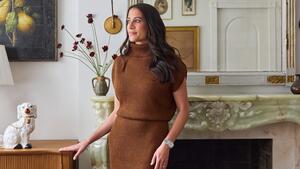
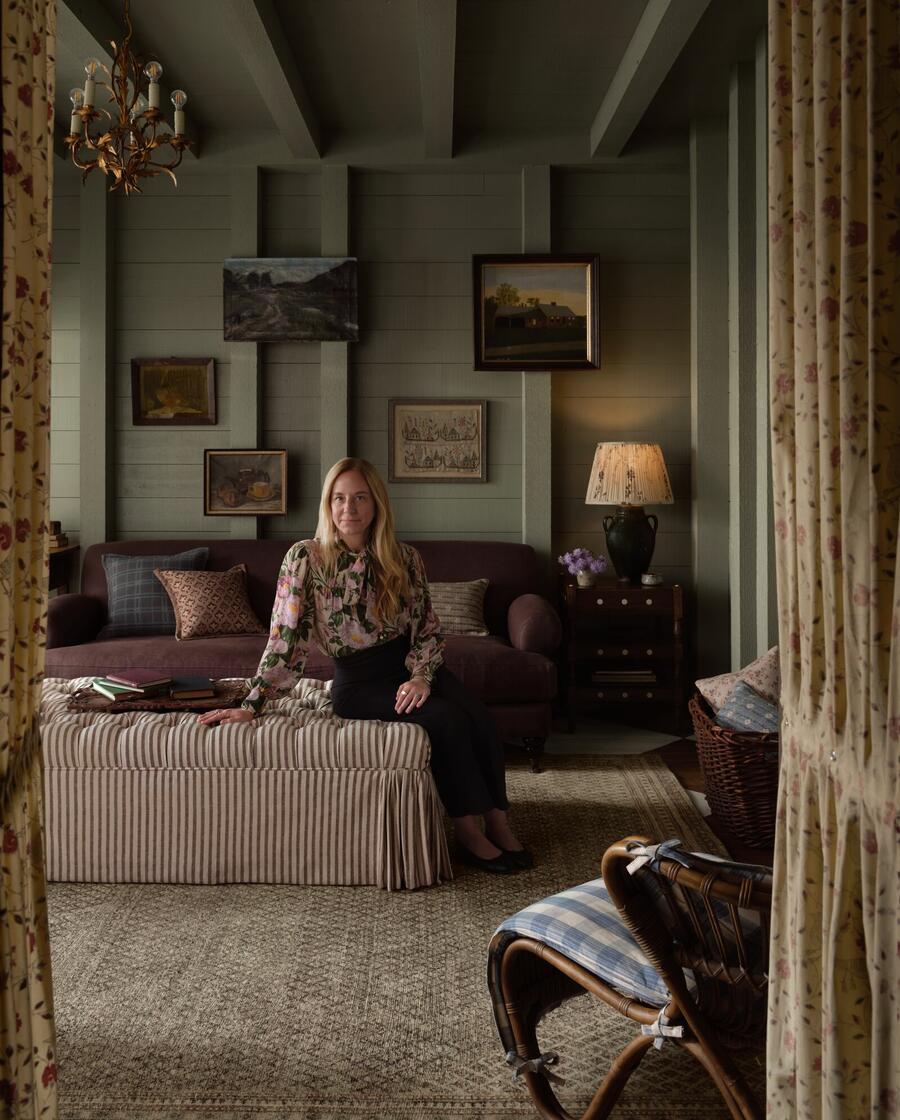
When Madeline Stuart was little, she asked her film director father to turn her favorite book into a movie. That movie ended up being 1971’s Willy Wonka & the Chocolate Factory—she even has a small cameo. While her father was making movies, her mother was working as a decorator for a slew of Hollywood clients, a profession Stuart never wanted to pursue. “The last thing a young girl wants to be is her mother—it was unthinkable that I should follow in [her] footsteps,” she tells host Dennis Scully on the latest episode of The Business of Home Podcast.
After a few career detours, a friend of hers recommended her to design an up-and-coming screenwriter’s apartment, which led to project after project. “I like to say that I was passed around young Hollywood like a hash pipe, and that was the start of my career,” says Stuart. “I went to the trial-by-fire university, which I do not recommend. I still rue the fact that I never went to work for a well-established designer, and so I went out and learned the hard way.” Nearly 37 years later, she has been featured on Elle Decor’s A-List and the AD100, and her eponymous L.A. firm’s projects have been published in magazines around the world.
The secret to her success: Stuart makes sure her designs are original, and unique to each client. “Not everyone strives never to use the same things twice, which I do,” she says. “There’s so much to be explored in our world of design, decorative arts, architecture, whether it’s a paint color or a light fixture. Why use the same thing twice when there are a plethora of options and an abundance of inspiration everywhere you look?” Her pet peeve? “Scavenger decorating,” what she describes as stringing together social media inspiration without much thought. “Everyone complains about beige and grayish and a lack of this, that or the other, and yet it seems like that’s what everybody’s doing,” she explains. “People are afraid to be maximalist, or they’re afraid to be minimalist. They’re just kind of constrained by their own lack of imagination. It’s about trying to find your own voice as a designer, and that does take time. It’s not easy to be fearless, so I always applaud the designers who are fearless. They know who they are, and we know who they are, and it’s something to be respected, even if you don’t appreciate the work.”
Crucial insight: When Stuart begins a new project, she looks to literature for inspiration. The designer has an extensive library covering everything from Japanese screens to Spanish ironwork and Ottoman embroidery, and looks to its pages when a new project arises in a style she’s unfamiliar with. “My client loved that I once said, ‘I want to be referential and not reverential.’ That became our slogan,” she says. “Explore different references, explore different ideas, especially from the past, and how the past influences what we do.”
Key quote: “Design should be a meritocracy, and it shouldn’t be because you do a house for Kim Kardashian. It should be about beauty, excellence, architecture, wit, charm and elegance. It should not be ‘because so-and-so lives there.’”
This episode is sponsored by Ernesta and Sixpenny. Listen to the show below. If you like what you hear, subscribe on Apple Podcasts or Spotify.
The Thursday Show
Host Dennis Scully and BOH executive editor Fred Nicolaus discuss the biggest news in the design world, including California’s ban on digitally altered real estate listings, a look at how AI might threaten the rendering business, and why Chairish’s owner keeps rejecting takeover bids.
This episode is sponsored by Loloi. Listen to the show below. If you like what you hear, subscribe on Apple Podcasts or Spotify.







 Withdraw Consent / Manage Privacy Preferences