












This is it: the five weeks between Thanksgiving and New Year’s Day, when businesses across the retail spectrum look to make 2025 a successful year.
Of course, the urban legend that the day after Thanksgiving is called Black Friday because that’s when retailers’ financial balance sheets move from being “in the red” (operating at a loss) to being “in the black” is a ridiculous story: If a retailer was really bleeding money for the first 47 weeks of the year, that would be a very bad business indeed. (While there are various theories on how the day actually got its name, none of them involve the color of the ink in their bookkeeping.)
Still, retailers do count on this year-end period to sell a lot of stuff and rack up profits, and 2025 is no different, despite tariff concerns and consumer uncertainty. The stretch is not quite as crucial for the home furnishings business, as case goods and upholstered products don’t really rank high on holiday wish lists. (Credenzas don’t generally fit under Christmas trees.) But many of these retailers use the Yuletide period to push decorative accessories, home decor merchandise and, yes, sometimes even furniture, playing the family gathering card to entice shoppers to purchase a new sofa or dining room set for the entertaining that comes with this time of the year.
And let’s face it, with a record-setting 187 million Americans expected to shop both in person and online this weekend, home furnishings stores would be foolish not to try to get in on the action. And there is some action to be had for retailers of home products. The housewares category—the world of blenders, coffeemakers and other assorted kitchen and household electrics—has been a perennial winner. But runaway sales for companies in this category have often been dependent on a hot product emerging each year, from salad spinners to hydration bottles to slow cookers. Though there doesn’t seem to be a standout candidate for 2025, products like air fryers and smoothie makers are still on the ascent.
Mattresses are another strong category for the holiday selling season, belying the entire needs-to-fit-under-the-tree theory. A recent report suggests that the Black Friday weekend has now become one of the five big tentpole holidays for this sector. (The others are Presidents Day, Memorial Day, July Fourth and Labor Day.) For a product category that never met a promotion it didn’t love, it makes sense.
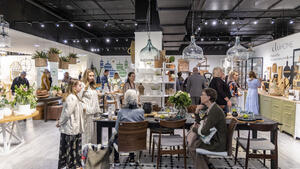
The Christmas season is also a good selling period for so-called “lifestyle” retailers: Crate & Barrel, Pottery Barn and their brethren. Hit any of these stores, or their websites, and you’ll see serious displays of decorative pillows, dinnerware, candles and holiday bric-a-brac; wait a few weeks and it can all be yours for 40 percent off.
Mainstream furniture dealers won’t want to miss an opportunity either. Ashley, the biggest furniture retailer in the country, advertises its Black Friday “event” as their “biggest sale of the year,” with savings of as much as 60 percent. This November and December, it is promoting living, dining and bedroom furniture—plus mattresses, of course.
Down the highway, Rooms To Go extends its Black Friday sale across its entire product spectrum, including outdoor and kids. Other big furniture retailers, like Ikea, Ethan Allen and Arhaus, get in on the action too. Only RH doesn’t specifically promote for Black Friday or the general holiday selling season, sticking with its tried-and-true membership playbook. It’s a bit ironic because in its earlier incarnation as Restoration Hardware, the brand used to roll out an extensive assortment of holiday doodads, from stocking stuffers to personal electrics to holiday decor. But that was then, and RH certainly doesn’t play in that space now.
Whichever the retailer, there are few signs of reduced promotional activity, much less reduced inventory levels, both of which were predicted earlier in the year when tariffs and supply chain glitches raised fears of diminished holiday selling.
It proves once again that the magic of the season—and American consumers’ love of shopping—can overcome just about any hindrance.
____________
Warren Shoulberg is the former editor in chief for several leading B2B publications. He has been a guest lecturer at the Columbia University Graduate School of Business; received honors from the International Furnishings and Design Association and the Fashion Institute of Technology; and been cited by The Wall Street Journal, The New York Times, The Washington Post, CNN and other media as a leading industry expert. His Retail Watch columns offer deep industry insights on major markets and product categories.