











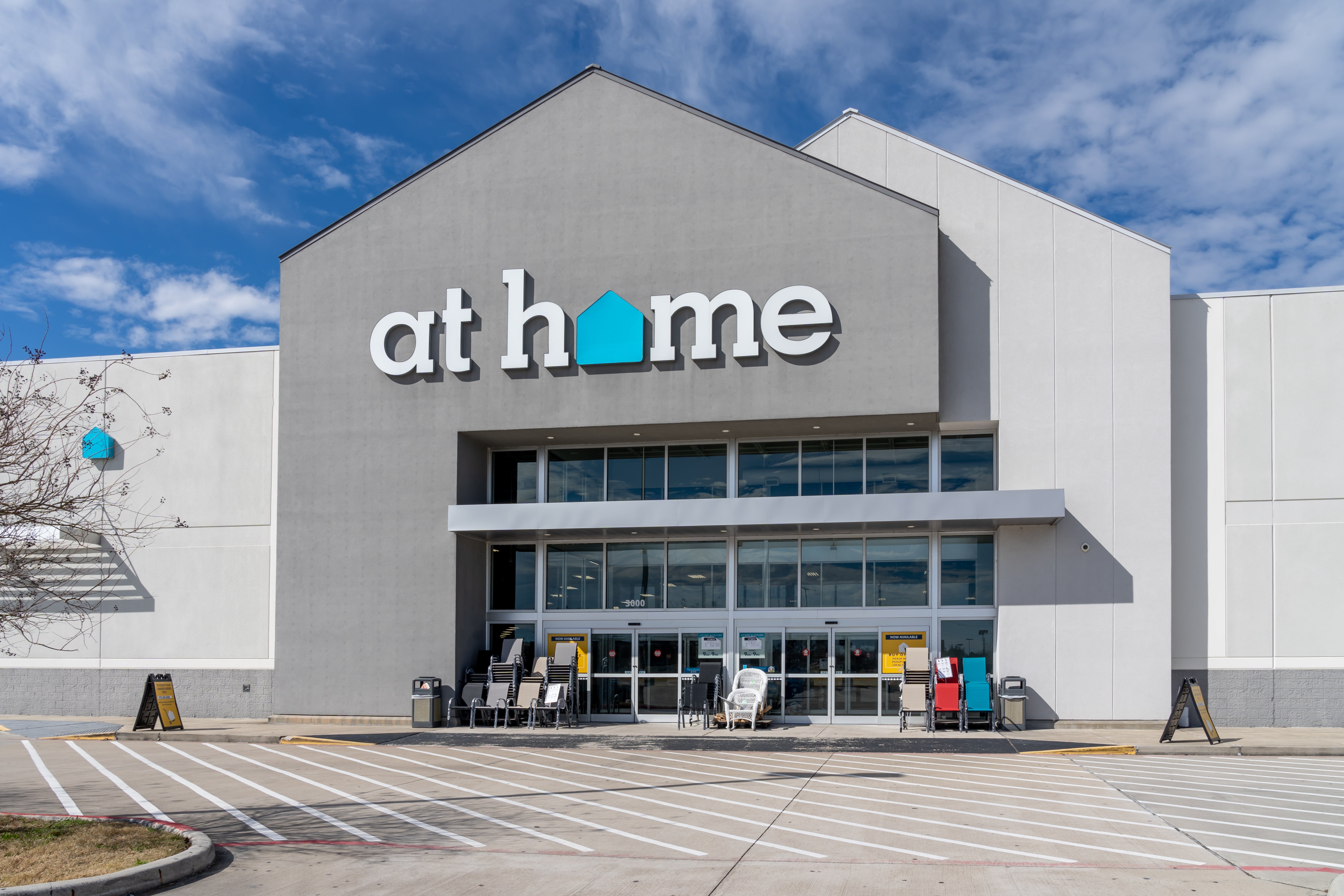

Once all the assorted legal paperwork is signed and filed, At Home—the specialty retailer with giant stores and apparently miniscule profits—will attempt (again) to get its business model right.
Earlier this week, At Home, which filed Chapter 11 in June, announced that the U.S. Bankruptcy Court for the District of Delaware approved its reorganization plan, and the home furnishings company expects to emerge from bankruptcy within the next several weeks.
“We are pleased to have reached this important milestone in our efforts to position At Home for future success,” said CEO Brad Weston in the statement. “Thanks to the hard work of our team over the last few months, we have now accomplished all that we set out to achieve at the beginning of this process.”
Once the company emerges, it will be with several important changes in its structure:
- At Home will have about 30 fewer stores from its original 260-unit base, but there are no public plans for additional closings. The selected locations are already running going-out-of-business sales.
- Its $2 billion debt load, accumulated when it was taken private four years ago by Hellman & Friedman, will essentially be wiped out. Since it’s a private company, it’s unclear whether At Home accrued additional losses on an operating basis. It will have access to about $500 million under a new asset-based loan, which will create a new debt structure.
- Most important of all, the company will have new owners: a group of its lenders, including Redwood Capital Management, Farallon Capital Management and Anchorage Capital Advisors. None of the three is a traditional owner of retail businesses, although Farallon has owned retail real estate in the past.
Left unclear is the one big change At Home will need to make in order to create a profitable business model. Its giant stores—often in subpar real estate locations, featuring deep assortments in such categories as rugs, outdoor furniture, seasonal decor and decorative accessories, usually with few, if any, well-known brands—worked during the height of the pandemic era when Americans focused on spending on their homes. But it has largely underperformed otherwise. Even as key competitors like Bed Bath & Beyond, Tuesday Morning and Big Lots all went bust (and when revived only did so with limited footprints), At Home is believed to have picked up very little market share.
Weston, who took on the CEO job in June 2024 after stints at Petco and Party City, said in announcing the news that At Home would have the resources and strategy to succeed going forward.
“We are one step closer to emerging from our court-supervised process with a fully de-levered balance sheet, a more profitable operating model and new financial resources to invest in our strategic initiatives,” he said.
He did not specify what any of these new initiatives would be; although, before filing bankruptcy, At Home had started to open significantly smaller locations in the 75,000-square-foot range—less than half the size of its largest stores. It had also begun to add some national brands as well as higher-profile private label programs, especially in its soft home categories. Still, some industry observers were surprised it ended up closing only about 12 percent of its store fleet during bankruptcy proceedings, when it could have more easily walked away from existing leases. Once out of Chapter 11, that will become much more difficult.
Many vendors that have sold to At Home in the past have said off the record at recent trade shows that they would welcome the brand back as a customer, albeit with tighter credit terms—even considering its new finances.
For At Home—which began life in 1979 as a regional Texas-based chain known as Garden Ridge Pottery and under that name went through Chapter 11 once before in 2004—this phase marks a new beginning. It is looking forward to the story playing out differently this time around.
____________
Warren Shoulberg is the former editor in chief for several leading B2B publications. He has been a guest lecturer at the Columbia University Graduate School of Business; received honors from the International Furnishings and Design Association and the Fashion Institute of Technology; and been cited by The Wall Street Journal, The New York Times, The Washington Post, CNN and other media as a leading industry expert. His Retail Watch columns offer deep industry insights on major markets and product categories.







 Withdraw Consent / Manage Privacy Preferences